Kingston, Canada based family physician, photographer, grandfather, thespian and philanthropist. Founding Trustee of the CanAssist African Relief Trust. Development work in Bosnia and Herzegovina and East Africa.
As I glanced at today’s date this morning, it transported me 60 years back to the afternoon of November 22, 1963.
I was in 12th grade, seated about two-thirds of the way back in Miss Allison‘s French class at Central Collegiate in London, Ontario.
Suddenly, the vice principal interrupted the class with an announcement emanating from the big, square, beige intercom on the wall at the front of the room.
“President John F. Kennedy has been shot in Dallas, Texas.”
The class was stunned into silent, wide-eyed shock.
It wasn’t until classes ended an hour later that we learned Kennedy had succumbed to his injuries.I remember walking home up Waterloo Street, kind of dumbfounded.
That dreary November weekend became a vigil, spent watching Walter Cronkite give solemn updates on an old black-and-white console television in my grandparents’ living room.
President Johnson being immediately sworn in as President in the back of a plane when Kennedy was pronounced dead.
Images of L.B. Johnson being sworn in as president in the back of a plane, while Jackie Kennedy, the new widow, wore a pink, blood-spattered suit, looking on.
The subsequent arrest of Lee Harvey Oswald and watching as he is fatally shot by Jack Ruby on live TV that Sunday morning while he was being transferred from a courthouse to jail.
The sound of drums throughout the next week in Kennedy’s funeral cortège.
Little John-John saluting as his father’s coffin passes.
Two things strike me about these flashbacks.
First, it’s amazing how vivid and detailed 60-year-old memories can be, especially as I increasingly find moments when I struggle for a few minutes to remember the name of someone I should know well.
Secondly, it makes me feel old — to have been “present” for a historical event most people now read about in history books. How many of you clearly remember JFK or that fateful November day 60 years ago?
I know I have some high school friends whom I still keep in touch with that will share these memories.
Do you have news events similarly etched indelibly into your long-term memory? What was the first striking news event you recall?
London Central Secondary School.
This reminiscence also got me searching for a 1963-64 night school yearbook that I knew I had packed away somewhere.
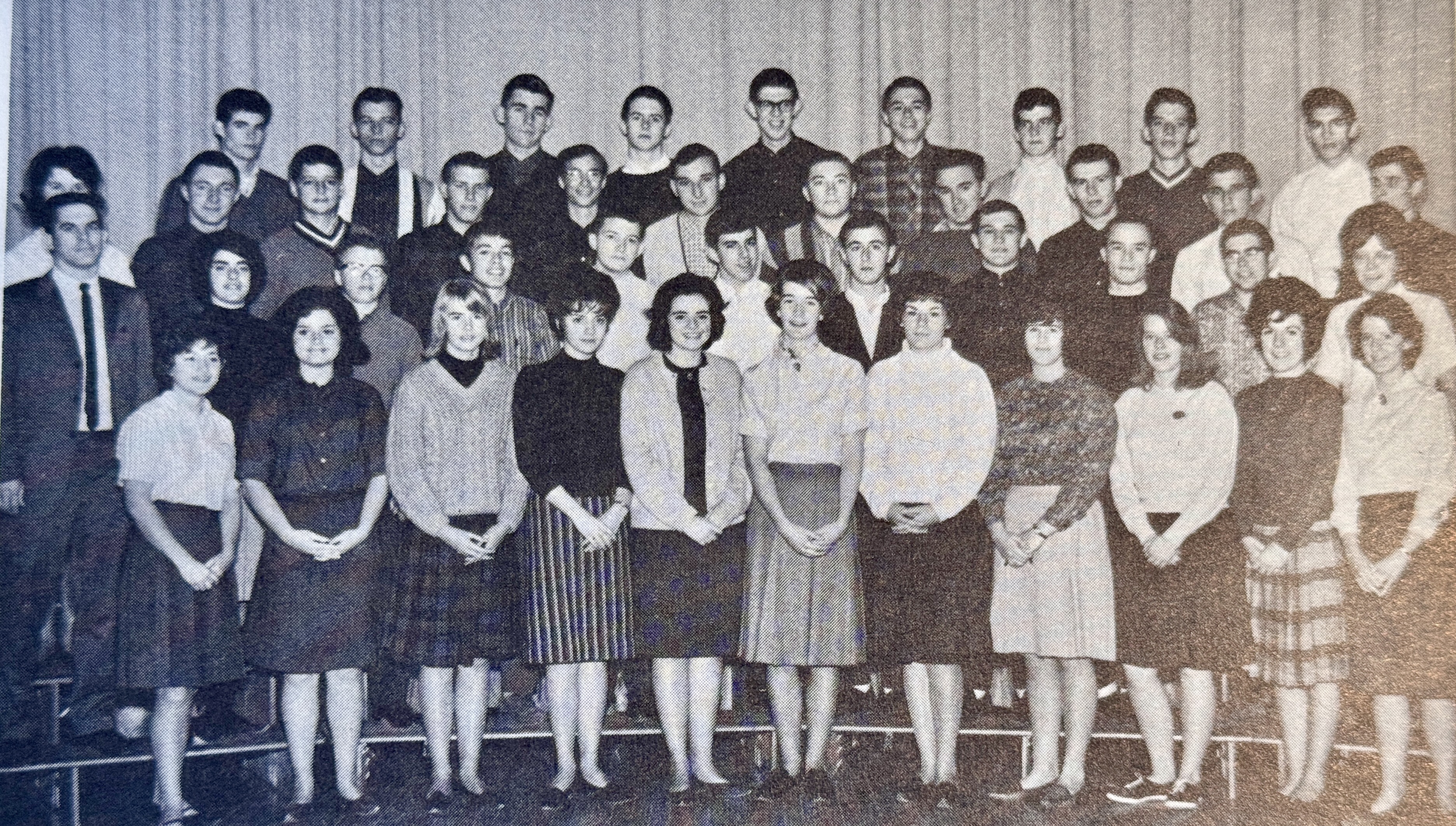
Here are a couple of photo memories I extracted from the yearbook.The first is a photo of my home room Grade 12-6 class in 1993. Can you find me?Can you find you?
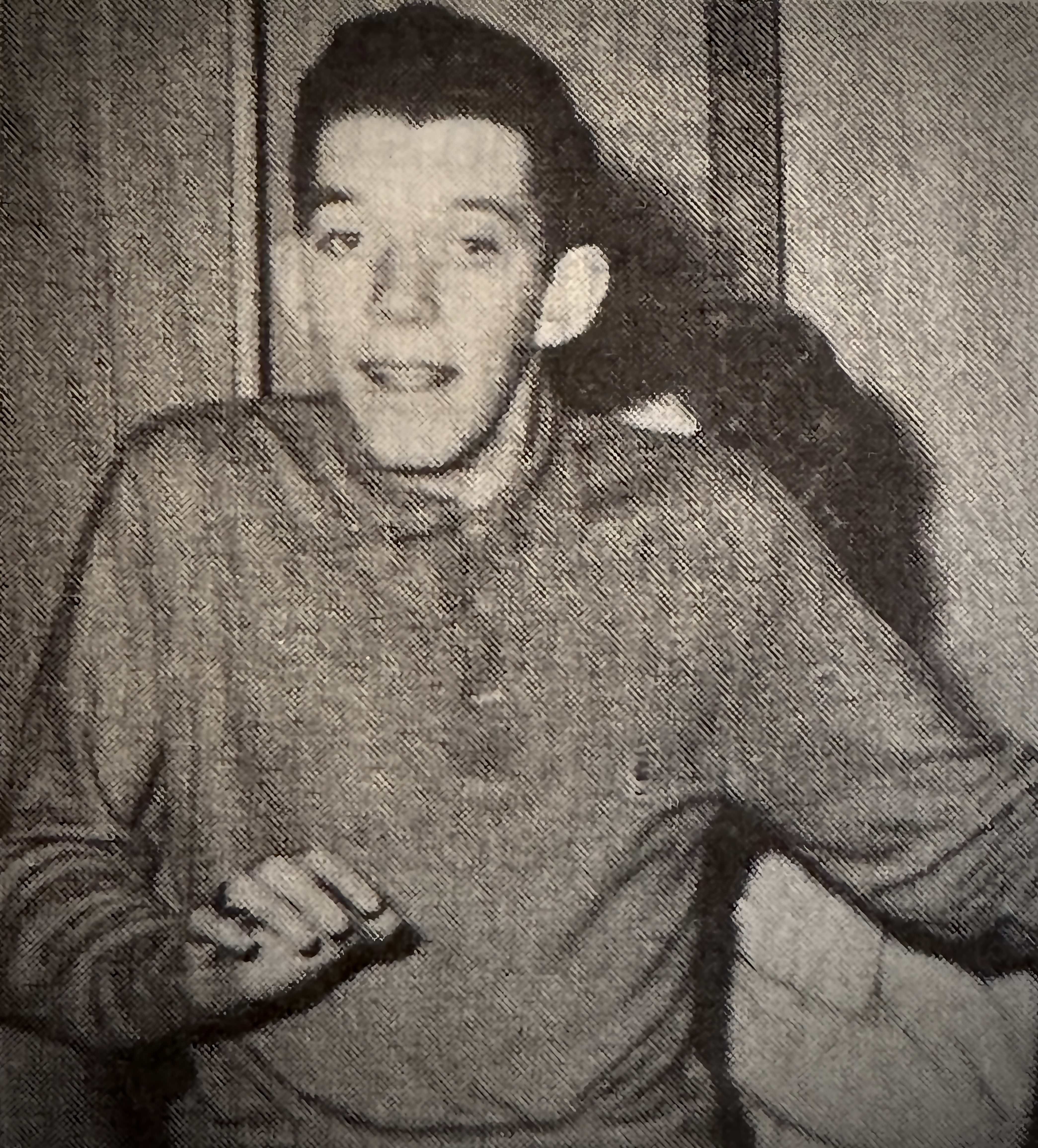
The second is of me rehearsing for the part of Mr Spettigue in the annual school show which was “Girl Crazy” that year. I played the part of a rich old letch … who danced, apparently.
I also found several pages of autographs in the back to the yearbook. Two stood out.
One from a girl i didn’t really know well. It read “Hi John, I hope that you are in my chemistry class again next year so that you can talk all through it.” Some things never change. My chemistry teacher (Art F) also signed the book…on a different page.
Another was from my math teacher who somewhat snarkily wrote ” Hope your mark is where it should be this time.” Always a bit of a curse to be someone with “potential”.
It’s been over two years since I last wrote here about COVID-19 and a lot has changed since then. Back when we started discussing this virus, things were quite different. There were no Rapid Antigen Tests (RATs), no vaccines, and no treatments like PAXLOVID. Hospitals were overrun with COVID patients and death rates from COVID infection were startlingly high. But I had a hunch that eventually, we’d have tests, treatments, and vaccines. And guess what? They’re here now, thanks to some remarkable research and development efforts.
Let’s fast forward to September 2023. I won’t bombard you with charts and graphs, but I do want to give you a quick rundown of what you should know in a straightforward way.
1. **Recent Uptick in Cases**: After a relatively calm summer, COVID-19 cases are on the rise again. This isn’t surprising, as respiratory illnesses tend to become more common in the upcoming season.
2. **Hospitalizations Reduced**: The good news is that while some folks are still ending up in the hospital, it’s happening at a much lower rate than before. Most of us have developed immunity through vaccination or previous infection. The best protection appears to come from a combination of both.
3. **Vaccination Works**: Vaccination remains a powerful tool against severe illness and death. Even if vaccinated individuals can still get infected, they tend to shed the virus for a shorter time, are less likely to infect others, and have a lower risk of experiencing “long Covid.”
4. **New Variants**: New variants keep cropping up, but the most prevalent one is still related to the Omicron strain. The good news is that these variants don’t seem to be more severe and are vulnerable to the immunity gained through vaccination.
5. **Booster Shots**: New vaccines have been approved and updated to be effective against recent strains. They will soon be available in Ontario, starting with older individuals, those with health conditions, healthcare workers, and eventually, everyone. If you’re six months past your last shot, I encourage you to get a booster to protect you from severe illness, quicker recovery if you do get COVID, reduced infectiousness, and a lower risk of developing long Covid.
6. **Flu Shot**: You can get your COVID-19 vaccine alongside the flu shot. Influenza is making a comeback this year, and early signs suggest that this year’s flu vaccine is effective against the strains we expect. It is safe and more convenient to get both of these vaccines at the same visit.
7. **Testing**: Rapid Antigen Tests (RATs) will, once again, be widely available through pharmacies and primary care providers. If you have COVID-19 symptoms and a negative RAT, consider repeating it 48 hours later or even a third time. More reliable PCR tests are available at some pharmacies, through public health, and certain primary care providers. A positive test is required for PAXLOVID treatment. No family doctor? Find where you can get PRR testing in your community here https://www.ontario.ca/assessment-centre-locations/
8.”Paxlovid”: Paxlovid is a medication that can reduce the severity of COVID-19, especially for vulnerable or elderly individuals with risk factors. It’s covered by Ontario health insurance if you qualify, but it must be started within five days of symptom onset and used cautiously with certain other medications. If you live in Ontario and have no access to a primary care team and you think you might need or qualify for Paxlovid treatment you can get help at this website. https://cantreatcovid.org/ Here they are conducting a study and will enrol you quickly, advise of the need for medical treatment and arrange it for you. Assessment and treatment is also available at many pharmacies.
9. **Masking and Isolation**: Mandates for masking and isolation are unlikely to return. If you’re ill with any respiratory virus, limit contact with others until your symptoms are improving and you’re fever-free. Wearing a mask in close contact situations can help reduce the risk of spreading the infection.
Stay informed, take care, and make wise choices to protect yourself and others from COVID-19.Have a safe and healthy winter.
The main reason I returned for my 25th Anniversary Tour of Bosnia and Herzegovina was to reconnect and catch up with folks that I met and taught and worked with there when I was part of the Queen’s Family Medicine Development Programme from 1998 to 2011.
In addition to wandering the familiar streets of Banja Luka, Tuzla, Sarajevo and Mostar I had lots of visits with past residents and translators when I returned to BiH in May. I even met some new ones at their Academic Half Days. In case you had not figured it out I am a “people person” and reconnecting with all these people was such a treat for me.
I am including photos here of these reunions, mainly as a remembrance for me, but also for my Canadian colleagues who will remember many of these delightful people. And for my Bosnian friends in these photos to reflect on our visits as well.
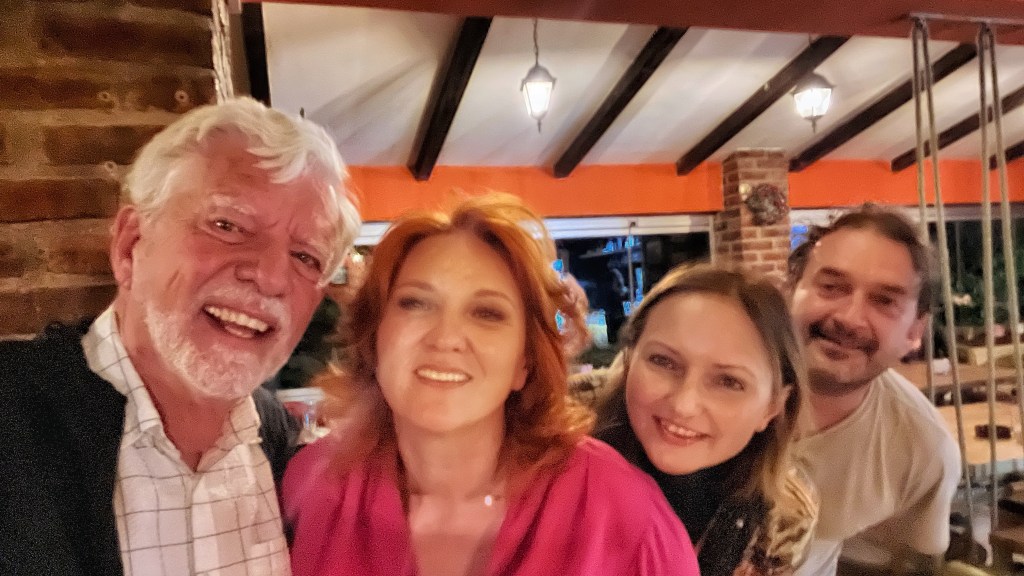
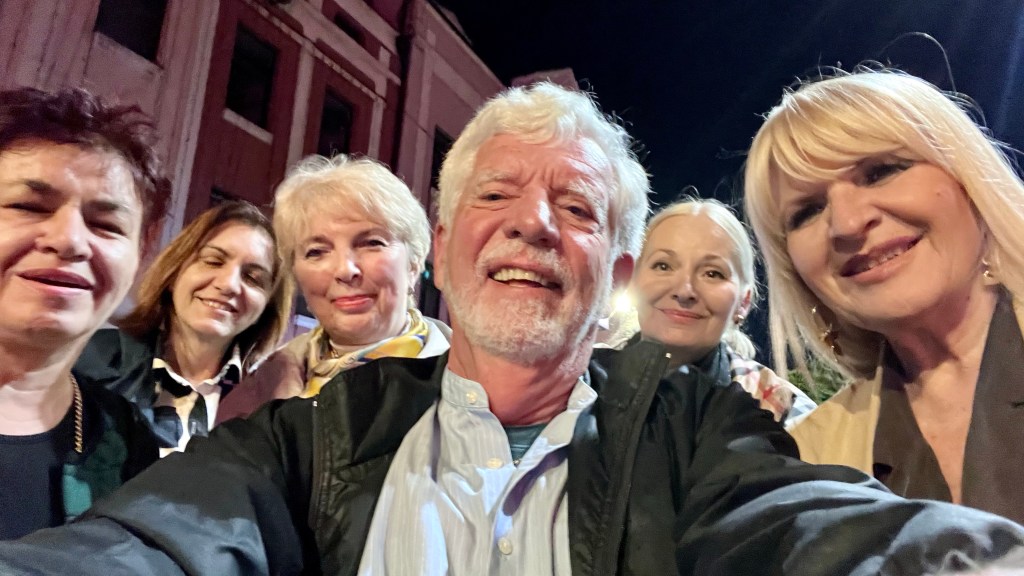
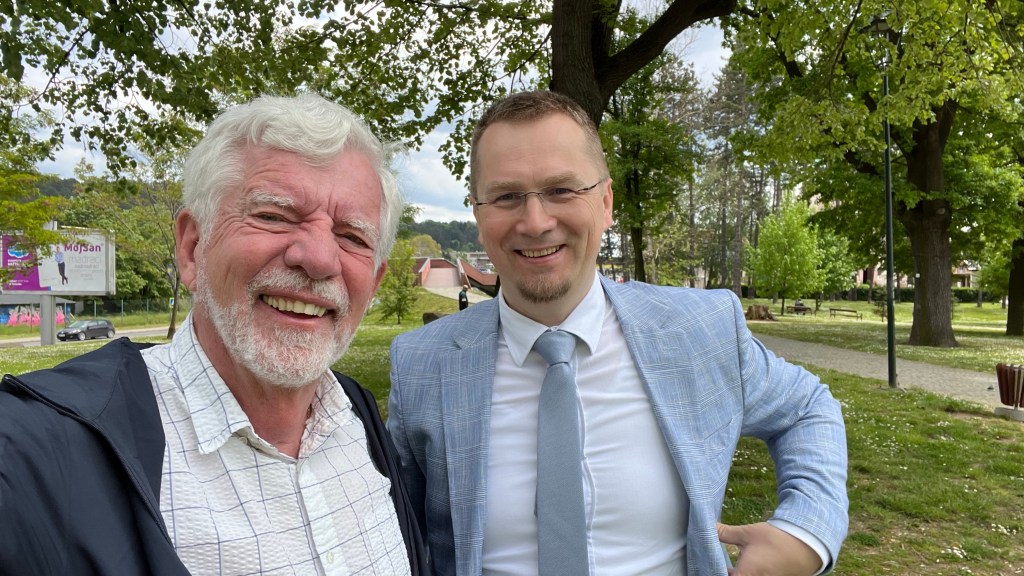
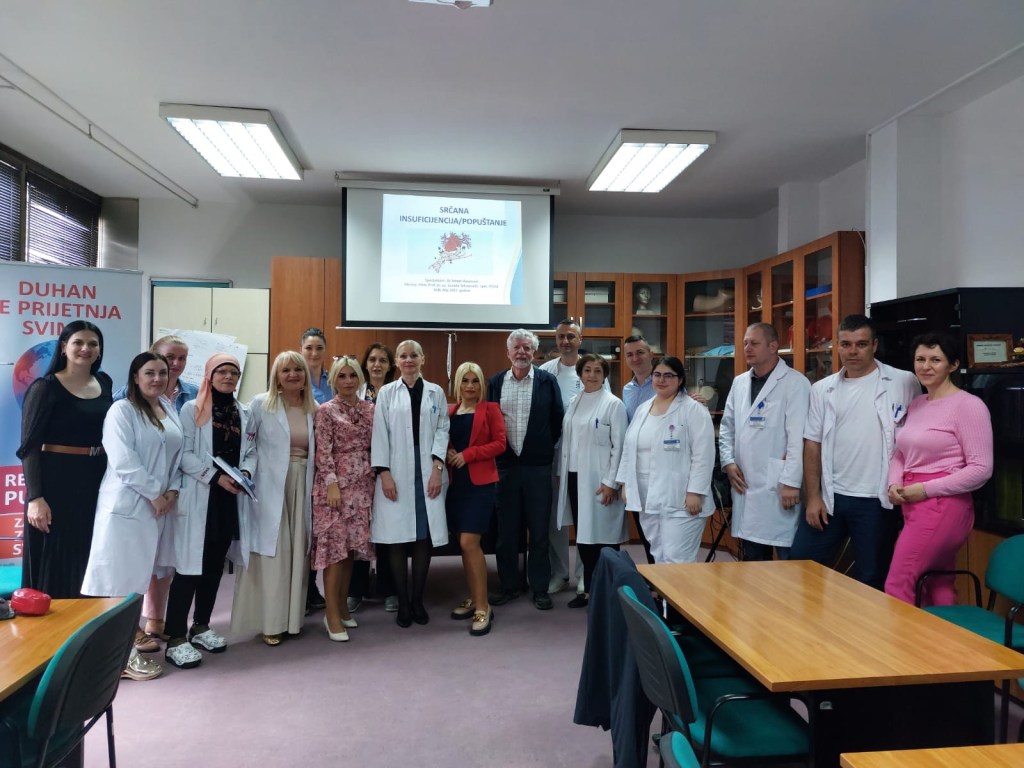
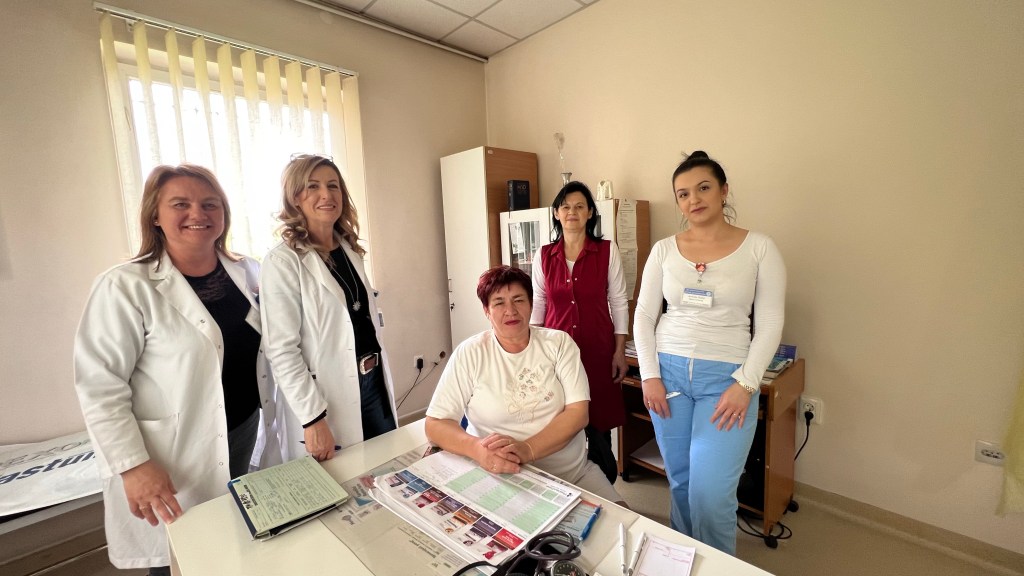
Saša Lonćar translated for me for several years and we became very close, he is now an interventional cardiologist. When he wasn’t driving me around last month he was putting in stents and saving lives. It was a treat to meet his family – wife Sandra and two of his three daughters, Lana and Hana. I also met his older daughter Nastasija who is not in this photo. It was a delight to hang out with him once again!In Banja Luka I had dinner with two “graduates” of our Family Medicine Education Programme, Irena and Brankica, whom I mentored several years ago.It was a real delight to see Muharem Zildzic, who was a stalwart in helping us establish Family Medicine in Tuzla. And Nermin translated for me on several occasions – he is now a gastroenterologist and leader in the Tuzla internal Medicine Department.These ladies were all “students”of mine and we connected regularly over several years. The Tuzla department was always enthusiastic and diligent and a pleasure to work with.Having dinner with some of the Tuzla bunch.I enjoyed seeing Elvir again! He also translated for me when he was a medical student and is now a Psychiatrist in Tuzla.This was at the Academic Half Day in Tuzla. Familiar faces and current residents in their programme.I made a special trip out to Gornja Tuzla. I always had a soft spot for this little Ambulanta and they are still going strong under Amila’s leadership.Saša was with me for a whole week as I wended my way through the country. As in the past, we took opportunities to share local beers whenever we got the chance.Zaim Jatic was one of our first Residents in Sarajevo and has been a leader in Family Medicine both locally and country-wide.Muco and Aldina and Lejla took me back to my old hang out “Avlija” for lots of good food and good cheer. Hvala!I was grateful to Branimir Vujica for taking the time to show me his village and practice in Kiseljak and then taking me to Zenica to connect with friends and new trainees there.After the AHD in Zenica, Branimir, Larisa and Ibrahim Gledo and I had lunch. It happened to be Gledo’s last day before retirement so we had two things to celebrate.After attending an Academic Half Day in Mostar, I went to dinner with some Mostar Family Medicine stalwarts. So nice to share this time with them.And last but certainly not least… I had an evening with Adis Pasalić who was a young med student when we met. We spent a lot of hours together on the road and in the classroom and I was so pleased to reconnect with him in Split where he is based as a busy ophthalmologist.
I often reflect on how lucky I have been to have had the opportunity to work both in BiH and in Africa where I have met so many wonderful friends who have enriched my life immeasurably. I have a deep connection to both these places that are homes away from home to me.
One of the goals I set for myself as I returned to Bosnia after a long absence, was to taste again as many of the traditional dishes that were a staple part of my diet when I worked here from 1998-2012 but have not had for quite a while. I made myself a list before I traveled so let’s see how I have done.
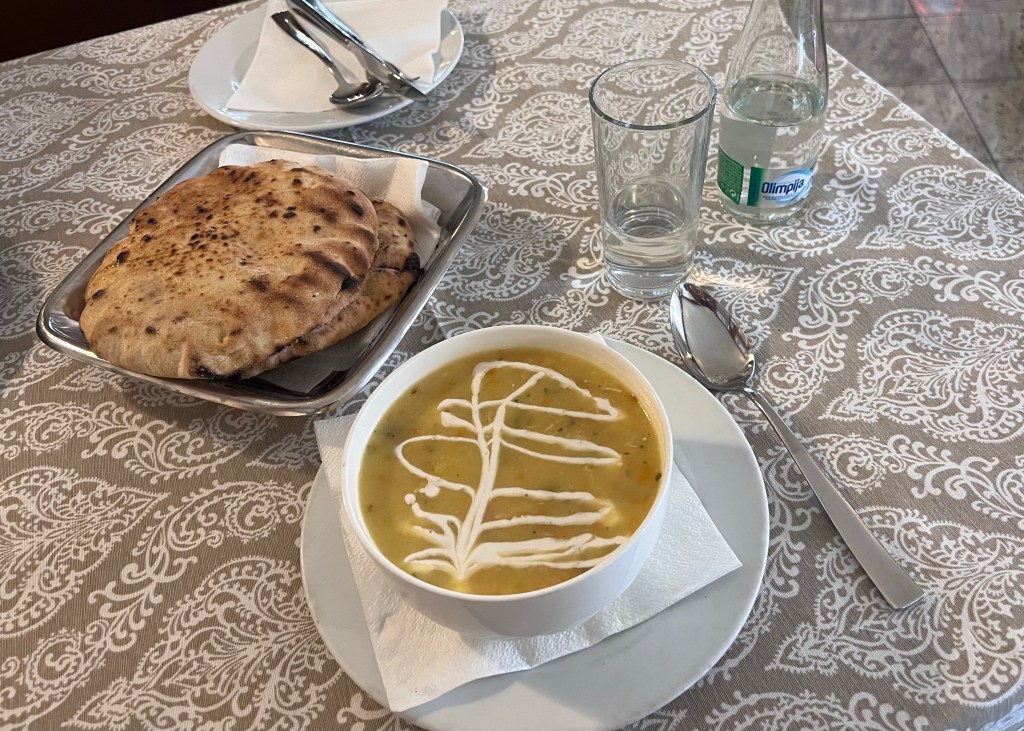
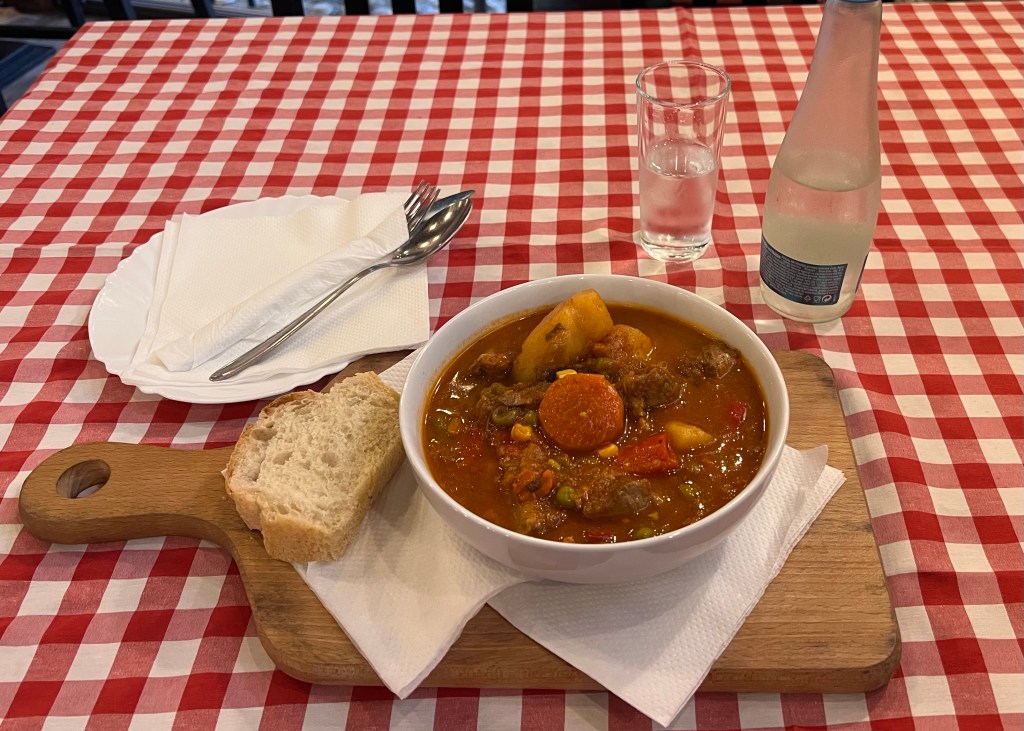
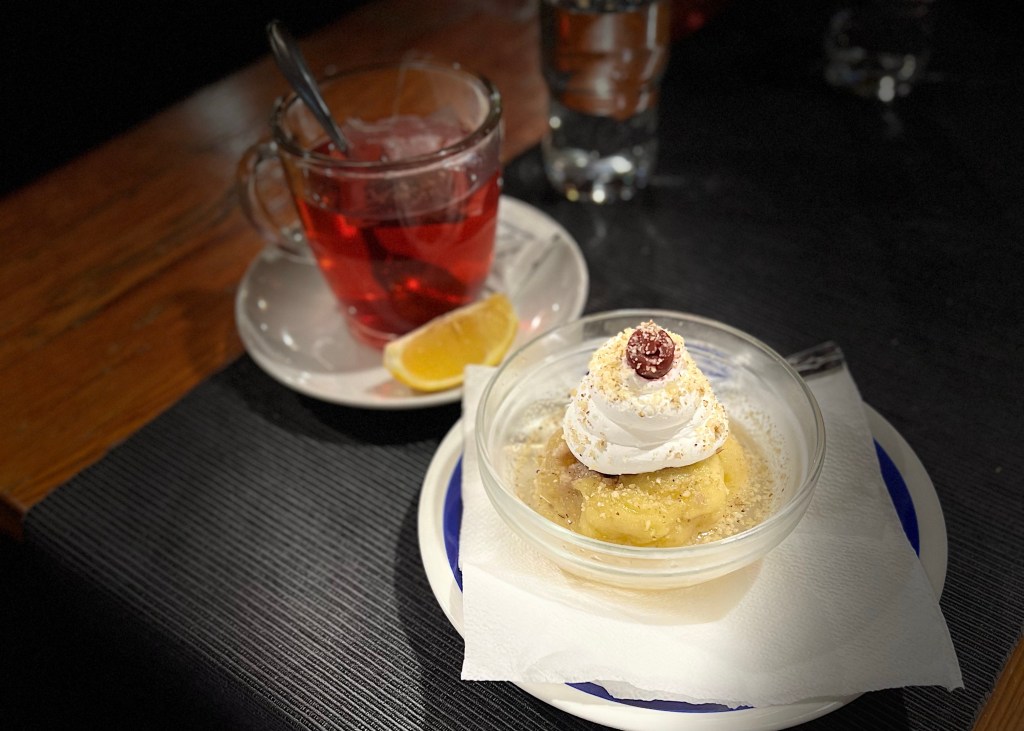
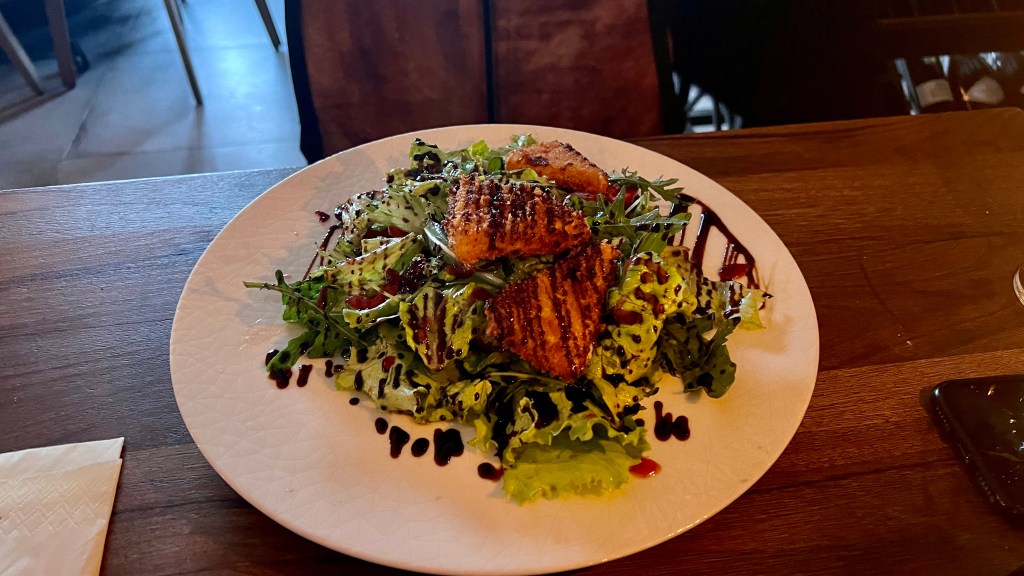
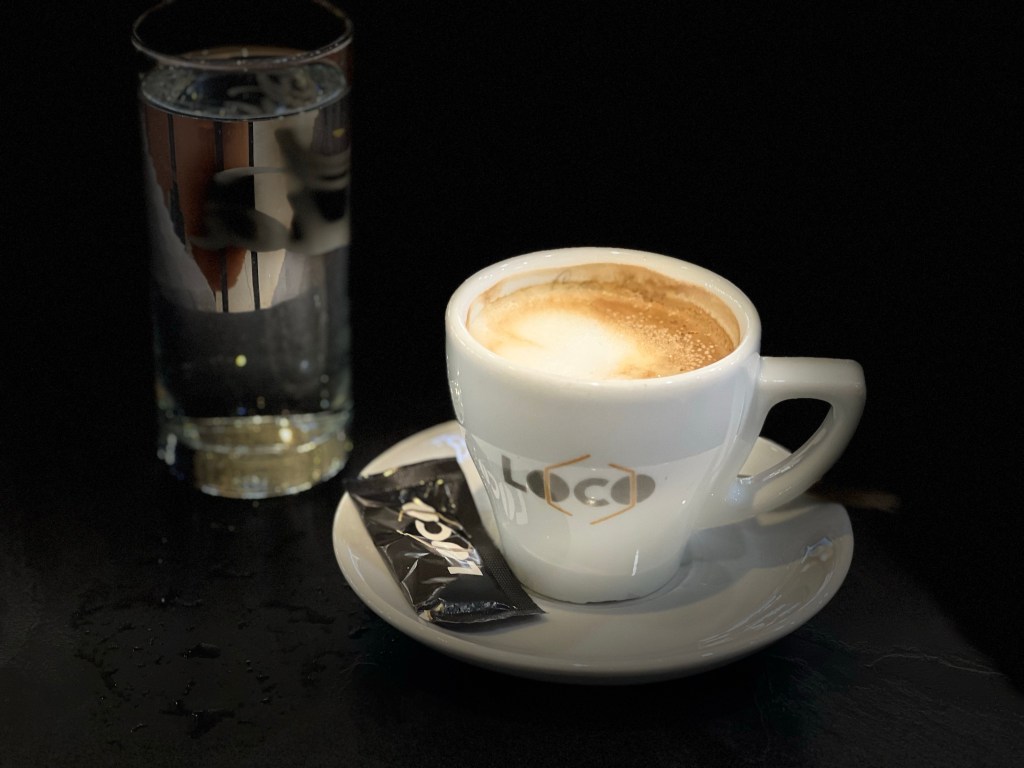
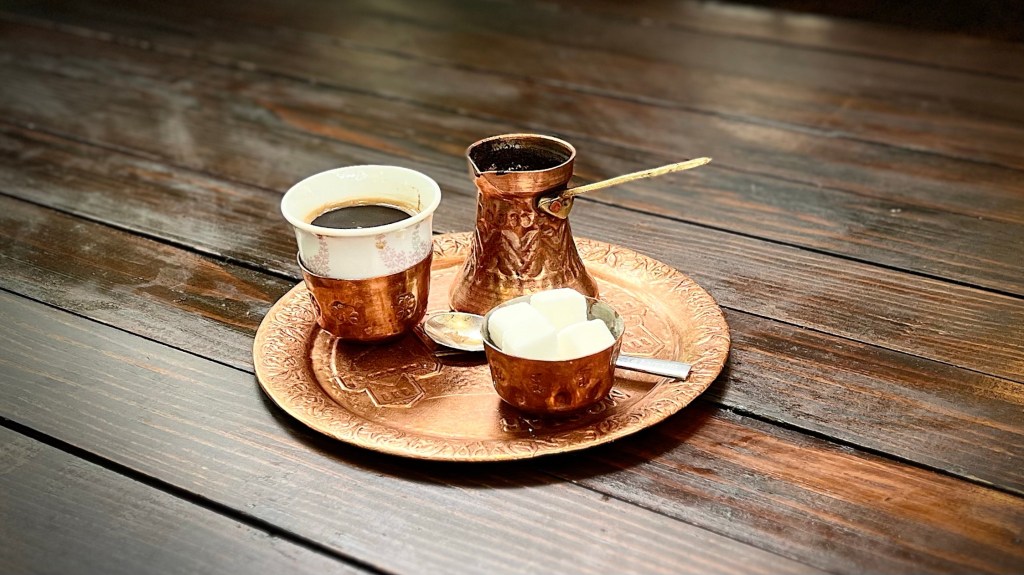
Ćevapćići. This was my introduction to Bosnian cuisine in 1998 at a restaurant called Hodzić in Sarajevo. So I had to go back there to do it again. Basically these are little skinless spiced sausages of lamb and beef grilled up when you order it and served with onions in a tasty, fresh pita-like bread called somun. It is often served with drinkable yoghurt but I am not a yoghurt fan so I take it will beer!Once again the somum bread accompanies Begova Ćorba, s creamy chicken/vegetable soup that also has sour cream in it. Great lunch dish.When at the Slava celebration in RS, part of the meal was sarma and corn bread muffins. Sarma is basically a cabbage roll, The filling typically consisting of a combination of ground meat (commonly beef and/or pork), rice, finely chopped onions, garlic, and a blend of spices such as paprika, salt, pepper, and sometimes herbs like parsley.Mućkalica is a flavorful stew that typically includes cubed or diced pieces of meat, such as pork, beef, or lamb, sautéed in oil or fat until browned. Onions, garlic, and bell peppers are then added and cooked until softened. The stew is further enriched with the addition of tomato sauce or crushed tomatoes, along with paprika, salt, pepper, and other seasonings. It is then simmered slowly until the meat becomes tender and the flavors meld together.At Inat Kuća in Sarajevo I had a mix of Bosnian specialties including dolme ( stuffed cooked onions), bamija (okra – always said to be “good for the potention”) and ćevaps. Served with a dollop of sour cream and a Sarajevsko pivo (beer)For dessert we wandered down the street to another old restaurant where I always enjoyed Tufahija, a poached apple stuffed with walnuts and topped with whipped cream. Accompanied by voćni ćaj (pronounced vochni chai) or fruit tea.Burek is a savory pastry made of phyllo dough and filled with either meat, cheese, or spinach. Sliced up like a pizza and good for breakfast or lunch.Fresh salads are always good, often with tomatoes and cheese and greens and cucumber.When I worked in Sarajevo I spend many a memorable Friday night in this little corner of Avlija with my co-workers Daren and Al and Donna in particular. What a treat to be there again with Lejla, Aldina, Saša and Muco. We ordered a couple of platters of food that included proccuitto, Travnik cheese, olives, tomatoes and a basket of Uštipci or Lokum. Uštipci are sort of like fried doughnuts that are often served as a snack or side dish. They are light and chewy and are often served with kajmak cheese or ajvar spread. Kajmak cheese is known for its rich, creamy texture and a slightly tangy and salty flavor. It has a smooth consistency that spreads easily. The other solid cheese on the tray is Travnik cheese often made from sheep milk. It is crumbly and salty and much like feta.Our second platter was grilled beef, baked potatoes, zucchini, deep fried chicken and mushrooms, more kajmak and lokum. And another toćeno pivo. (draft beer).My go-to request for coffee for breakfast or a break was usually is “Ja BiH Produženu kafu sa mlijekom, molim” that translates to “I will take an exyended coffee with milk, please. Sort of like a small latté. Comes with a glass of water and sometimes a little biscuit or lump of sugar.And then there is Bosnian coffee . Bosnian-style coffee or Turkish coffee, is a traditional method of preparing and enjoying coffee in Bosnia and Herzegovina. It is a strong and aromatic coffee brewed in a special long-handled pot called a “džezva.” Lots of grounds in the pot and foam on the top. The grounds settle to the bottom of the small coffee cups. Usually sweetened with sugar cubes you can drop into the cup before decanting the coffee or sometimes you dip the sugar cube into the coffee and eat it.
I loved getting a taste of all these foods that I had enjoyed years a go. I also sampled local beers from all the cities (Nektar in Banja Luka, Tuzlanski pivo and Sarajevsko pivo and Mostarsko pivo in those cities.
The downside was that with all this beer and bread and Bosnian cuisine, I put on 4 pounds over my visit to BiH!
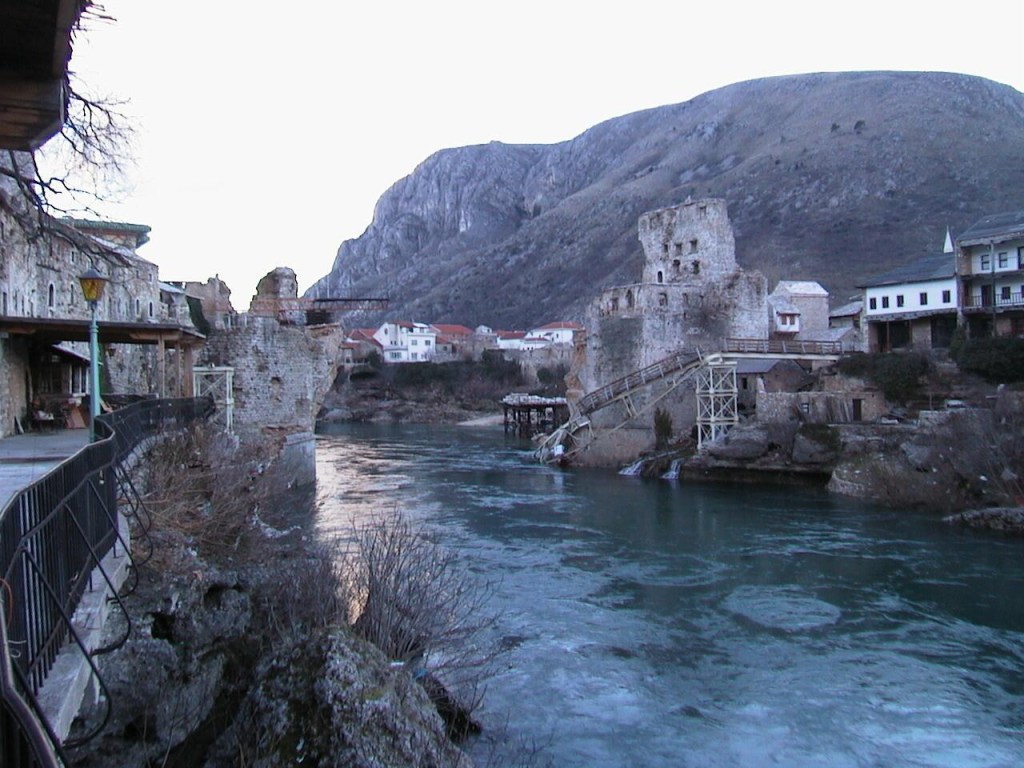
It was good to be back in Mostar for a few days, to visit with friends and wander in the town, I was reminded of the first time I came to Mostar in 1998 and seeing all the devastation along the Neretva River that was basically the front line of the hostilities there. The iconic 400-year old bridge had been destroyed in 1993 and the whole east side was battered.
I had a photo that I took of the bridge in 1998 and went back to the same spot, now the terrace of a restaurant by the river. I asked a young waiter if I could go down by the railing to take a comparable photo and showed him what I was trying to copy. He showed my phone pic to a waitress friend. Her response was “where is the bridge?”. She was 2 years old in 1998 and the young man was not yet born. They never saw first hand the devastation that the war caused although there are still buildings that remain waiting repair.
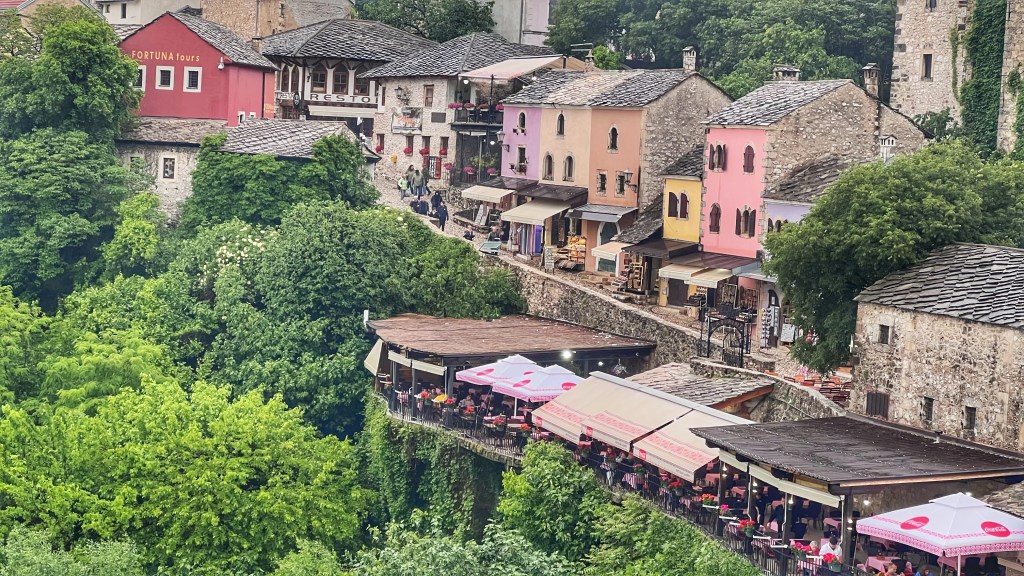
The historic old part of the city has been mainly restored and now attracts a lot of tourists. In 1998 there were none. It is good to see this recovery.
The destroyed bridge in 1998From the same vantage point 25 years later. The bridge photos above were taken from the far corner of the restaurant by the trees.In May 1999 that riverbank looked like this.
Here are some photos of the old bridge area now.
Video: A montage of photos of the old bridge in May 2023.
NOTE: This post has a video image. If you are reading the post on an email you must click on the title of the post to be taken to the WordPress site where the video can be streamed.
I was hoping for sunny spring-like weather as I travelled in Bosnia in mid May but there has been a big, wet weather system hovering over the Balkans for several days. I have been able to get out and walk most days between showers or in a light drizzle and I am trying to take solace in the fact that cloudy weather is often better for photography.
Earlier this week when I was in Sarajevo we got a little break in the rain and as I strolled through the town in the evening I took some photos that I will share here.
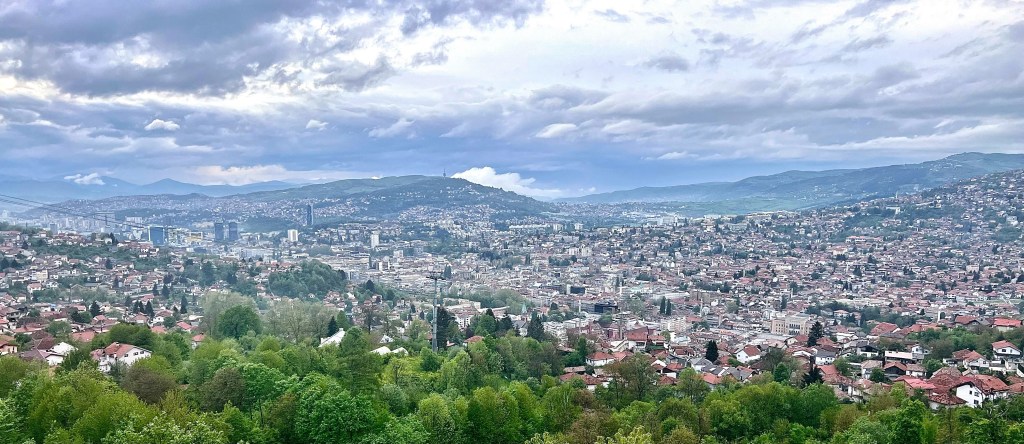
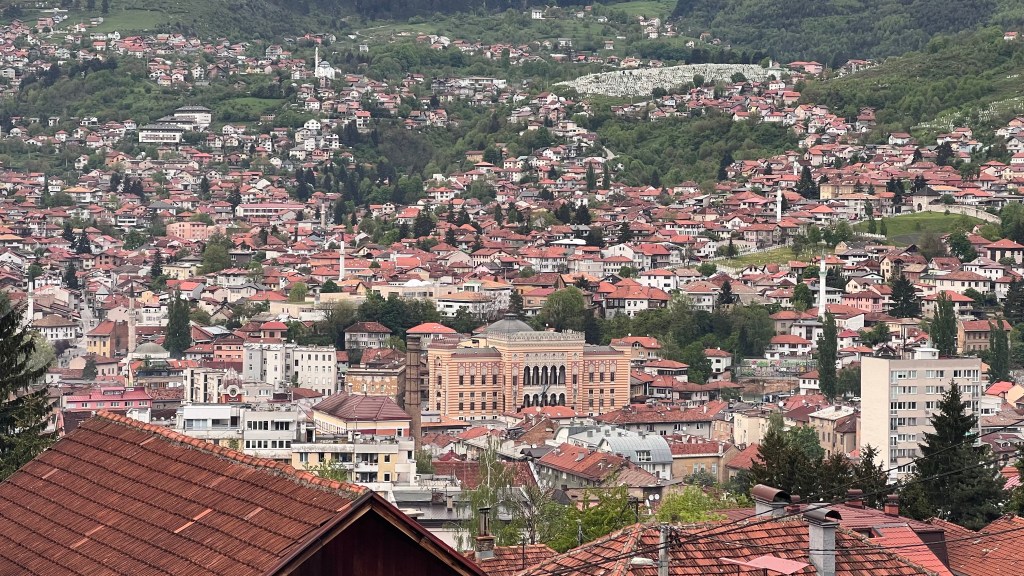
At dusk we drove up into the hills overlooking Sarajevo for a fantastic panoramic view of the city. During the Bosnian war this was a vantage point that allowed snipers to shoot people in the streets below. Many Sarajevans of all ages were killed by sniper fire.
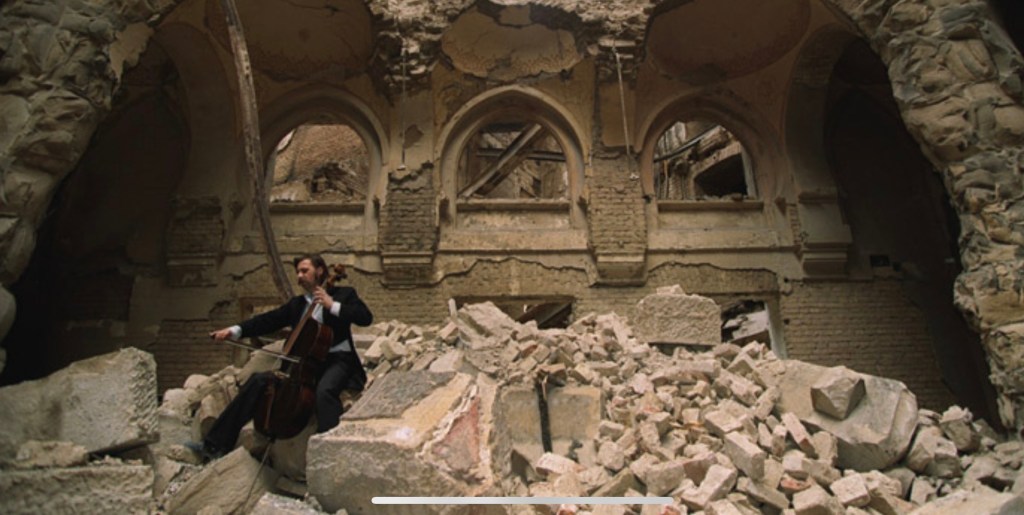
The grand building in the first photo that can be seen in the photo above is now the city hall. It was, for some time also a library that was destroyed during the war. You may have seen photos of the cellist, Vedran Smallović, playing amidst the debris of this building in 1992.
The Cellist of Sarajevo, Vedran Smallović, and the ruins of the library, taken by photojournalist Mikhail Estafiev in 1992 serves as a lasting reminder of the atrocities of war, the resilience of the human spirit, and the ability of art to provide solace and hope even in the darkest of times.
It was also the site of the visit of Austrian Archduke Franz Ferdinand on the fateful day in 1914 when he was assassinated on the street about two blocks from there by Gavrillo Primcip, an event that was a catalyst that started World War I.
Archduke Franz Ferdinand leaving the Sarajevo City Hall moments before he and his wife Sophie were assassinated.
One spot that I wanted to eat while in Sarajevo was a restaurant in front of City Hall called Inat Kuća. The story is that the fellow who owned this house on the site where the city hall would be built refused to sell his land. Eventually the city negotiated to move the house, stone by stone and reconstruct it where it sits today. Inat Kuća is translated “Spite House”.
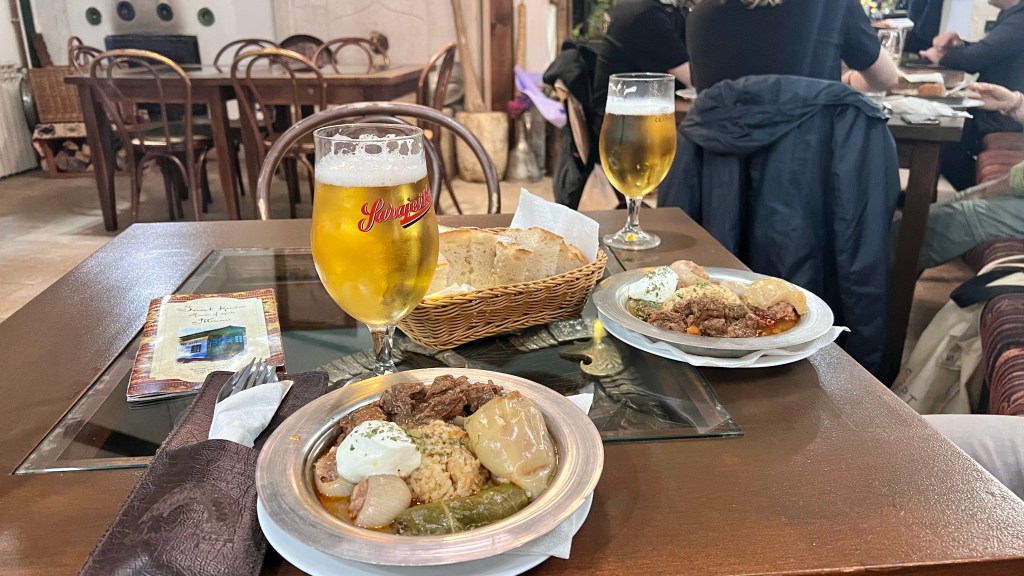
Friends have been particularly interested in the food I am eating and at the end of my trip I will post a blog all about the different foods. At Inat Kuća they had a meal that was a combination of various local specialties. Including čevapi, dolme and bamija. More about all the different foods in a later post.
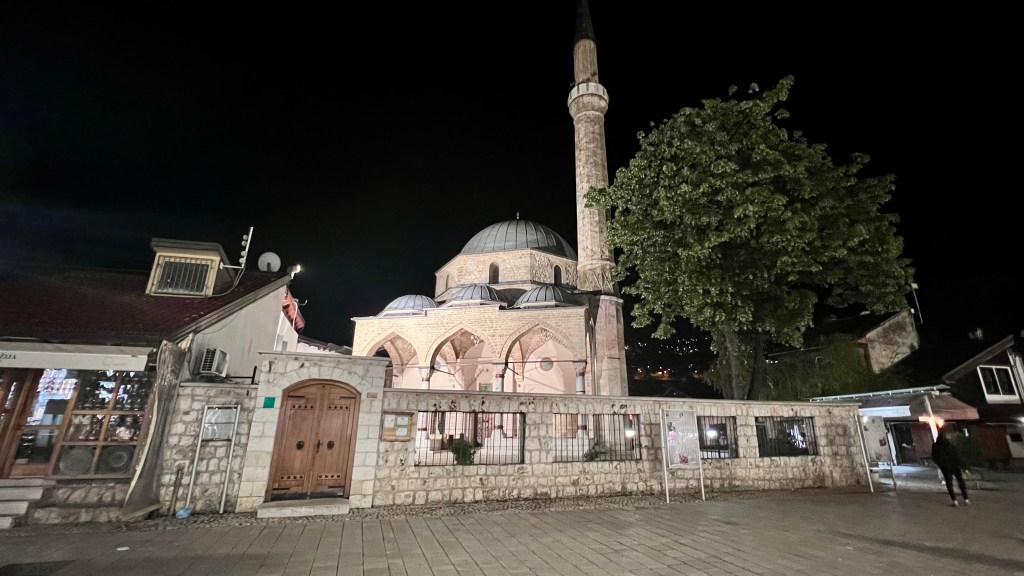
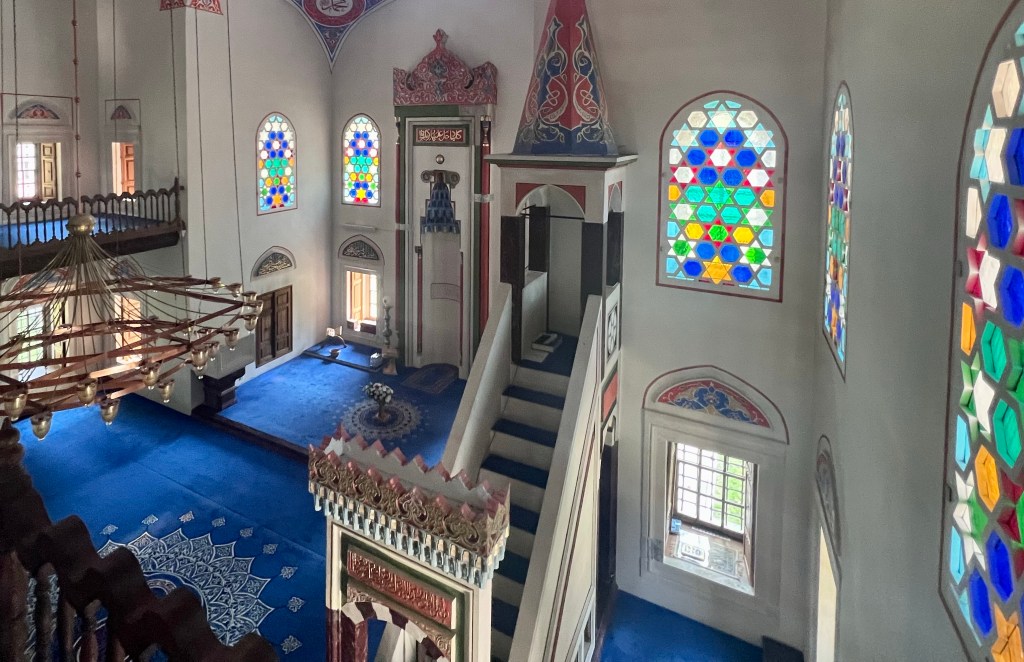
Meal of mixed traditional Bosnia foods at Inat Kuća of course along with a Sarajevsko pivo.The Bsscarsija Mosque, built in the 16th century is at the end of the long central walking street. Fortunately it was not significantly damaged during the 1990’s war.The Ferhadija Mosque was also built in the 16th century and its architecture is a combination of Islamic and Ottoman. It was damaged during the war but it has been refurbished.
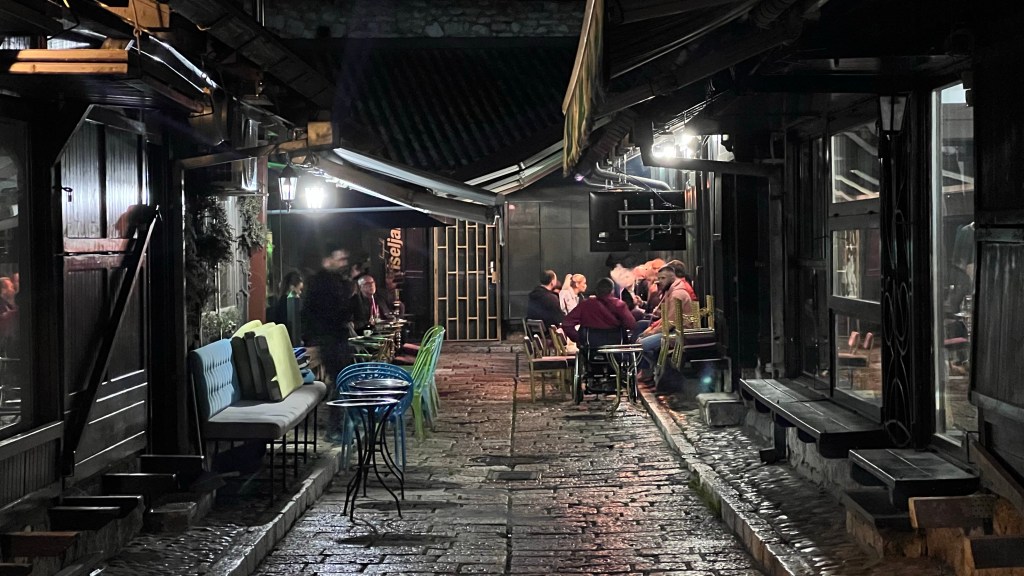
In the evening friends gather in little bars or cafés or on patios to visit and drink coffee or beer as they chat.
When I worked in Tuzla 15-20 years ago I always find the town to feel industrial and the people to be “salt of the earth”. The city had experienced a lot of trauma during the war and there were many refugees, particularly women who had escaped from Srebrenica when their husbands and sons ( 6000 of them) were slaughtered in July 1995.
Now “salt of the earth” is appropriate in more ways than one. The people here are sturdy and diligent and resilient. But Tuzla also got is name from the Turkish word for salt – Tuz. The area was once covered by a shallow sea, and as the sea dried up, it left behind large deposits of salt. Over time, the salt deposits were buried under sediment and rock, and geological processes caused the salt to dissolve and form underground brine lakes. These were mined for many years by a process where the salt was dissolved underground and brought to the surface as salivated water which was evaporated.
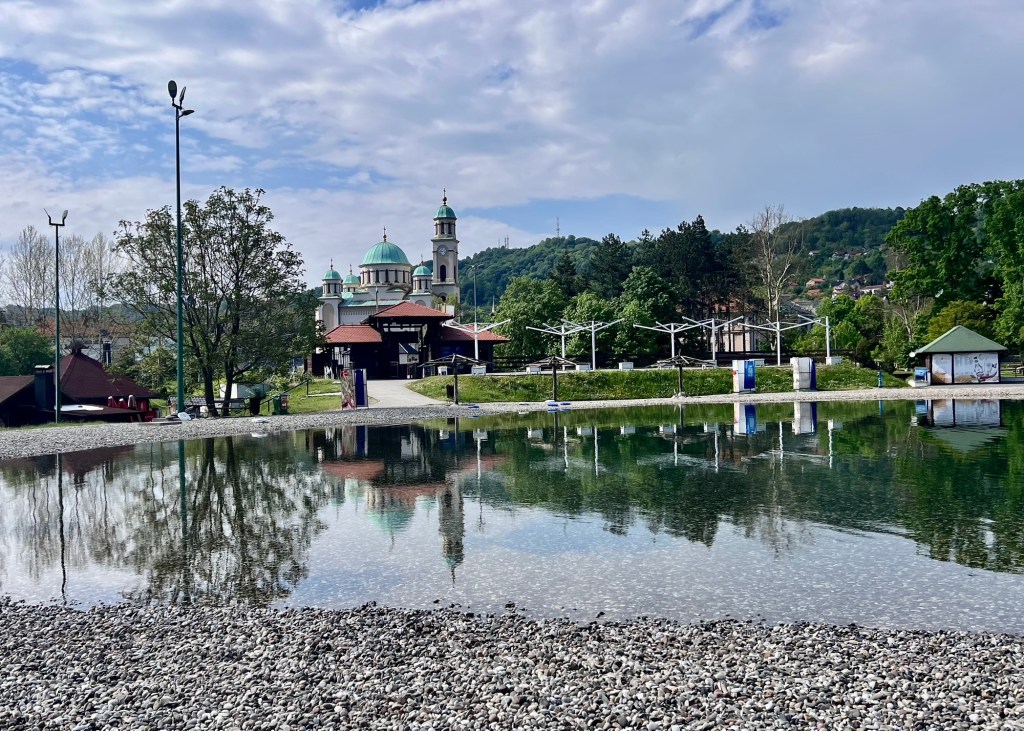
As a result of this process some of the land in the centre of the town is unstable and has sunk a bit in places. But when you are given salt…make some salt lakes. In the centre of the city are three small salt lakes that have been developed as a recreational area for swimming and exercise and enjoying summer weather. These have been more fully developed since I was working here and are now even an attraction for tourism.
One of the three salty lakes in the centre of the city.
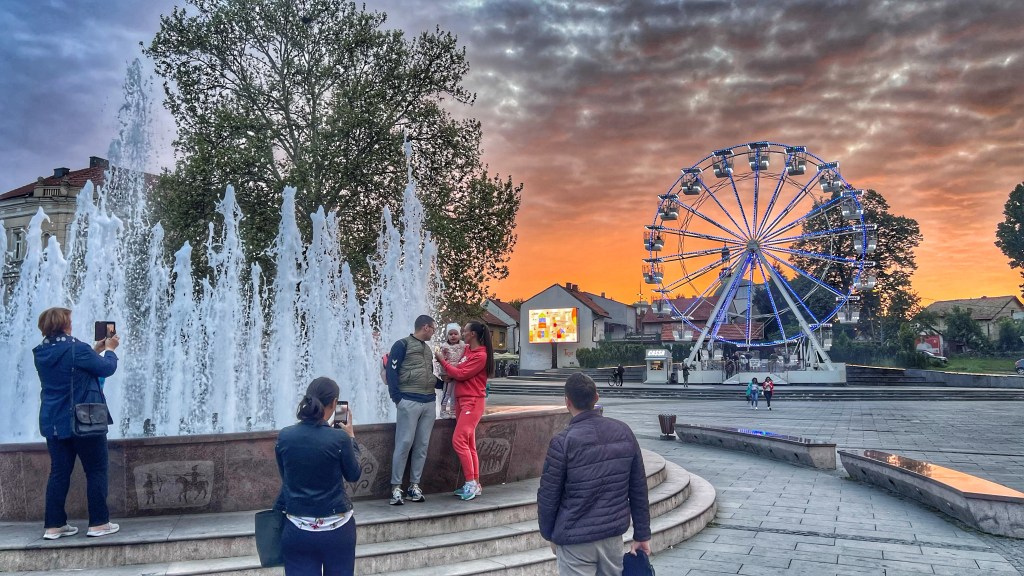
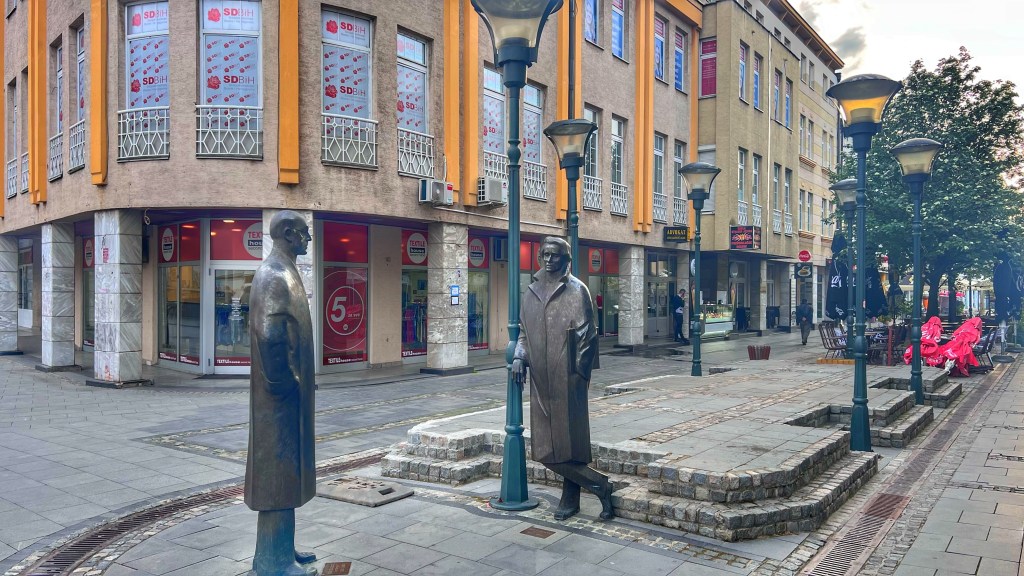
Today the city also seems more vibrant than I remember it. The core area walking street is livelier and more colourful but still has a sense of history. The main square has been upgraded with a big fountain and there are lots of restaurants with patios around it and a big Ferris wheel.
The main Peace Square is a friendly gathering spot.
I had lunch in a restaurant that I used to go to twenty years ago, called Citte del Sale. I have been on a quest to eat some of the traditional Bosnian foods that I enjoyed over my years here and for lunch I got some Begova Ćorba creamy soup made with veal or chicken, vegetables, and sour cream that was served with some fresh hot Somun bread. Somun bread is a type of flatbread that is a staple in Bosnian cuisine. It’s similar to pita bread, but is thicker and softer, with a chewy texture and a slightly sour taste.
Begova ćorba with Somun.
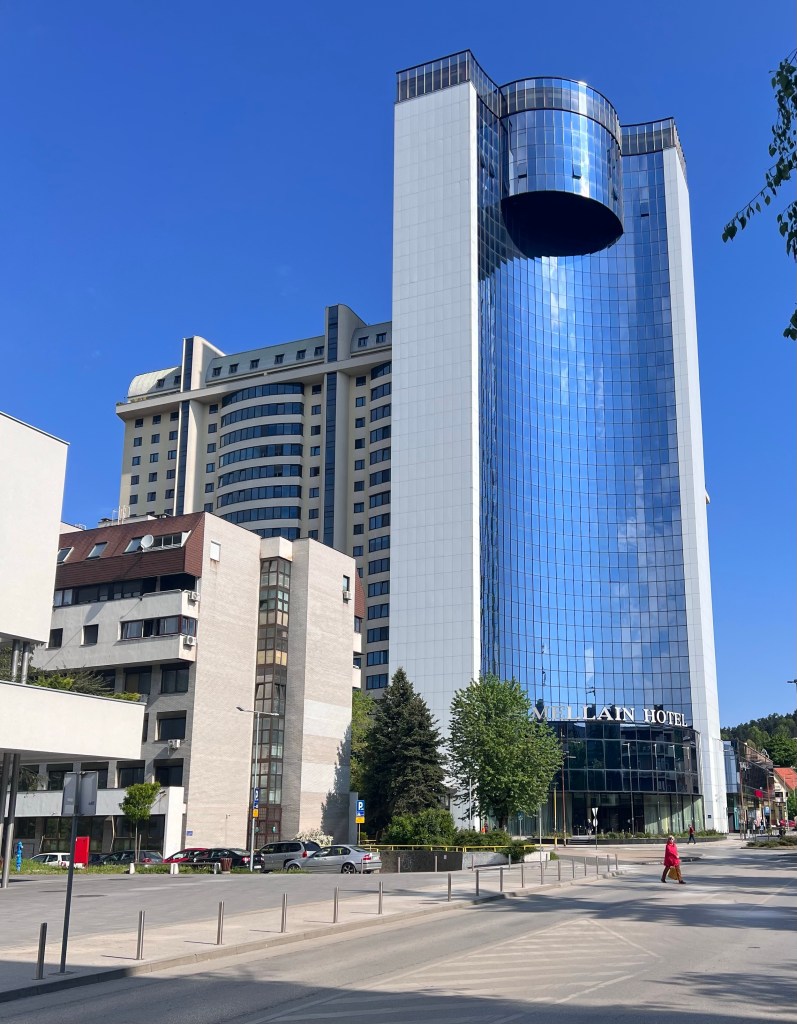
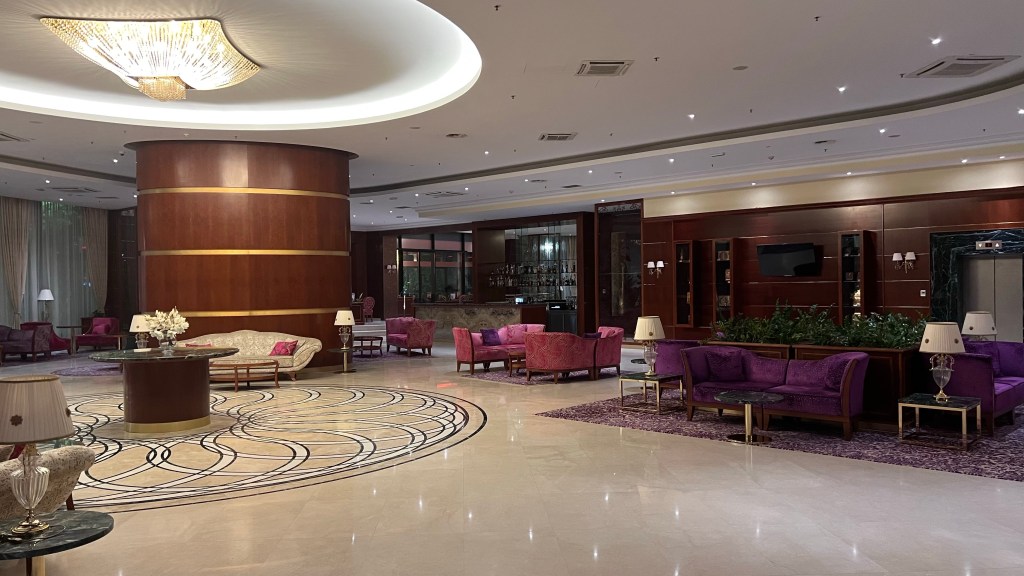
There is a large new modern hotel that is so much more appealing than the Hotel Tuzla where I used to stay. It looks modern and spacious and well appointed and has a gym and pool.
Lobby of the new Mellain Hotel
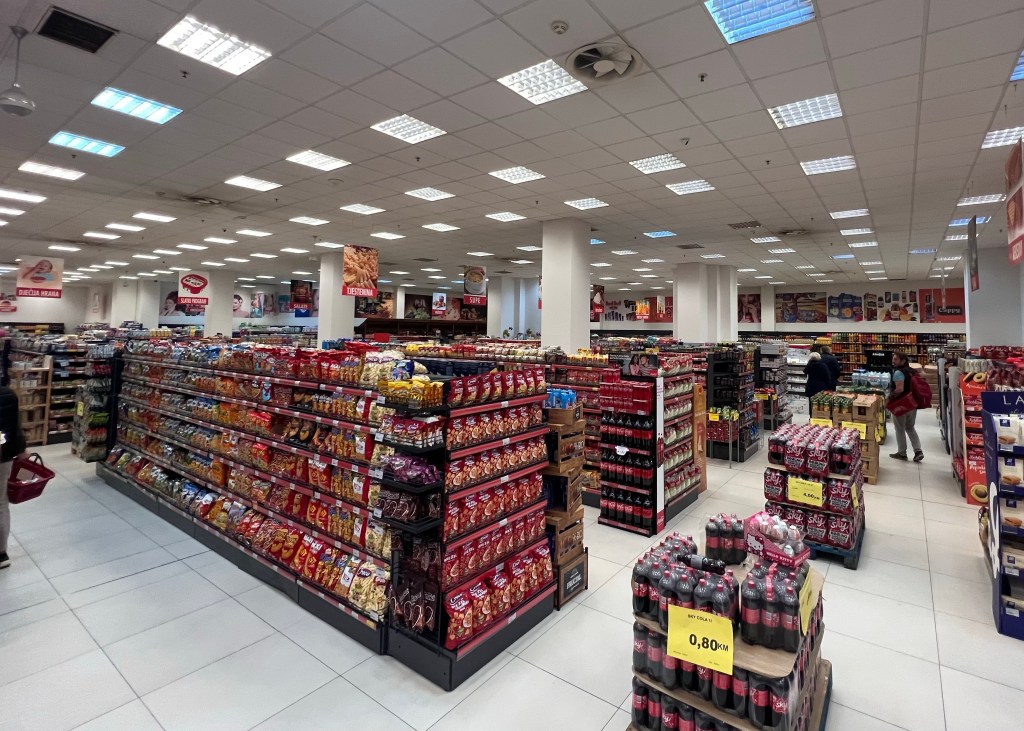
There are larger shopping centers and grocery stores. One supermarket below the new hotel is gigantic and a far cry from the little shops that were the norm in the past. Shops along the main walking street also seem more colourful.
Well-stocked Megsstores have sprung up in all Bosnian towns – a far cry from what was available 20 years ago.Walking street in central Tuzla.Small central street at night.
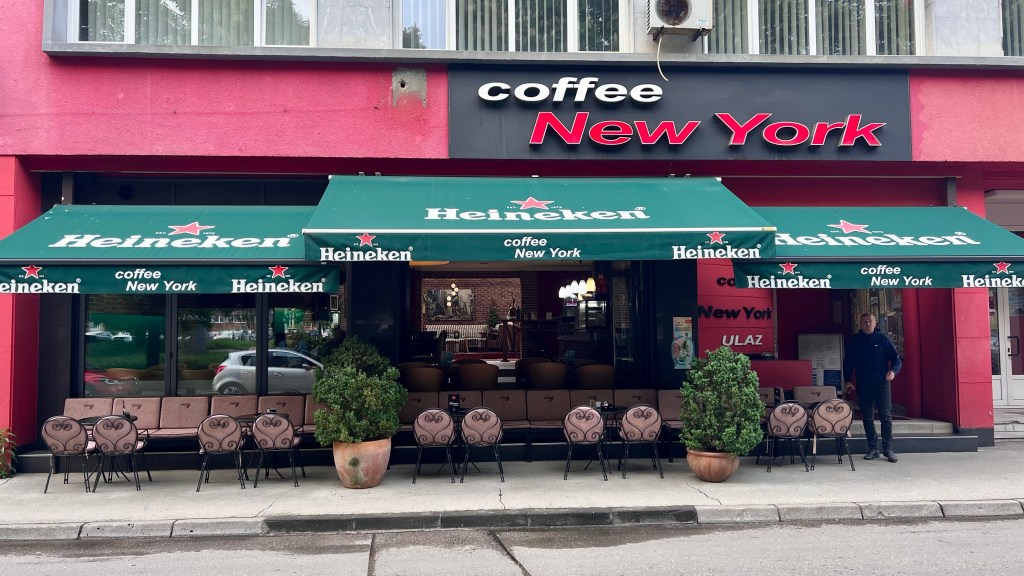
When revisiting Tuzla I made a point of going into a café that I used to haunt several years ago for a “produženu kafu sa mlijekom” (sort of an Americano coffee with milk). The café used to be called “Mozart”. The name has been changed to Coffee New York but the café has not changed much.
I was reminded of a post that I made twenty years ago about this cafè and the story is good enough to share again. The waitress who served me was probably not even born when this story unfolded. And the cat is long gone.
Bosnia and Herzegovina September 10, 2002.
If Sarajevo is the Montreal of Bosnia, then Tuzla is its Hamilton. Not much to do here in the evenings except wander the streets with many of the rest of the people who live here. During the day I work teaching principles of Family Medicine to local doctors. At night I am on my own.
Last night was a bit rainy and I thought I would wander downtown for some dinner. While I was looking for some keys in my knapsack, I came across the Stuart McLean Vinyl Café book that friends had given to me for Christmas a couple of years ago. I had brought it along with me, knowing that it would be good for short reads on the plane or while waiting for my meal in a restaurant. I tucked it under my arm and headed out.
I ate in a restaurant called Cite del Sale, a Bosnian version of an Italian restaurant and I was actually able to order Vegetarian Lasagne – not bad in a country that sometimes seems to worship meat. The beer, a local Tuzla variety, smelled a bit sulphury but it tasted OK. I started into a story about Dave and Morley and Harrison Ford’s toes and smiled to myself, all the while hearing Stuart McLean’s distinctive voice tell me the tale.
After the meal I decided to head down to a café called Mozart that is a short stroll along the main walking street in the city. I often go there for a cappuccino in the morning – a replacement for my Canadian Starbucks habit. The café has a small outdoor section that was not busy since it was misting rain, another large main room and then a wicker- furnished salon at the back that is kind of separate from the rest. I usually sit back there in the morning and read a bit while having my coffee and at 8 am, I am often the only one there. In the evening, I discovered, the music is louder – sort of Euro Disco. I wondered as I ordered my tea if I would be able to concentrate on my book.
There were three couples spread around the room. I pulled out the Vinyl Café and started to read. Soon I was distracted, not by the beat of the music but by the sound of kissing which seemed to be going on all around me. I quickly realized that I had stumbled into a make-out area of the café. So, here I was, a middle aged foreigner, sitting at a little table in the middle of the room, reading Stuart McLean and trying not to look up at the couples surrounding me who were fiercely groping at one another. This felt worse than the week before when I had accidentally found myself in the middle of a Nudist Colony on the Adriatic coast! But that is another story.
The stereo sound of smacking and sucking seemed to rise above the music. I was having trouble concentrating. I casually looked up. One couple, kind of fat were making most of the noise. The guy had a sort of Henry VIII look to him. I imagined that he makes similar noises as he tears into his chicken legs for dinner. Another couple had ordered both coffee and coke to drink. They must have wanted to stay awake. They smooched away between drags on their cigarettes. The third couple were in the corner and at first I thought they were having a bit of a tiff. I decided that if I had to look up, I would gaze in their direction. Soon, unfortunately for me, true love rose to the surface and they started kissing away, the woman also chewing gum between slurps.
I thought maybe I would leave but I had ordered a veliko caj (large tea), which came in a cup the size of a sink. So I was stuck, feeling a lot like a High School Hall Monitor.
Just as I was starting to feel sorry for myself, a small kitten appeared at my feet. It was a nice little grey striped thing that was sharpening its claws on the carpet. It started to pounce around and jump like it was being poked by an imaginary stick. I put my hand down to play with it but as it got closer, I noticed that its right eye was oozing and crusted and swollen shut. I withdrew my hand, thinking that I didn’t want to catch anything. But this didn’t deter the cat. Soon it was pouncing on my feet and grabbing at the laces of my sneakers and climbing my pant legs. I tried to look inconspicuous, periodically shaking my leg to detach the tiny sharp little claws from my pants. The kissers broke apart and looked over at me as I tried unsuccessfully to discourage the cat. I ended up downing the rest of my tea as quickly as possible and headed back to the hotel.
February 20, 2003
I am back in Tuzla.
I find the breakfast at the hotel simply annoying. It usually consists of dry buns, scrambled eggs that have turned greenish black from sitting in the warming pan too long and “orange juice” that is a cross between Tang and Fanta , a watery orange coloured sugar water that is sometimes even effervescent. My preference is to start the day on a more positive note, by walking to a local Pekara or bakeshop to pick up a fresh bread roll filled with cherry jam. I then head a bit further down the street to the Mozart café for some coffee. They don’t serve food there so they don’t mind if you bring your bun in a bag and eat it while you have your drink. And I usually go to the Wicker room at the back of the café that I have come to view as the nocturnal lair of lust. In the morning, however, it remains bright and cheery and almost empty. This morning was no exception.
I ordered my coffee, pulled out a journal to read, and got the cherry bun out of the paper bag. I put the bag on the chair beside me rather than have it obviously displayed on the table. I was trying to be discrete about bringing food into the café although I know that this is a common practice and the waiter really doesn’t mind.
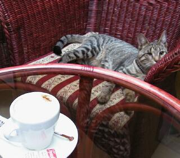
I hadn’t counted on the rustling sound of me getting my food out of the bag to attract…the cat. Suddenly this little grey striped beast ran from the other side of the room and jumped up on my chair to quickly begin exploring the empty bag. Within seconds he was halfway buried into the bag. He pulled his head out of the bag and stared up at me. We hadn’t seen each other for five months. He had grown but was still scrawny and where his right eye should be was now a hollow socket.
We sat together, the cat and I, reacquainting. Periodically he would chase the shadow of a bird on the roof, bounding over the furniture as he ran around the room. I crumpled up the bag and he batted it around on the floor. We played and visited while I drank my coffee. When I got up to leave, he lay back on the chair pad and cocked his head to look up at me with his good eye. I imagined him thinking, “Nice to see you again”
This little cat has it’s niche in a café here in Tuzla. I travel all over but I can still come back to find this friendly kitten here several months later.
It was great to go back to the centre if Banja Luka and stroll around the streets where I had lived and worked on and off over several years.
Basically the place looks pretty much the same as it did when I was last here in 2012. Here are some photos of the centre of the city which has a population of 200,000 spread around it.
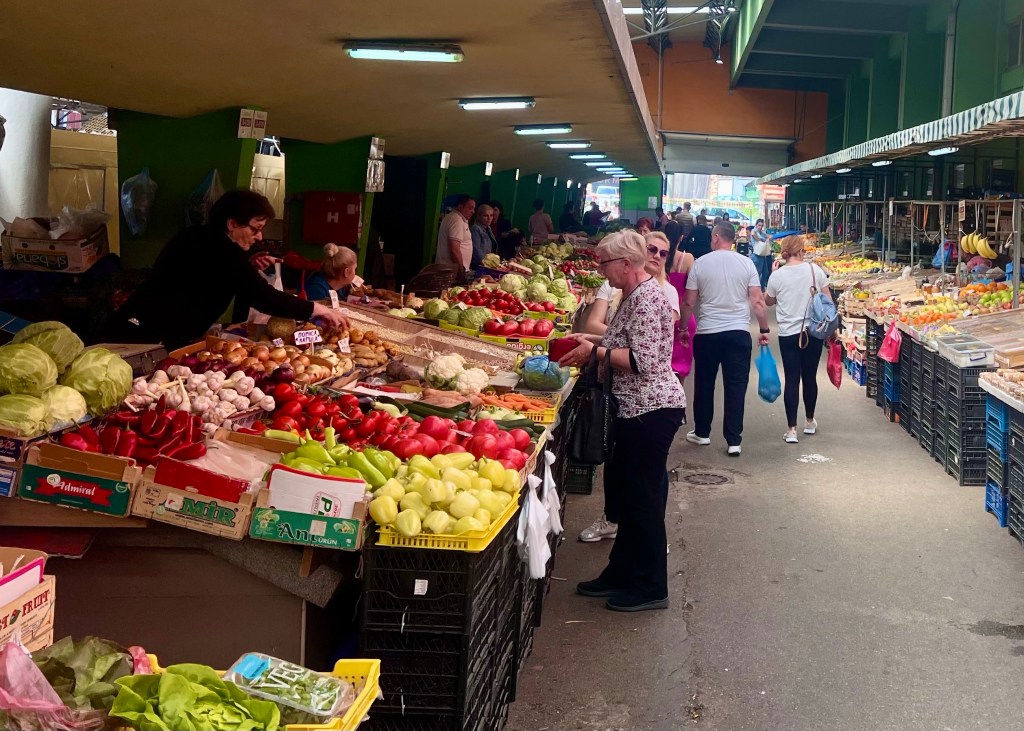
The main waking street has not changed much in 15 years.This market behind the mosque used to be open air, cold in the winter and wet when it rained. Now it is covered and larger. Lots of fresh fruit, flowers and vegetables.This little restaurant is where we had our burek lunch.
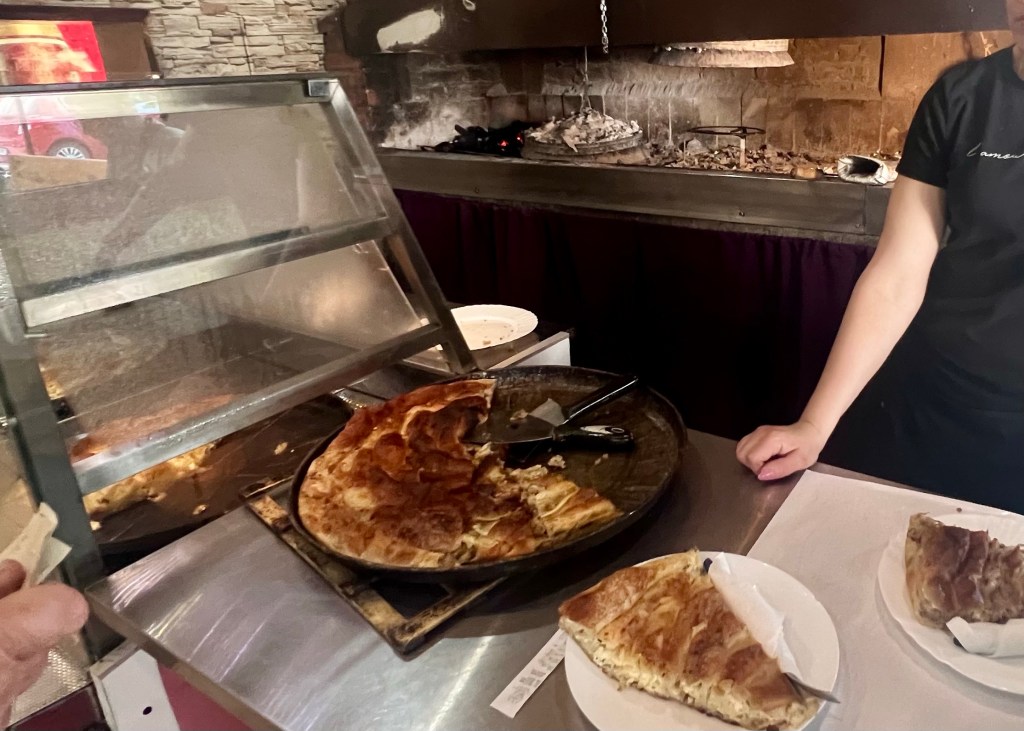
We stopped for lunch at a small restaurant that makes burek under the sać. Burek is a pastry made of phyllo pastry stuffed with cheese, meat or spinach and in this case cooked on a pan that is covered with a lid and then with hot coals piled on top. This way of cooking can also be used to cook meat and vegetables under a dome piled with coals. It was filling and delicious lunch of a traditional food made in a very traditional way.
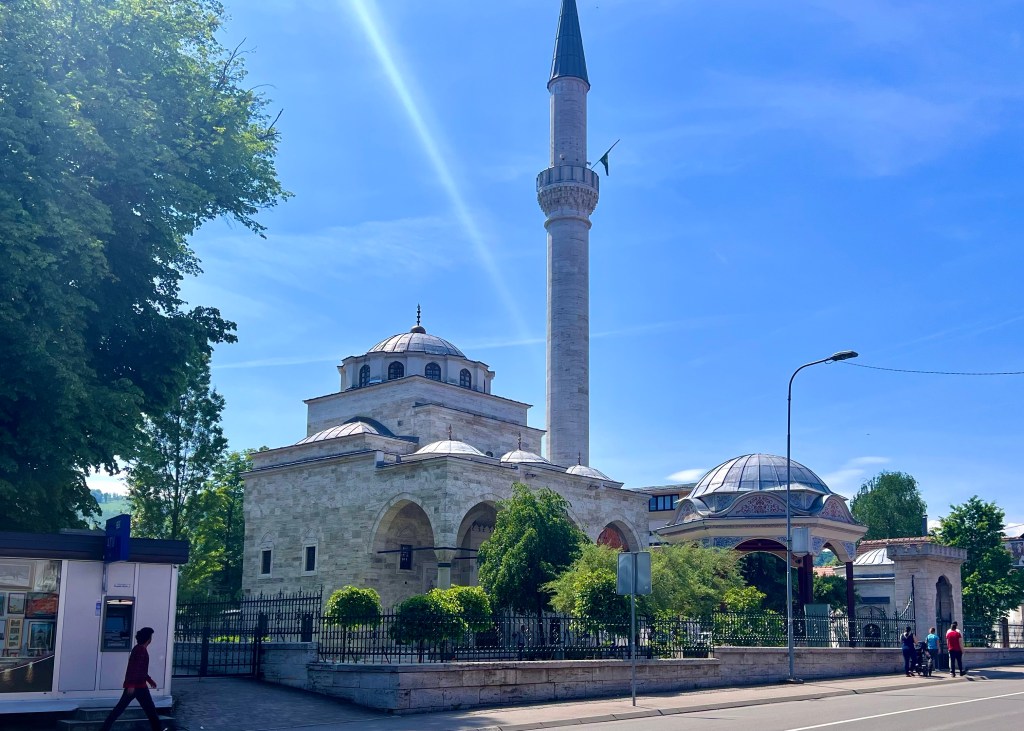
A pan of burek just off the coals from the oven behind.The reconstructed Ferhadija mosque in the centre of Banja Luka
Exactly 22 years ago to the day, May 7, 2001, Saša and I had stood on this same corner when a large crowd gathered and hooligans held 200 Muslims (and the Canadian ambassador) hostage in a building by an empty lot here. The group had come to lay a cornerstone to rebuild the Ferhadija mosque that had been destroyed during the war.
The original mosque at this site was built in 1579 during the Ottoman period and was named after its founder, Ferhad Pasha Sokolović. The mosque was an important religious and cultural landmark in the region, serving as a gathering place for Muslims in Banja Luka for over 400 years.
However, during the Bosnian War in the 1990s, the Ferhadija Mosque, along with many other historic buildings and cultural sites, was heavily damaged as ethic conflict plagued the country. The mosque was set on fire and its minaret was destroyed, leaving only the stone walls and foundation intact.
As tensions tose on that 2001 May Day, two busses that had brought some of the people now barricaded in the building burned and black smoke rose over the site. SFOR helicopters roared overhead. Thankfully the tensions were eventually brought under control and no one was injured but it was a day filled with uncertainty and threat. My co-worker and friend, Daren Trudeau and I were forced to make a hurried escape through the mountains to Sarajevo while the crisis was evolving. Today, 22 years later, I was delighted to see this beautifully reconstructed Ferhadija mosque.
On the street , men gather in the spring sunshine to play chess.
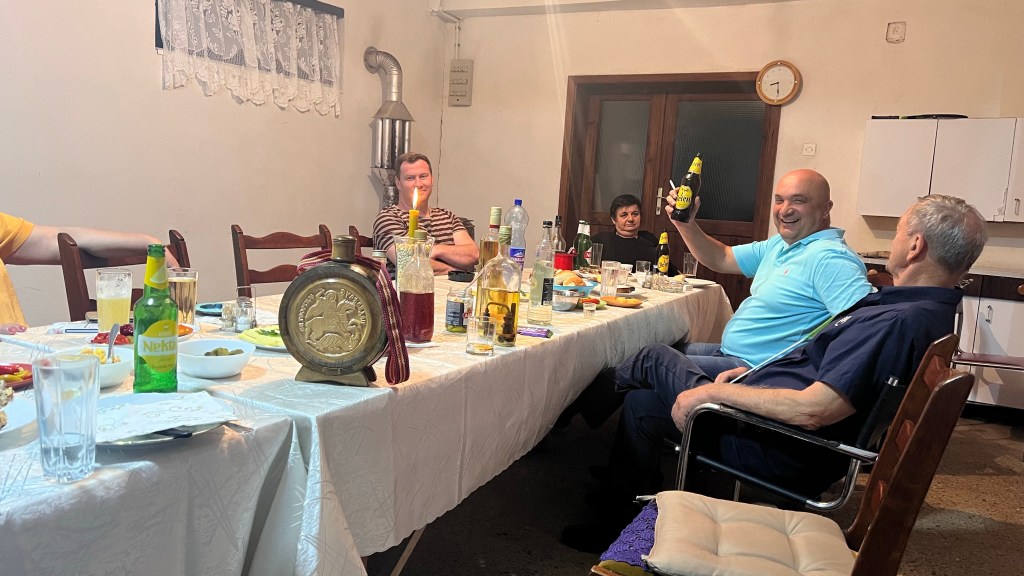
This week I am staying in Banja Luka, Bosnia and Herzegovina with my friend, Saša Loncar, who was a translator for me when I lectured to family medicine residents here from about 1998 to 2012. He is now an interventional cardiologist living in Banja Luka with three daughters and a lovely wife, Sandra. Yesterday (May 6) marked the celebration of Saint George’s day for many families at Republika Srpska in Bosnia, including Saša’s.
Since each family has its own patron saint and therefore its own “Slava”, the date of the celebration varies from family to family. The date is usually determined by the family’s ancestors, who chose the saint and the date for the Slava based on various factors, including family history, personal experiences, and religious beliefs. Bosnia has always been a melting pot of different religion-based cultures, Muslim, Orthodox and Catholic and this has proved both a strength and a source of conflict. But one thing they always seemed to agree on was marking each other’s holidays – any excuse for a day off and getting together for food and drink.
So, on St. George’s day, to celebrate the Lonćar family’s patron Saint, we all packed into the car to head north about an hour’s drive to the homestead of Saša’s grandfather, near Dubica. Saša’s uncles now live on the rural farm property.
The extended family, maybe 20 of them, all descendants of grandfather Milan Loncar, gather in a large workshop-like room behind the garage, where three long tables are set up so that everyone can sit to share traditional foods mostly coming from the farm itself. In addition, there was an extensive collection of various Rakias – homemade liquors – and local beers.
Behind the house are fields of wheat, barley, onions, beans and garlic, and a barn with a few pigs and piglets. One of the pigs had the misfortune of being roasted on a split along with a lamb to provide meat for the large multi-course lunch.
Liquors made by the host, Slobodan, kept appearing – Šlivovica (made from plums), Kruškovica (pear) , Dunjovačka (quince) and others made from walnuts and cherry. I was encouraged to have a little taste of all of them and it would’ve been impolite to refuse. Some I enjoyed. Others were a little more…caustic.
Even more intriguing for some was the presentation. Two of these home-made liquors were served out of bottles that had large items trapped inside the bottle. The Kruškavica was a clear liquor and there was a full-size pear at the bottom of the narrow-necked bottle. Magic? In another bottle was a miniature wooden wagon-like structure that looked like it had been carved. How could this be?
The explanation followed after I was flummoxed trying to figure it out. The little wooden ornament had been assembled through the bottle neck, piece by piece, using large grasping tools. Once the liquor was gently filled into the bottle, the wood joints swelled to make it a stable little ornament.
And the pear? When the immature pear was forming on the tree, the bottle was slid over the branch, and the pear allowed to grow to full size inside the bottle. The branch and any leaves were removed and the home made pear rakia funneled into the bottle, preserving the pear inside. The bottle with the could be refilled year after year and this one was apparently 10 years old.
The meal started with homemade chicken noodle soup, and then Sarma served with homemade cornmeal biscuits. Homemade even extends to growing the corn and grinding it into the flour that went into the biscuits. Sarma is something like a cabbage roll with meat –pork and lamb in this case – and rice.
Then there were platters of pork and lamb, both having been spit-roasted, along with pickles, peppers, and local cheeses. For dessert there was a selection of sweets (Kolaći) with Bosnian coffee.
Despite being a bit jetlagged after my flight the day before, I thoroughly enjoyed this large family gathering. Did they really care about celebrating St. George? Not likely. It was more a good excuse for an extended family to come together and socialize and I was delighted to be invited to share in this celebration.
Video:: Celebrating Slava in rural Republika Srpska, Bosnia and Herzegovina
NOTE: This post has a video image. If you are reading the post on an email you must click on the title of the post to be taken to the WordPress site where the video can be streamed.






























 johnageddes