A Canada Day Challenge

Every year around July 1, I unfurl a big, red and white Canadian flag over my balcony with pride. I consider myself fortunate to live in a country where people value the notion of respect for one another.

Collectively, we respect our democratic government process, even if we don’t always agree with our politicians.

We respect and protect the rights all Canadians despite religious, cultural or ethnic differences. Diversity makes up the colourful fabric of our nation. On Canada Day, new citizens from around the globe are welcomed to Canada in ceremonies across the land. I remember attending one such occasion a few years ago when the family of one of my co-workers from Bosnia and Herzegovina officially became Canadian. At that ceremony, the Mayor of Kingston had been born in Scotland, the Governor General in China (both were women, by the way) and the Ontario MP was born in Holland. That tangible recognition of our varied backgrounds reminded me of what it is to be Canadian.

And we are generous to the rest of the world with our support – military, moral and financial.

This week I was reminded of this generosity when I received notice that the Sasamat Foundation in British Columbia will donate $10,000 to the CanAssist African Relief Trust to be put toward building two classrooms for the Hope School in Mbita, Kenya. This gift is being given with no strings other than the accountability of CanAssist and the recipient community to use the money for their school. It is independent of other obligations and given without cynicism or suspicion, cultural or religious bias, but with trust that the community in Africa will utilize it to benefit their children. I think this is a very “Canadian” gesture.


In addition to their generous $10,000 donation, the Sasamat Foundation has presented CanAssist with a challenge. They will donate another $5000 to the school, matching donations that CanAssist receives 2:1. But this has to happen within the month of July.

Are you be willing to support this initiative with a donation of $50 to CanAssist and the Hope School? You can make a secure, tax-receiptable donation online now with a credit card by following the Canada Helps link below. You can even select a small monthly donation option through the Canada Helps link. Indicate that your gift is to bolster the Hope School Fund.

Donate Now Through CanadaHelps.org!Faire un don maintenant par CanadaHelps.org!

CanAssist is always happy to receive a donation by mail.
CanAssist African Relief Trust, 562 Sycamore Street, Kingston, Ontario. K7M7L8

Happy Canada Day!

Check out out the CanAssist web page about Hope School at http://canassistafrica.ca/Mercy.html

Donate Now Through CanadaHelps.org!Faire un don maintenant par CanadaHelps.org!

Images of Africa – Elephant in the room

Take a moment to close your eyes; think of Africa; form an image.  What comes to mind?

In all likelihood the image is of a lion…or a Maasai warrior dressed in red, adorned with beads and carrying a spear…or of an emaciated child struggling for life in the arms of her distressed mother.

Although these images are all legitimate, they represent only a small portion of the cultural depth and diversity in sub-saharan Africa.  They are icons.  Is Canada thoroughly represented by a photograph of a  Mountie on a horse in a red tunic? Niagara Falls? A beaver? A big bull moose with horns like a hat rack?  Chances are that a large portion of the Canadian population has never come across a moose in the wild.  And the reality is that the majority of Africans have never seen a lion.

One of Heather Haynes paintings depicting the characteristic image visitors to East Africa retain forever.

The images we get are iconic and restrictive.  Charities often show pictures of starving kids to tug at heartstrings and garner donations. But these sad images do not reflect what one sees when visiting Africa. Instead the majority of people you meet there are polite and open and generous. They smile and are often immaculately dressed, no matter where they come from.  They are friendly and outgoing and eager to interact.  They know what they need to help their communities…they just don’t have the resources to put their ideas and dreams into action.

At the CanAssist African Relief Trust we try to present an accurate description of the needs of the communities we support without indulging in what has been called “the pornography of poverty”.  Some African people may be very needy by our standards but they are still proud and deserve not to be exploited with images of their poverty being the primary focus.

Heather Haynes, a Kingston artist, has travelled in East Africa and has found beauty and colour in the villages she has visited.  Her safaris in Africa have transformed her as an artist. She paints remarkably stunning life-sized portraits of African women and children and gives part of the profits from selling them back to charities working in Africa.  Heather has become immersed in this work and along with her sister, Whitney, who makes jewellery with an African theme, has opened the Heather Haynes Gallery in Kingston, Ontario at 318 King Street – across from the market. 

I recommend a visit to the Heather Haynes gallery, if only to see an accurate portrayal of the colourful, resilient people one meets every day while traveling in Africa. It would be wonderful if these were the images that pop into your mind when the word Africa is mentioned.


Sanitation….or lack of it.

When I was selling my house three years ago, prospective buyers were always anxious to see the kichen and the bathroom(s) as a priority.  What was the bathroom countertop like?  Were there two sinks? A rain shower?  One of those toilet lids that closes quietly without banging?   Magazines and web sites intrigue us with bathrooms where we could luxuriate all day. We in North America are certainly spoiled when it comes to bodily ablutions and evacuations and we have all been in service station washrooms that make us cringe.

According to Unicef and World Health Organization data, less than 35% of the population of Kenya has access to “improved sanitation” – which might just mean a clean ventilated outdoor latrine. Flush toilets for most…forget it.

One of the areas of focus for the Canassist African Relief Trust is to help schools in East Africa improve the situation for their students by constructing new latrines and having rainwater collection for both drinking and washing.

Let’s compare our expectations for sanitary toilet facilities with what some students and teachers endure in Kenya

These are the two buildings that serve as toilets for 300 pupils at the Mutunda School in Kenya

Recently CanAssist received another request for latrines from a school in a region where we were not acquainted with anyone as a contact.  So we sent one of our Kenyan colleagues to check it out.

Initially he was surprised that the request was coming from this community which, on the surface, seemed to be reasonably well off.  But as he went a bit more rurally to one of the schools, even he was shocked by what he found.

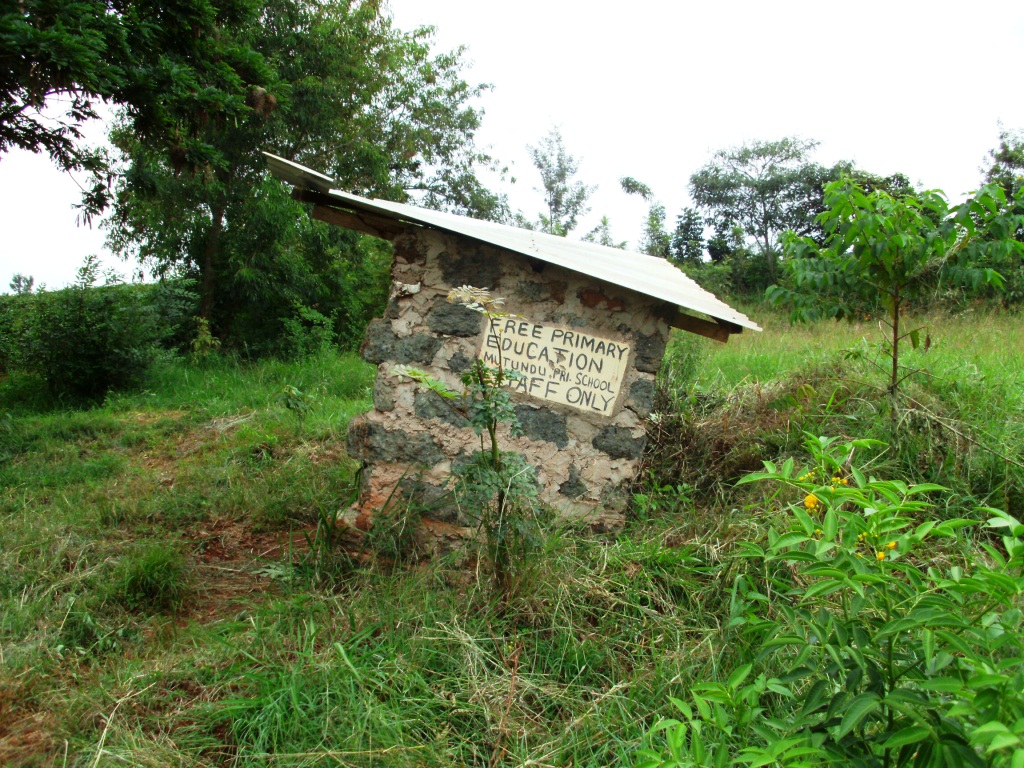
The Mutunda Primary School has about 300 pupils and ten teachers.  There are six stances in two toilet buildings to serve the students. The latrine for teachers  had long ago collapsed and was unusable.  The student latrines were in disrepair.  There was no access to water for hand washing.

The toilets that were used by the teachers have collapsed and can not be used. Want to teach here?

Dan sent photos. I have seen other latrines like this in Africa and remember the smell. Just looking at the photos almost made me gag.

The girls’ toilet. No further explanation necessary.

How on earth can you teach young people the health advantages of using clean sanitation facilities and hand-washing when the school toilets look like this?

The school has requested $5000 to build new toilets – ventilated drop toilets that are 30 feet deep. There will be 8 stances for the boys, 8 for the girls and two for the teachers (about $250 for each unit).  They will also install some rainwater catchment gutters on the school building to help promote hand-washing.  Hand-washing has been demonstrated to be as effective as clean drinking water to reduce disease from fecal contamination.

The CanAssist board has yet to review this proposal but I can’t imagine that we will not approve of this project.  How can we refuse? This is not only a matter of sanitation and health but also one of simple dignity.

Something new

Not sure if this is the place where I welcome you to my blog or you welcome me to the Blogosphere.   Maybe we should do both.

I have returned this week from a very stimulating and helpful conference called MyCharityConnects in Toronto. I went there to get ideas about how to reach out to people about the charity that has consumed me for the past couple of years – The CanAssist African Relief Trust.   I came away with the instruction to “get the story out there” by blogging and Facebook and Twitter so I am going to jump right in.

I have lots of stories. And know lots of very interesting people in Africa.  I hope that by sharing them with you on this blog, I can excite you, too, in some way about global issues, reducing poverty in the third world and just being a global citizen.

I am very proud to be Canadian. But in the past several years I have worked in post-war Bosnia and Herzegovina and made over a dozen trips to Africa and I have developed close ties with a family in Italy. I have families in all of these places that have made me feel like I am part of them. I have been given nicknames and pet names in several languages – Oseuri, Otim, John Ole Moiko, Amooti.  My family here in Canada all refer to me as Dedo – Bosnian for Grandpa.  So, although I am Canadian to the core, I feel very globally connected.  I care about all these people who have shown me love and respect and connection that is hard to describe…and in MasterCard terms, Priceless.

Since starting to work in Bosnia in 1998, I have published over 80 articles in the Kingston Whig Standard about my experiences. Perhaps I will uncover some of those to share in this blog as well.

I hope I can make it interesting. I hope I can entertain, educate and enthuse you.  I hope that you will give me feedback and that we can chat about issues and stories for which we share some common ground.

And what I have learned from my travel is that we all share a lot of common ground. This world.