A letter from Africa

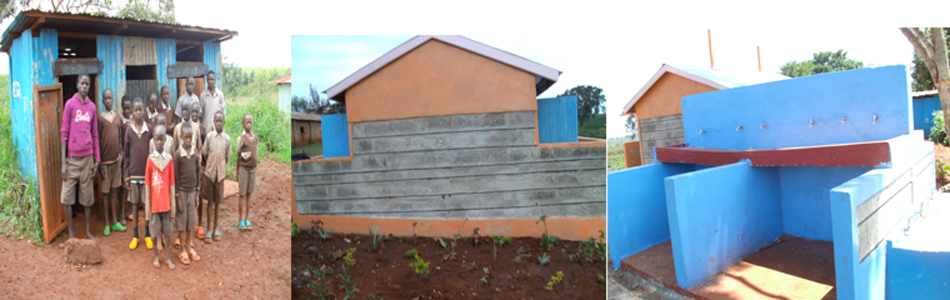
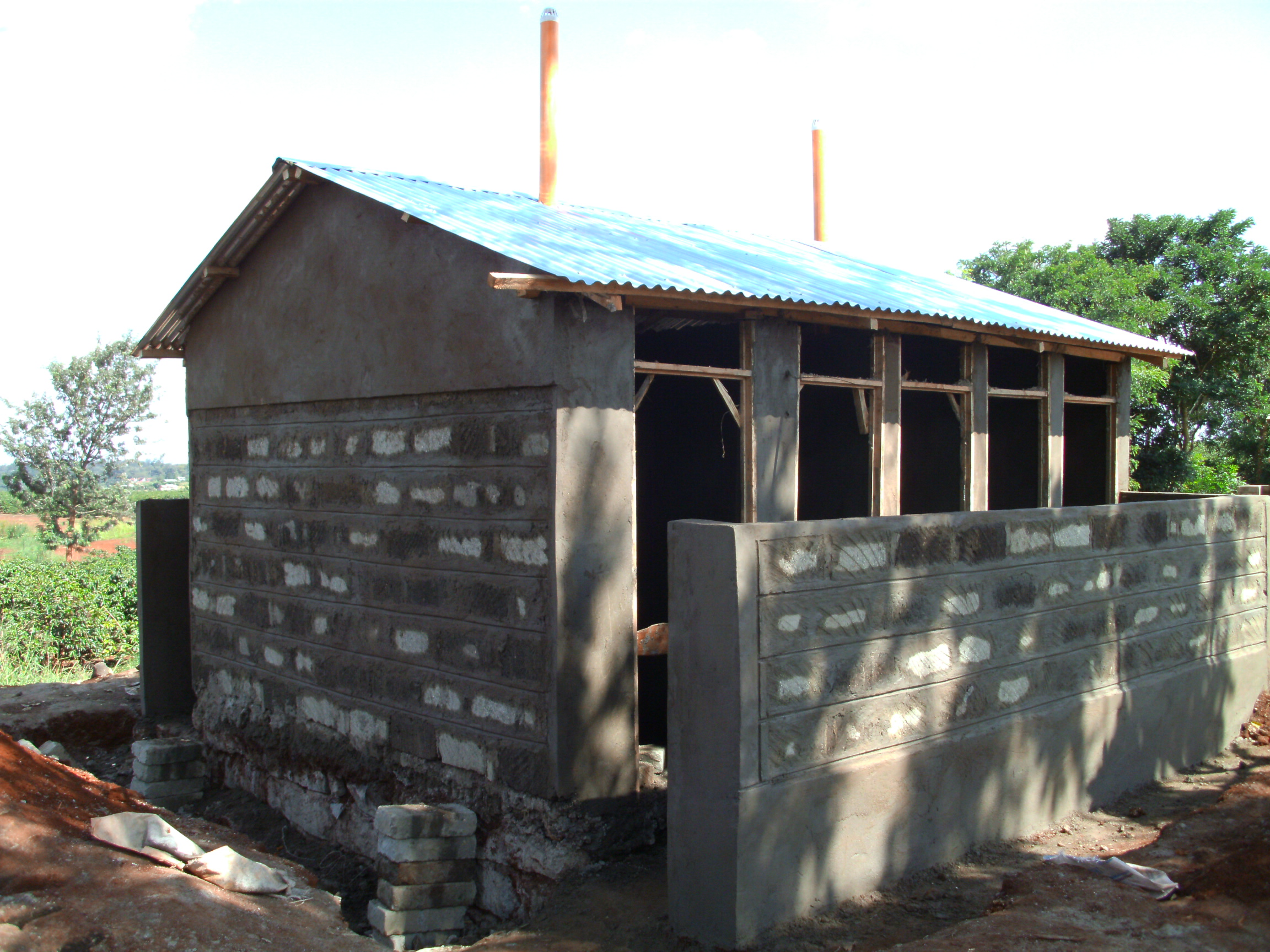
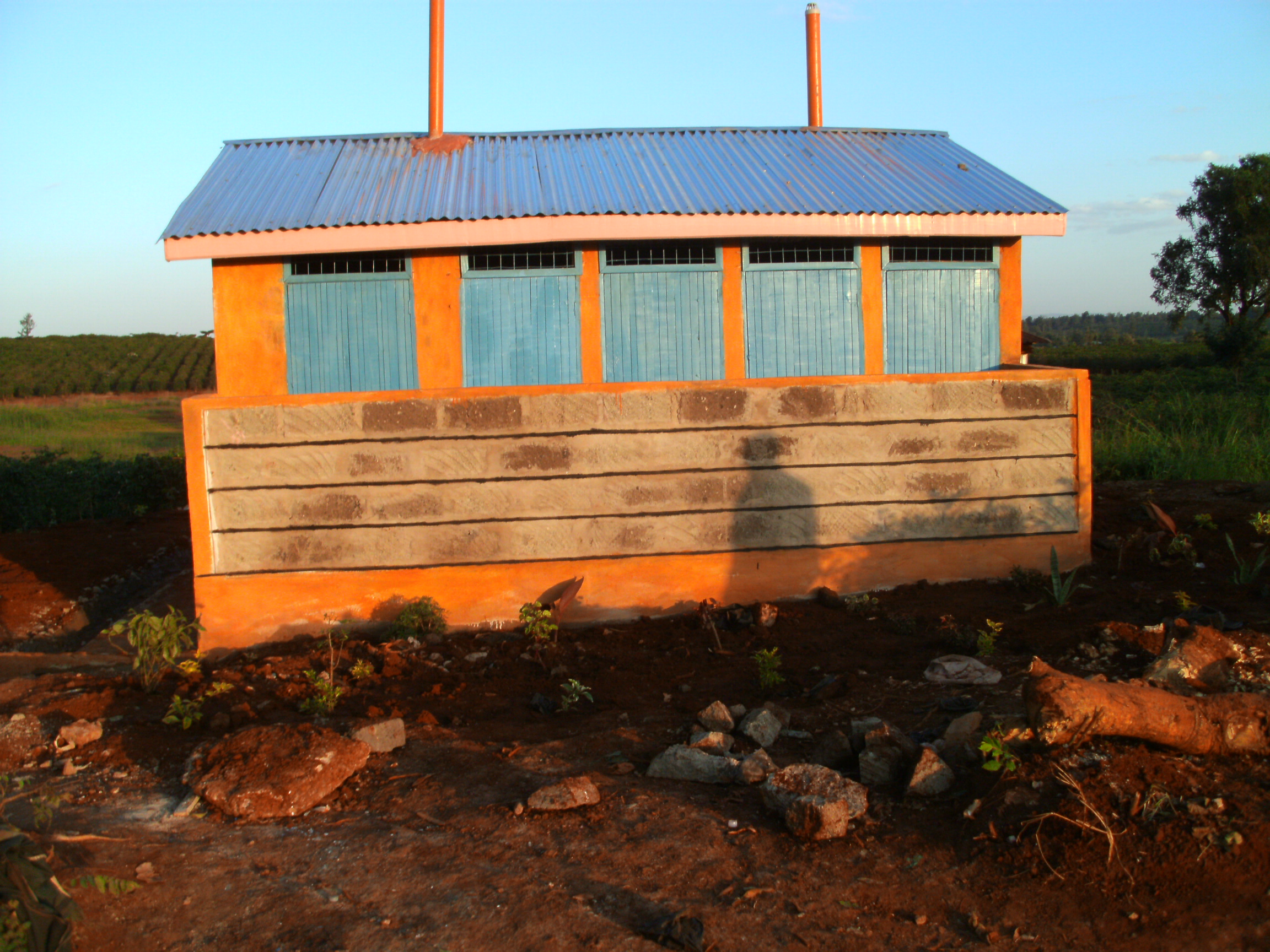
One of the three completed latrines that will dramatically improve sanitation for students at the Mutundu School in Kenya – funded by CanAssist African Relief Trust

I am happy to share this letter of appreciation from Michael Gichia who has been the African contact with the Murera Community Empowerment group and the Mutundu School where the CanAssist African Relief Trust has funded construction of new latrines and provision of clean water.

See these earlier posts for background on this project.

Sanitation…or lack of it
Sanitation..making progress
Not just new latrines

Dear John,
I hope you are doing fine as we are here in Kenya. I would like to let you know that we have completed the proposed project successfully and I’m taking this opportunity on behalf of MCESO to thank all the trustees, board members, staff and the friends of Can Assist African Relief Trust for their generosity in support of our project titled, provision of clean portable drinking water and construction of enhanced sanitation facilities in Mutundu primary school in Ruiru District 0f Kenya. Your financial commitment has incredibly helped and has allowed us to reach our goal. We would like to let you know that your financial inputs towards our proposed project have greatly helped the project turn into a successful and replicable model and the situation at Mutundu pry school has improved from worst to best.

We pray that may God keep continue giving you good health as well as good will to keep on helping marginalized communities.Please find attached our end project for your files.Too, we have kept all the project invoices safe.We look forward to submitting another project proposal to Can Assist African Relief Trust soon.

Thank you once more and God bless.
Sincerely,
Michael.

Read Michael’s full report on this project here.

Mutundu school latrines

Before and after photos of the boys latrines at Mutundu School. In addition to the latrines, sanitation has been improved by the construction of handwashing stations. CanAssist has been delighted to have funded these sanitation improvements.

Now look what you have done!

On July 1, I issued an appeal/challenge on behalf of the CanAssist African Relief Trust to raise money to build two classrooms at the Hope School in Mbita, Kenya on the shores of Lake Victoria.

The Vancouver-based Sasamat Foundation had offered $10,000 and up to another $5000 to match 2:1 donations that were received from CanAssist supporters to build the school.

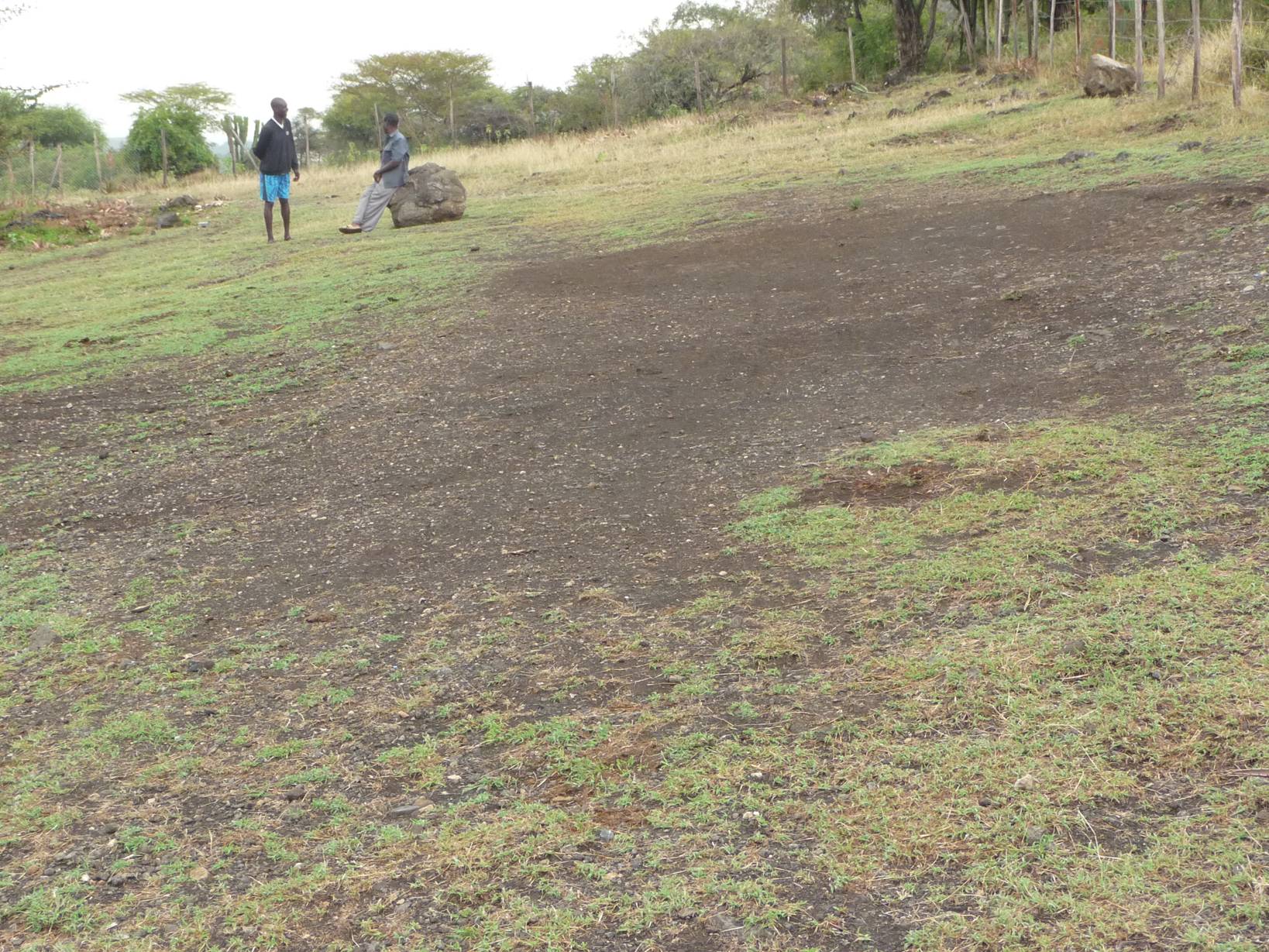
This is the schoolyard of Hope School in mid August 2012. The site of proposed CanAssist classrooms.

By the end of July we had reached our goal and in late August the money to start construction was sent to the Hope School.

The CanAssist Hope School Classrooms are coming along in leaps and bounds. I could not believe my eyes when I received photos today of the construction under way. The barren piece of ground in the schoolyard is quickly being converted into a learning setting for the children of this community who have previously been taught in a rudimentary building or under a tree. Most of the children in this neighbourhood are disadvantaged and some have simply not been able to attend school even up to age 9 or 10.

The CanAssist Hope School Classrooms are coming along in leaps and bounds.

This project will transform the community for these kids. And as I have mentioned previously, this not only provides the classrooms for the children, it gives some employment to local workmen who struggle to find employment.

Thanks to everyone who rose to the challenge. I hope you are gratified with the way that your gift to these children is working so quickly. I look forward to visiting this school in early February and participating in a Grand Opening celebration.

Read earlier blog posts about this project here:
A Canada Day Challenge
Canada Day Challenge Met.

My thanks, as well, to Kennedy Onyango for the photos and for the ongoing responsible supervision of this project.

Where were you when….

Neil Armstrong, first man to plant a foot on the surface of the moon, died today. I got to thinking about where I was on July 20, 1969 when that event was taking place. In many ways it was the equivalent of Christopher Columbus landing in North America. An historical voyage of exploration.

That afternoon I was at a family gathering that was honouring my upcoming marriage three weeks later. I had been Best Man at the wedding of friends the day before. We were all 21 years old. So young when I think about it now. But unmarried young couples didn’t openly live together back in the sixties. If you wanted to live together and be socially accepted you were obliged to get married. Not that there is anything wrong with that.

It was a summery afternoon and we were all sitting on webbed lawn chairs in the back yard of my future wife’s Aunt Una, drinking beer and preparing a barbecue. We shared with the rest of the world as Neil Armstrong gave his “One small step for man“** sentence and later that night marvelled as we looked up at the moon and thought that there was indeed a man up there.

One of the other powerful things about that event was that it was broadcast live on television. Bear in mind this is long before the days of the Internet and even home computers. Transmission of a live TV signal from the moon so everyone could watch this historic happening was remarkable in itself.

I wrote last week about “turning” 65. Part of my reflections around that birthday were also centred on all the things that had happened in my 65 years – the first step on the moon being one of them.

What were some of the others and where was I when they happened?
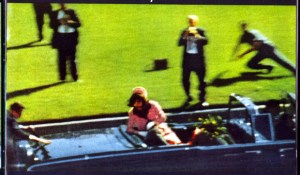
November 22, 1963. That afternoon as I sat in the row next to the inner wall in the upstairs classroom of my high school, Jackie Kennedy was leaning over her assassinated husband in the back seat of a limo in Dallas.

I remember exactly where I was sitting in Miss Allison’s French class at London Central Collegiate Institute when news came over the intercom that President John F. Kennedy had been fatally shot. I remember walking home from school in a daze and spending the weekend in front of my grandparent’s TV as the rest of the weekend happened, including seeing Jack Ruby emerge from the crowd shoot Lee Harvey Oswald as he was being transferred somewhere.

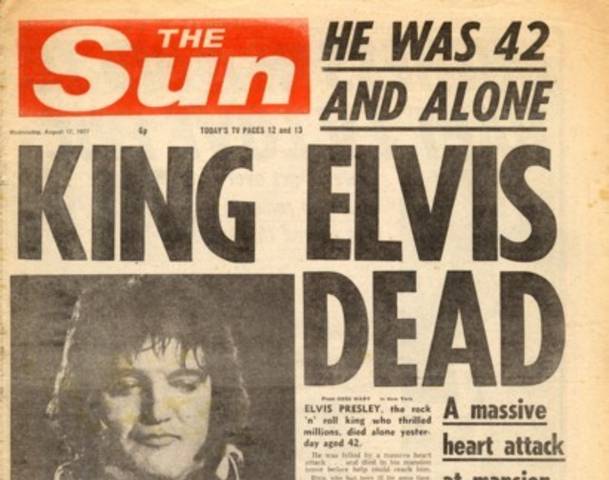
I remember where I was when I learned that Elvis Presley had died. It was the day before my 30th birthday. I was feeling like part of my past had disappeared and I remember sharing that thought with a young woman who was in the hospital with metastatic breast cancer. “He was so young“, she said. She was less than 40 with three kids and was dead within the month.

Even earlier I remember the day that Marilyn Monroe was found dead. I know it was a Sunday. I was a teenager then, spending the summer at Bluewater Beach near Goderich, Ontario. A friend and I had a job peeling potatoes for french fries in a local restaurant (that is a story in itself) and the news happened to come on the restaurant radio as the owner of the restaurant scraped fat off the big iron grill to make fried eggs for the patrons…and for him and his wife who sat in the back booth smoking and eating between customers.

It is intriguing to me that many of the triggers for these very distinct memories are around the deaths – Elvis, Princess Diana, JFK, Martin Luther King, the Challenger Astronauts, 9-11. They all call forth distinct pictures of where I was exactly when I heard the news. Perhaps the passing of someone famous triggers a landslide of thoughts and reflections that are all bound up in one moment of information. Death events mark a finite irreversible transition point in history.

In contrast, the Moon Landing was one of celebration and achievement. And to be a witness to it with the rest of the world was pretty special.

My experience of the inauguration of Barack Obama was also influenced by memories of race riots in the U.S., Martin Luther King and segregated drinking fountains.

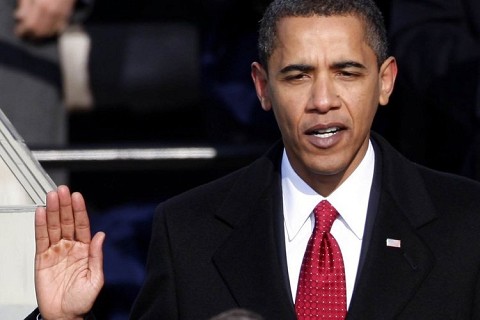
More recently, I shared watching the inauguration of Barack Obama with a bunch of students all gathered around a television in Nairobi, Kenya. It was a very special way to experience that historical event given that Obama’s family hailed from Kenya. Downtown in Nairobi the students at the University gathered to watch. They all stood up when the Oath of Office was administered in Washington. Respectful and touching. I did wonder, however, if my take on the first African-American President of the U.S.A. being sworn into office was different from the young students with whom I watched it. I remembered apartheid and segregated washrooms in the U.S. and Martin Luther King as well.

Do you have some moments that had so much impact that you remember exactly where you were and what you were doing when they happened? Want to share them with me? Enter your significant historical moments in a comment, I’d love to hear about them.

**Apparently Neil Armstrong was supposed to say “One small step for a man” but he left the “a” out when he made his step off the ladder onto the moon surface. Imagine the excitement for him of that moment.

Not just new latrines

I’m delighted to have received further updates about the sanitation improvements that CanAssist is funding at the Mutundu Primary School in Kenya.

Toilet for girls at the Mutundu School – Spring 2012

I first wrote about this in a blog article in June (Sanitation – or lack of it) and subsequently updated it last month (Sanitation – Making progress) As you can see from the photos, the state of the toilets for staff and students at the school when our Kenyan assistant, Dan Otieno, assessed them was nothing short of disgusting.

Last week I received more pictures of the new latrines at the Mutundu School I would like to share along with some hidden advantages to the community from the kind of development work we are doing through the CanAssist African Relief Trust.

New CanAssist-funded girls toilet at Mutundu School. August 2012

I have come to realize that often the stimulus to a community provided by the funding of an infrastructure project such as this one has other less obvious benefits. The materials for construction are all locally purchased and the skilled (and unskilled) labourers to construct the projects are local tradesmen, often without much work. So we are not only providing the structure or item that will be part of the community and improve well-being there, we are also giving some employment to the locals, albeit temporary.

CanAssist recently sent money to another school in Uganda – Hope for Youth School near Mukono – to purchase 70 desks and chairs for the school. The cost comes to just over $5000 to do this. The bonus is that the desks and chairs will all be made locally by carpenters who will therefore benefit as well. This is a Win-Win situation. The school gets the needed furnishings and the local carpenters (and suppliers) benefit from the business.

It makes me happy to see this work at the Mutundu school progressing, knowing that the sanitation (and thereby health) conditions at the school will be greatly improved. I am also glad that the community are having some opportunity to participate in the construction and even earn a bit of money as they contribute to achieving these goals.

When money for infrastructure projects like the latrines at Mutundu School becomes available, it creates lots of interest in the community, a sense of ownership of the project and employment for tradesmen in the region.

A letter from Ivan – Kyabazaala, Uganda

My daughter recently pointed out to me that I was fortunate to be the recipient of most of the feedback from the communities in East Africa that we help through the CanAssist African Relief Trust. She’s right. How can I share that with other supporters of CanAssist?

I do consider myself lucky to have been able to visit the schools, clinics and communities that have been supported, in one way or another, by the CanAssist African Relief Trust…or rather by the donors who give to CanAssist to keep our activities afloat. One of the appeals to our donors is that we pay no Canadian salaries, travel at our own expense and therefore every donated dollar is spent by Africans in East Africa. The cost to us as volunteer travellers, however, is repaid ten times over in the wonderful experience of interacting with our friends in Africa.

Recently a group of Canadians who are supporters of CanAssist visited the B.L.K. Muwonge Secondary School in a remote, small Ugandan town called Kyabazaala. One of the students at the school sent back a letter of thanks to CanAssist supporters. I thought it only appropriate that I share this. I hope you find it as motivating as I do to keep doing what we are working toward to help communities in Kenya, Uganda and Tanzania with their infrastructure needs.

Students at the B.L.K. Muwonge Secondary School in Kyabazaala, Uganda write exams in a building that was constructed with funding from the CanAssist African Relief Trust.

(I don’t know if Ivan’s letter will reproduce well in the blog so I have also uploaded a pdf file of the letter here.)

Canada Day challenge met!

A huge THANK YOU is in order for everyone who responded to the Canada Day Challenge I wrote about in this blog on July 1. Through your generous donations and a bonus from the Sasamat Foundation in British Columbia, CanAssist has secured the money to build the two needed classrooms at Hope School in Mbita Kenya. Everyone is delighted. I will be sure to provide updates as the school classrooms rise from the dust.

Kennedy Onyango is our contact and the founder of the Hope School. I first encountered him in July 2010. He exemplifies the typical story of relatively ordinary Africans (but motivated ones) who see a need in their community and they dedicate their personal resources and time to finding ways to improve the plight of the people who live around them.

In Kennedy’s case this was to help vulnerable young children in his region – kids who lived in poverty or were orphaned – get a start at being educated. He founded a “school” which is divided into two locations. One is in two crammed classrooms behind a bank in the town of Mbita and another on a larger property in the hills beyond the town. There are 160 kids who come to these makeshift classrooms.

In addition to giving them education, the school also provides a mid-day meal for the children. Sometimes this is the only food that they get for the day.

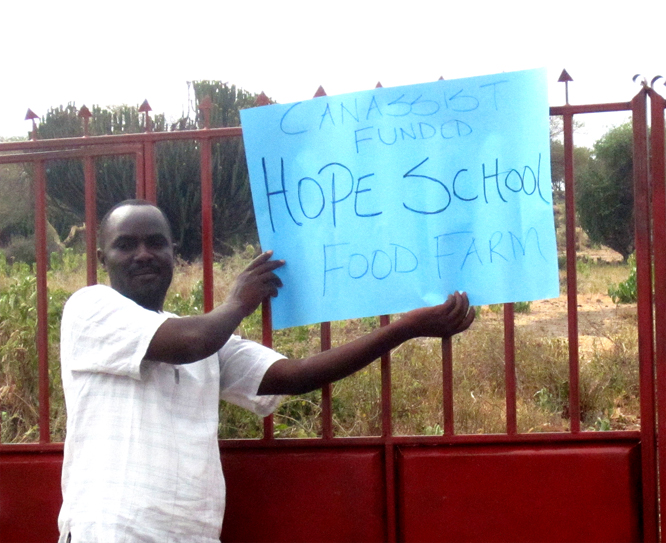
Kennedy Onango holds up a sign that marks the beginning of the CanAssist Oasis of Hope Garden for the Hope School at Mbita Kenya

Kennedy first asked CanAssist to help develop a small farm where they could raise vegetables and fruits to supplement the otherwise bland gruel diet provided to the kids. In early 2012, CanAssist gave the money to start this up and very soon Kennedy had created what he calls the “Oasis of Hope” on the rurual school property.

In mid July, I got this report from Kennedy. It surpassed my expectations for success in the early months of developing this garden. Kennedy writes:

This month in CanAssist funded ‘Oasis of Hope Garden’, we take a deeper look at this farm, which is celebrating its first harvest. In a single 3 month production cycle, 480 kilograms of sourghum, 120 kgs of beans have been harvested so far from a 2 acre ploughed open farm. The same 3-month production cycle is also projected to yield a 120 kilogram of maize (corn). This has clearly reinforced our earlier thought of making the garden both food granary and source of funds to support key school operations. It’s true, a good income can be realized from the selling of sourghum.
Why is this important? 140+ children at Hope School have never had an opportunity to drink nutritious porridge from the initially barren school farm yard. Rural peasant families of Mbita don’t have the money to take a chance on unproven technologies. Demonstration farms like the CanAssist funded ‘Oasis of Hope Garden’ give families a firsthand look at the income increases they can achieve with an investment in appropriate technologies for improved on-farm yields
You can see how CanAssist’s approach of working with poor, marginalized rural communities of East Africa transforms lives on our first ever bumper harvest in this school farm.
We remain appreciative for CanAssist supporters and with special thanks to Sasamat Foundation for having donated funds towards classrooms construction at Hope School, besides nutritious meals, the children will now get conducive learning environment!”

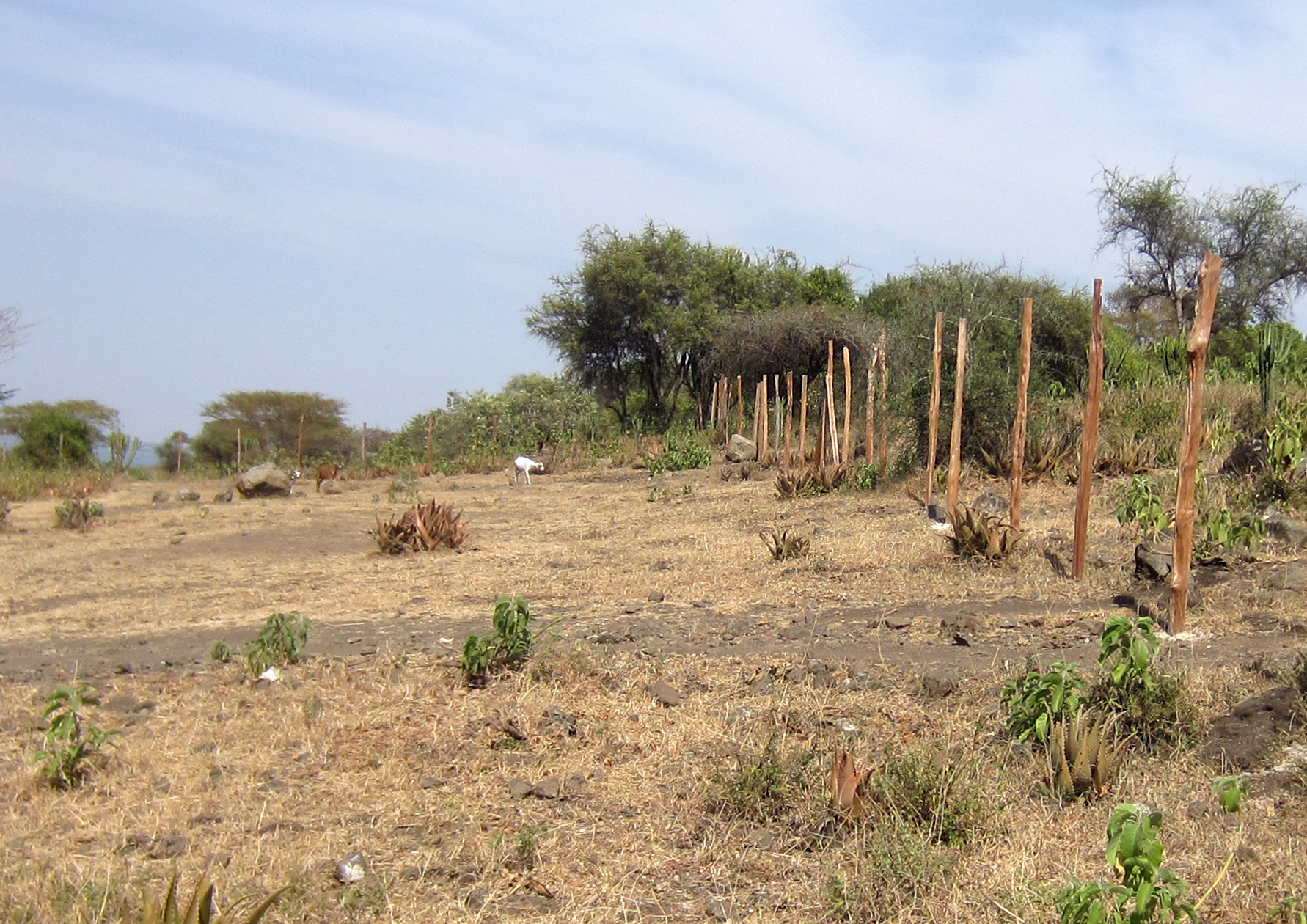
The first step in creating a garden was to fence the property to keep protect the garden from wandering neighbourhood goats. This dry corner is the same place where the banner picture of maize plants was taken three months later.

I hope that this enthusiastic endorsement of the work that we are doing through CanAssist makes our donors smile with satisfaction. With the support of Canadian donors, Kennedy and others in his community have been able to take a barren piece of land and turn it into a veritable Oasis of Hope for the children at Hope School and those who live around it. We are making a difference to individuals and communities in East Africa. Asante sana for your help in achieving this.

The story of Jerry O.

(Published in the Kingston Whig Standard – July 18, 2012.)
My friends told me that I needed an updated photo for my Facebook page. I have been a somewhat reluctant Facebook user but I recently attended a conference for charities on behalf of the CanAssist African Relief Trust and the message was that “conversation and collaboration” are now the keys to successful charities and fundraising. And Facebook, with over eighteen million users in Canada … half our population … is the way to communicate in 2012.

So I opened up my previously fairly clandestine Facebook account to the world, started a blog and I am going to give it a good try in the next few months.

I had been using a photo of the Rift Valley as my profile picture. “Not good enough,” was the response. “It has to be a photo of you. People will communicate with you because of common interests so they have to see who you are.”

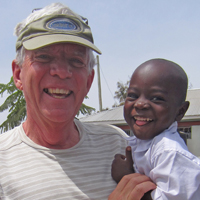
I compromised. I found a picture that was taken last winter when I was in Kenya of me and an African child. I have always liked the photo. But I knew little about the child.

It was taken at a very small school in Mbita Kenya, one where we were working to start a school farm. There were kids everywhere. Playing and running and singing. Many were curious about this “mzungu” who was standing in their midst with a camera. One little fellow was particularly eager to be near me. He followed me around for a few minutes, sometimes holding on to my pant-leg or “petting” my hairy arms. (African men usually have little or no hair on their arms so my furry forearms are a novelty that many African children cannot resist. “You are like a lion,” one kid told me a couple of years ago.)

I was drawn to this little fellow’s smile and after a few minutes I picked him up and carried him around as I greeted the other children. He beamed. I gave my camera to one of the teachers to take our picture. You can see joy on both our faces. We became friends quickly and were relishing the new-found bond between us.

This photo has become a symbol to me, representing the happy association that I cherish between me and African people, particularly the children.

So I put it up on my page. I immediately had comments and “likes” for the photo. It seemed a good choice.

Later that morning I happened to be chatting with the Director of the School in Kenya using Skype. I asked if he could identify the child.

His name is Jerry Otieno,” I was told. “Fantastic,” I thought. Jerry sounds like such an active, outgoing name and suits the smile that I remember. And Otieno is a very common Luo man’s name meaning “born at night”. I have dear friends with that name in Kenya. It seemed perfect.

What a sad case,” continued Kennedy.

This poor little fellow was brought to our school by a teenage caregiver. He had no money for school fees or food. He is about 4 years old. His mother worked for another woman in town as a housekeeper. She got pregnant and there was no father in the picture. Last year she became ill and was taken to a hospital in a neighboring town. She died there. Her body rots in the mortuary of the hospital, unclaimed. Jerry is being looked after by the woman for whom the mother worked but she has children of her own and cannot afford his care.

We have taken him into Hope School and support his education. He gets one meal a day here. He loves school, walking to school himself most mornings.

I was startled by this story. I had picked this photo because I thought it was upbeat and the child in it the epitome of a happy African kid. I have seen lots of heart-tugging photos of emaciated children covered with flies used by charities to promote their cause. I don’t want to use those images to portray African children because even though their stories would break your heart, most of them look like little Jerry. They are smiling and cuddly and loving and resilient.

The Hope School is one that CanAssist supports. The school has about 150 students ranging in age from about 4 to 12. Most of them are categorized as “OVC’s” (Orphans and Vulnerable Children). The teachers work at the school for little remuneration and the school struggles to provide both education and one meal of porridge a day to these kids. CanAssist has helped the school by providing funds to start a school garden that will both provide better nourishment to the students and perhaps a bit of extra income for the school to help with expenses. Children who can afford it, pay about $8 a month as a school fee. But at least 30% cannot afford even that and are included with no fee.

Jerry’s story shook me but it is not that different from many others I have heard. I still think about little Rose, the Ugandan waif that got me started with this business of trying to help out in Africa. Now Jerry has added motivation to my work through CanAssist and I will leave his picture with mine on my Facebook page to remind me — and my Facebook friends— of the happiness that can come from helping where you can and the joy that just caring brings to others.

Looking back at 1966

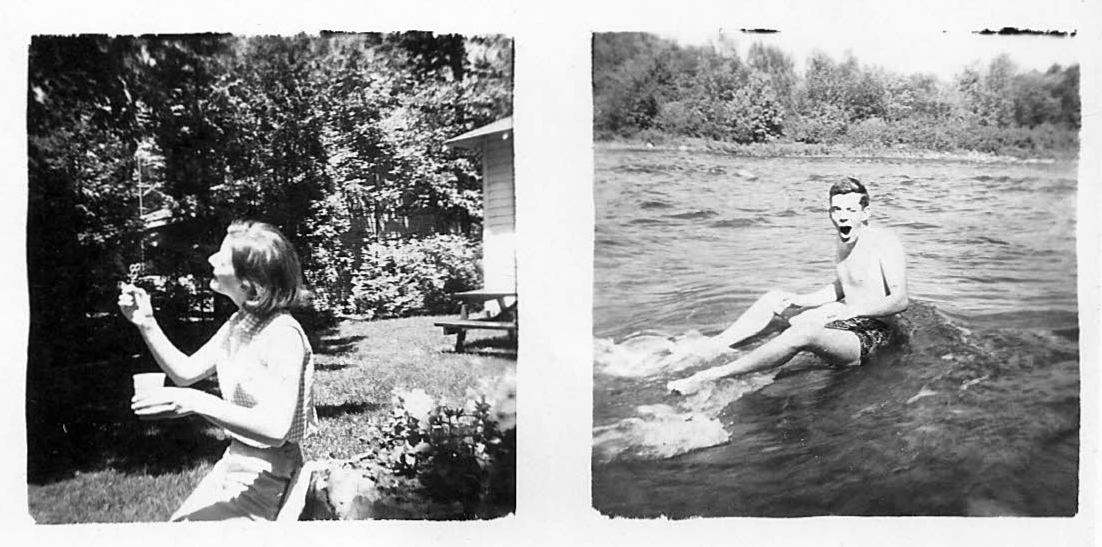
This week I had a friend, Lorna Harris, send me photos that were taken in June 1966 at my family’s cottage near Goderich, Ontario. She found them tucked between the pages of an old book she was preparing for a garage sale this week. We were both 18 at the time and had just completed first year at UWO. While hippies were smoking dope and drinking coffee in the Yorkville District of Toronto, here I was, a skinny teenager, shivering in the river; she, a coy young woman blowing bubbles on the lawn.

Looking at these photos, I wondered what else was happening in 1966? Not that the bubbles and the rapids weren’t enough to keep me intrigued.

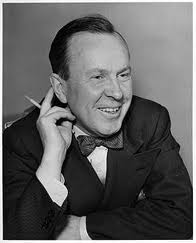
Prime Minister of Canada in 1966.

Lester B. Pearson was the Prime Minister of Canada and Lyndon B. Johnston was President of the United States – a good year to have the middle name “B.”. We gradually went downhill to “W.” as a middle name over the next 40 years.

Obviously in 1966, smoking was thought to make you look “with it”.

The Montreal Canadians beat the Detroit Red Wings in overtime on April 29 win the Stanley Cup – the best of six NHL teams. Gump Worsley and Jean Belliveau were on the team. No helmets, no goalie masks. Now, with 30 teams in the league and a season that stretches to June it is less hockey and more big business.

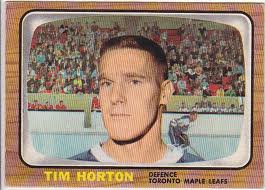
Before the donutsThe Toronto Maple Leafs had Johnny Bower, Frank Mahovolich and Tim Horton. They won the Stanley cup in 1967 but have not come up drinking champagne since. Tim Horton was still known for hockey, not donuts. Imagine a Canada with no Timbits or line-ups for double doubles. Hockey player Horton had one store in Hamilton in 1966. Today there are over 4000 Tim Horton’s Donut shops in Canada.

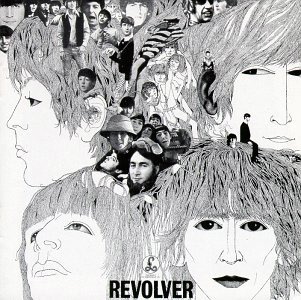
Revolver Album cover

Album Cover for the Beatles “Revolver” album

The Beatles released the Revolver Album (Eleanor Rigby, Yellow Submarine) in August of 1966. Other musical hits that year included “Monday Monday” by the Mamas and the Papas, “Strangers in the Night” by Frank Sinatra and “You Keep Me Hangin’ On” by the Supremes. Simon and Garfunkel released their “Sounds of Silence” album in 1966. They were little-enough known that I saw them perform at a free concert at UWO that fall.

The average cost of a house was $14,200 ( I bought my first house in 1971 for $17,500) and gasoline cost 32 cents a gallon. (Gallon not Litre).

The War in Viet Nam was going strong but protests against the war were escalating.

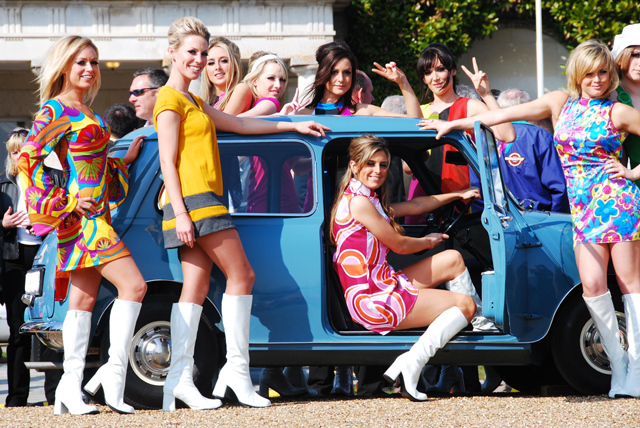
The Mini Skirt was a popular “fashion” trend for women. For men it was the paisley shirt. I had one. Black with red and yellow paisleys on it.

The first episode of Star Trek aired on television. And the first broadcast in Canada in colour was made by the CBC. I remember the first colour TV I saw – a big monstrosity in a cabinet with colour that was anything but subtle. But then I also remember my grandparents first Admiral TV in the mid ’50’s. We would sit and watch the test pattern – the one with the Indian on it – waiting for Howdy Doody to come on.

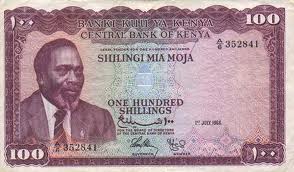
And what was happening in Africa in 1966? The Republic of Kenya was less than two years old, having achieved independence in December 1964. Jomo Kenyatta was the president. The Kenyan, Ugandan and Tanzanian Shillings were introduced as the currency for those countries. Botswana achieved independence in 1966.

Now the cool thing about all this is that the Supremes are long gone, Lester B. Pearson and Jomo Kenyatta are historical figures, the war in Viet Nam is over (but has been replaced by a similar one in Iraq and Afghanistan), the Leafs…well, we won’t go there. But Lorna and I, 46 years later, are still friends. We live in different parts of Ontario but we correspond regularly by email to share ideas and memories and we meet periodically for a catch up dinner. We still learn from each other – she has recently introduced me to the em-dash. Our friendship seems to be like the Eveready bunny – it just keeps going; and that makes me feel very fortunate.

And what did Lorna think about when she found those photos….check it out on her blog “Forever Blowing Bubbles” here.