Kingston, Canada based family physician, photographer, grandfather, thespian and philanthropist. Founding Trustee of the CanAssist African Relief Trust. Development work in Bosnia and Herzegovina and East Africa.
My penchant for finding my ancestors has become a bit of an obsession. Not sure why. And I don’t have to go all the way to Scotland to chase up some reminiscences.
Last weekend I was in Toronto and staying at a hotel near the Annex district. For some reason I remembered that my grandfather, Joseph Alison Vardon, his parents and his sisters, had lived somewhere in that area when he was younger.
I happened to have found a copy of my grandfather’s record of recruitment when he was drafted into the army just shortly after his 20th birthday, on October 16, 1917, exactly 100 years ago. From this document, I discovered that his address then was 188 Delaware Ave in Toronto, about a ten minute walk from where I was staying.
My grandfather lived in this house when he was conscripted into military service in 1917.
So, on Sunday morning, I wandered down to this neighbourhood, found the house (upgraded but still the original three story house) and stood outside it wondering if my grandfather’s bedroom was in the dormer on the top floor and how many times he might have walked down that street as a teenager. I went down to the corner of Bloor and Delaware and sat for half an hour on a cement bench by the street, conjuring up images of streetcars going by on Bloor, old model cars, people on bicycles.
I looked across the street at an old building that is now called the Black Horse Restaurant and Bar and knew that building (built in 1892) was there when my grandfather lived in the neighbourhood. The building has a horse’s head sculpture coming out of the second floor. It was originally built as a store. Did he ever go in there? How many times did he look at that horse’s head?
I thought about my grandfather signing up to go to war in Europe. A boy, heading off to battle. I wished that I had taken the time or the interest when I was younger to ask him about those experiences.
As I sat there, thinking about my grandfather, I wondered if my own grandchildren would, some day, 50 years from now, sit on a bench somewhere and remember me in a similarly curious and fond way. I hope so.
This was my grandfather, Joseph Vardon – exactly 100 years ago – aged 20 – going off to WW I.
Maybe it is because I am getting closer to being an historic figure myself that I have become very interested in my ancestral background. In September, I traveled to Scotland, a trip that was, in part, inspired by the option of exploring parts of the country where my forefathers once lived and roamed.
My trip started in Edinburg where my first stop, after an overnight flight from Toronto, was at St Giles Cathedral.
I revisited the place where Jenny Geddes (not my niece, the other one) threw a stool (a wooden one, not the other kind) at the Pastor who was attempting to read from the Common Book of Prayer that was being introduced (forcefully) on the Scottish Church by Charles I at St Giles in July, 1637.
Legend (Or “constant oral tradition” as the plaque says) affirms that Jenny Geddes, a local market woman, picked up a wooden three-legged stool and threw it at the vicar, yelling something like ““Devil cause you colic in your stomach, false thief: dare you say the Mass in my ear? This started a riot, causing the minister to have to flee for his safety and this event is reported to have been the beginning of events that led to expulsion of the Anglican bishops and archbishops, establishment of the Presbyterian Church of Scotland and further conflict in the Bishop’s Wars and Wars of Three Kingdoms (England, Ireland and Scotland) from 1639-1651.
Friendly guide, Kevin at St Giles.
I talked at length with two of the guides in St Giles. Maybe Jenny Geddes never really existed. Maybe she did and was a set-up. Maybe she was a man in woman’s clothing ready to start a riot. Maybe she really was Janet Geddes. Regardless, this July day in St Giles was historic for both the church and the country and today there is a small (modern) monument in the church where the event was said to take place and a brass plaque marking the occasion. Much of the church is still the original 1400’s pillars and bricks. Kevin pointed out a lot of the architectural details to me and was very friendly and informative.
I have no indication that this Jenny Geddes was any relation to me although she likely came from the Geddes clan that originated in the North of Scotland. I can trace my own tree back to a Charles Geddes who was born in 1520 and lived in Edinburgh. My ninth great grandfather, George Geddes was born on May 17, 1603 in Leith, a “suburb” of old Edinburgh, not far from Holyrood Castle and lived in Edinburgh when the infamous Jenny G. caused the commotion.
So this is a story that links me to Scottish Geddes history (loosely) and whether it is true or not, it is fun to hear it told. Patrick Geddes was also an interesting and well-respected biologist, philanthropist and town planner from the late 19th century who is commemorated in several plaques and small streets throughout Edinburgh. (also no relation except for the shared original Geddes lineage). The Geddes coat of arms has three fish on it and the name may be derived from the word “gedd” which means pike. Or, my friend Judith Adam might be pleased to know that it could actually be a derivative of MacAdam (the letter G sometimes representing Mac in Gaelic and “eddie” being a substitute for Adam)
So I have started my exploration with some name dropping (I could have also mentioned actress Barbara Bel Geddes or Australian photographer, Anne Geddes ). This is all the Geddes name exploring I did on this trip but I will be back for sure to dig deeper into that history. In the meantime I did a lot of travel around the Borders and will document that in subsequent posts about the Riddell’s and the Turnbull’s and the Crinklaw’s.
Here is a little video of my time wandering about St Giles Cathedral.
Have I said how much I love living in Downtown Kingston? All these photos were taken within a 5 minute walk of where I live!
This weekend had perfect end-of-summer weather and the downtown was full of activity ranging from Bollywood to jets to skydivers to a wonderful multicultural arts festival.
Here’s a five minute taste of how the weekend unfolded. Never a dull moment…or a quiet one.
Whenever I visit my friends in San Michele, Italy, Gloria makes me this pasta dish and I love it. Adis Pasalic and I used to get a similar version of it at a restaurant in Zenica, Bosnia. Today I saw the new potatoes and green beans at the market and decided to indulge.
This is not really a recipe, but an ad hoc version of how to make Pasta Genovese that is close to what Gloria taught me. It is delicious and very easy.
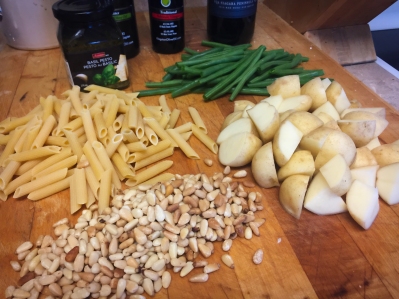
Ingredients: (I dont measure, use what you think you need)
Potatoes (sliced in 1 inch cubes or thereabouts)
Green Beans
Pasta ( Tagliatele is the traditional pasta for this dish but I usually use penne)
Pesto (you can make your own or buy a jar)
Pine nuts, lightly toasted
Method:
Put a big pot of water with some salt in it on the stove to get boiling. While the water is coming to a boil you can cut up the potatoes into cubes, prepare the beans, and lightly roast the pine nuts under the broiler (watch them).
Throw (gently) the potatoes into the boiling water and boil for about 5 minutes. Add the pasta and boil for about 9 minutes. Add the beans (I cut them up into one inch pieces with a scissors into the water). Boil for another 2-3 minutes or until the potatoes are cooked and the pasta is al dente.
Drain. Add the pesto and pine nuts and mix. Add salt to taste.
Sprinkle with some good quality Parmesan cheese.
This is so easy and tastes so good!
ADDENDUM: I had this with a glass of OPEN Cab2-Merlot VQA wine from the Niagara Peninsula. Generally I don’t like Ontario Red wines but this one is really good and has drawn me from California Cabs. $12.95 at the LCBO or Wine Rack (where you can get a case at $10.95 a bottle!)
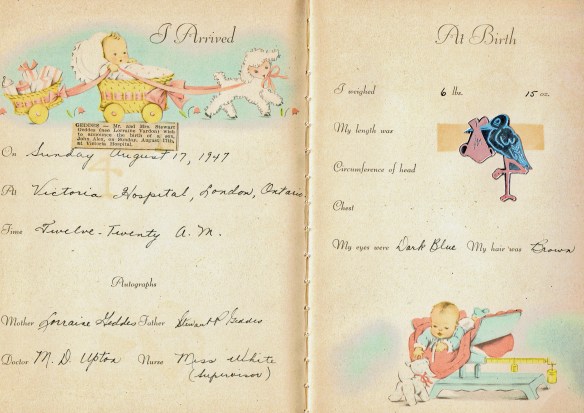
Last week I found my hospital birth certificate from August 17, 1947 complete with a little foot print and thumb print. ( Don’t worry, privacy freaks, I altered the prints to post the photo here.)
What else was happening on the day I was born?
William Lyon MacKenzie King was Prime Minister of Canada
George VI was king of England
Other Canadians born in 1947 included Andrea Martin, Doug Henning, Ken Dryden and Burton Cummings
The Toronto Maple Leafs beat the Montreal Canadians 4 games to 2 to win the Stanley Cup. Maurice “the Rocket” Richard was named MVP after scoring 45 goals in the regular season.
Jackie Robinson became the first African-American to play baseball in a US major league team (Dodgers) and on Feb 3, the first black reporter was admitted to the US Congressional press gallery.
Life with Father was the Best Picture at the Academy Awards.
Tex Willams country tune “Smoke, Smoke, Smoke that Cigarette topped the hit parade.
Dec 27 1st “Howdy Doody Show” (Puppet Playhouse) was first telecast on NBC with Claribel the Clown and Buffalo Bob.
Here is how my Mom recorded my birth in my “baby book”.
Last fall, my friend Margi McKay interviewed me as part of a Kingston Public Library project to have people select an old photo from their past and talk about it. You might enjoy listening to the 22 minute interview. I am happy to have it preserved. Some day my grandchildren or great grandchildren will be able to hear me talk about my childhood.
And how things have changed in my lifetime. I feel like a bit of a pioneer. The TV set in the photo was the latest technology. Now everyone has this in their pocket.
There is a link below to an edited version of the interview but if you have the 20 minutes, the longer interview is better as it is more thoughtful and complete. You can access it by clicking on the photo below or here.
For the shorter edited version you can click here. It is a bit more rushed and the editing sounds like I have had about 4 cups of coffee prior to the interview. But in these days of shorter attention span, this works well. Click here for the abbreviated version.
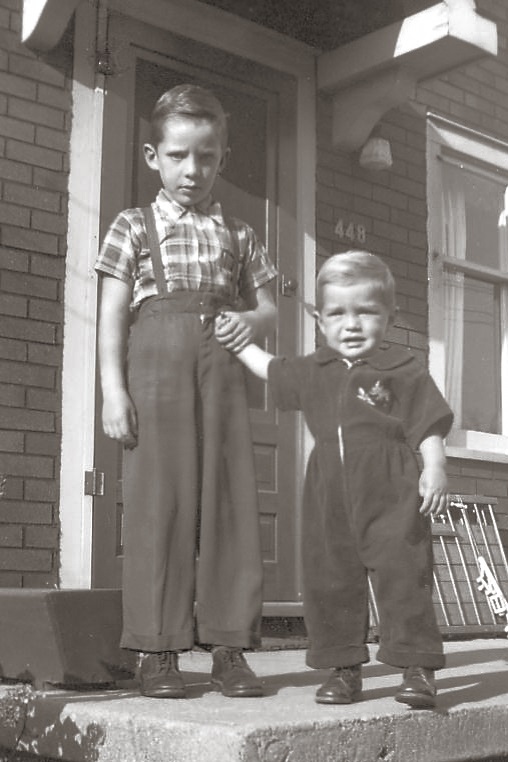
I talk about 448 Mornington Ave, London in the interview. It is where the party took place. Here is my brother Bob and I on the front porch of that house about the same time.
I have been going to the Stratford Festival since 1964. I saw King Lear with a Canadian All-star (of the day) cast including John Colicos, Leo Cicero, Bruno Gerussi, William Needles, Douglas Rain, Frances Hyland and Martha Henry. I may not have realized then that I was watching the creme de la creme of Canadian Theatre but the effect on me was lasting. And I have probably gone to 30 productions or more there since that time.
Last weekend I took in three plays at Stratford.
Romeo and Juliet
I wondered how to write about this one. Everything has been said. It also made me realize how it must be daunting to put a unique spin on it as a director. I have been in the play twice and seen it another two times. What was new? Well, this time I was certainly more aware of Romeo and Juliet’s teenage youth than I usually am. Most productions tend to make their quick infatuation with each other ooze with sexual tension and palpable emotion. In this one, both Romeo and Juliet seemed like impetuous teenagers who made impulsive silly decisions that led to their eventual demise. Juliet screamed at her nurse in a hissy-fit more than once. Romeo lay on the floor like a five-year-old bawling his eyes out and thrashing. Whereas I am used to the Friar’s lines “Art thou a man?…Thy tears are womanish…I though thy disposition better tempered” given in a sort of avuncular empathetic fashion, this Friar delivered them with a “Grow up, you wimp!” tone.
I did enjoy the interaction between the Nurse and Juliet and I also liked the Friar. They were able to accomplish the play in less than three hours (we never did) but sometimes that was because they thrashed through some lines without taking a breath. I am very familiar with this play and still missed some of the lines. If you were at all hard of hearing it would have seemed like garbled nonsense. The couple beside me left at intermission.
Later in the week someone asked me if the acting at Stratford was that much better than the productions I have been in. I thought for a moment and then realized that we likely did as good a job on the acting. It is all the rest of the production accoutrements that comes with a big budget that makes a difference to the how the show looks.
(Remembering our Kingston production of Romeo and Juliet in April 2013.)
I also have wonderful memories of Gilbert and Sullivan productions at the Avon Theatre, particularly recalling the late Richard McMillan and Eric Donkin in the Mikado (1982) or a hefty Maureen Forester as the Fairy Queen gliding in on a rope in the 1988 Iolanthe.
This production took me by surprise. Mainly because I thought it was Pirates of Penzance and only realized on my way to the theatre that it was a different G&S. No matter. They are kind of all the same anyway.
And it was delightfully silly and airy and visually lovely. What is not to like about a good G&S? I give it 4 out of 5 stars since it is hard to go wrong with a good cast and orchestra and, once again, money for costumes and staging.
Treasure Island
I was happy to take two of my granddaughters to this and we had a fun day that started at 11 with a “Treasure Hunt” lunch where we dressed up as pirates, met one of the pirates who later was seen in the show, got tattoos and then walked through town stopping at various places on our map to say “Arrh” to a pirate and get more candy or a cupcake or ice cream. By the time we reached the theatre for the production the kids were high on glucose and food colouring.
The show was pretty thin on plot and dialogue and anything meaningful but it was entertaining. Paper mâché birds flying in from the balcony. A trap door to the belly of the ship, a boat sailing through dry ice fog, pirates giving lines from one of the boxes with wide-eyed audience now in the show.
The kids liked it and I did too, but only because there were lots of kids in the audience who got into yelling back at the actors and looking for the treasure on their maps. Maybe the highlight of the weekend for me was when my six year old granddaughter whispered to me during a particularly vigorous storm scene in Treasure Island “It must be fun to be an actor in this.” and then “I think that their fights with those real swords were all planned”. I know my theatre friends will smile at this, knowing that this is why we do it! I hope that some day Maia joins the fun of participating in theatre. Her happy discovery made the weekend for me. Treasure Island as a production, however only ranked 3 out of 5 for me.
I was a bit disappointed in professionalism at a couple of spots in two of the plays. Once, in a quiet part of Romeo and Juliet, there was laughter and talking going on in the hallway behind the audience that was quite noticeable. Not sure if it was ushering staff or even actors who soon after entered through the audience doors. Twice I momentarily saw actors in the wings waiting for an entrance. Nevertheless it detracted from the show (as did the mobile phone that went off for a minute at least). In Treasure Island I could see some backstage light and movement and actors waiting to come on stage and one could see in a gap in the curtain by the orchestra pit where actors were descending down through the stage floor. These things tend to spoil the magic and really are not expected in a professional production company like the Stratford Festival.
I have spent the past few days on what has turned out to be a Reminiscence Tour of Huron and Bruce counties, visiting longstanding friends and familiar locations from my past.
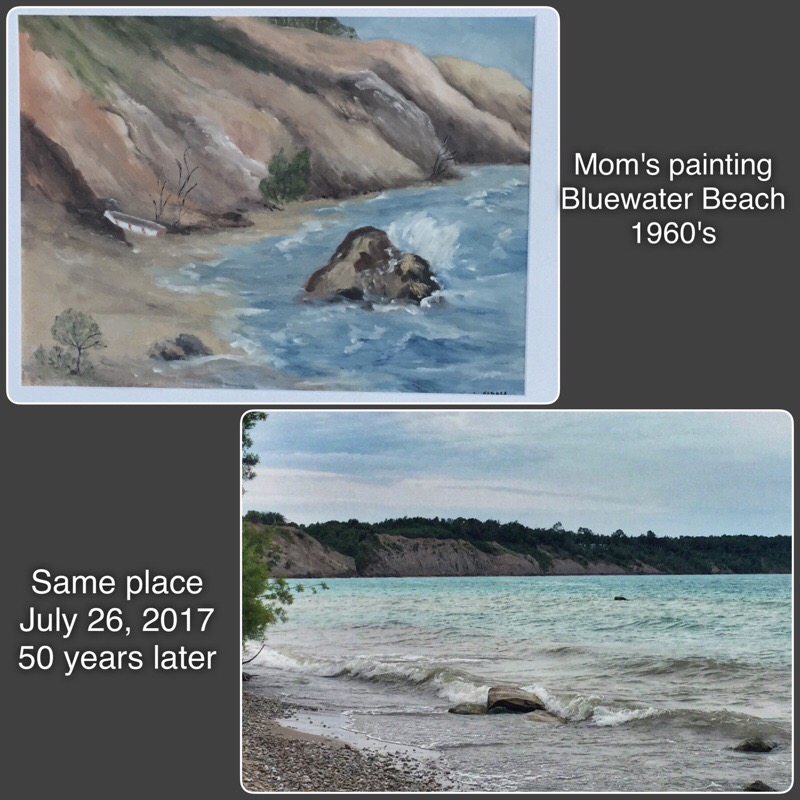
I have camped out for a couple of nights at my brother’s cottage just south of Kincardine and on the wall in the living room is a painting that was done by my late mother sometime in the 1960s. This morning when I looked at the painting, I decided to go there, to sit on that beach and see if that rock was still in the water. For years, our family had a cottage at the top of the hill in the community known as Bluewater Beach. I spent many summers there from about age 5 on. My kids also remember Grandma and Grampa’s cottage well.
I picked up a coffee in Goderich and a Danish at Culbert’s bakery. I parked at the top of he hill across the street from where Vasiloff’s had their cottage and walked along the road past Hartman’s and Haskett’s and Footwinkler’s and Halpin’s. None of those people are there – most of them are dead. The buildings, most of them drastically changed are there but with different owners they feel empty and foreign.
No one was home at the cottage that used to belong to my family – we had called it Tip Toe Inn –so I went out onto the front yard, sat down and had my coffee there looking out over Lake Huron. The cottage was built by my Dad starting in 1952. The structure remains the same although it is now brown, not white with red trim.
I then took the well-worn path and steps down to the beach.
At the bottom of the hill I could see the rocks in my mom’s painting. It’s true, she did take some artistic license with the size and perspective but the rocks are still there with waves crashing over them just as in the painting.
While I was on the beach, I met a fellow who was wandering along with his dog. He had a beard and long hair pulled back with an elastic. I know he would not call it a man-bun. He said he had a place at the top of the hill that sounded like it was where Art Johnson, the local woodsman, used to live fifty years ago. He said he spent a lot of his time wandering the beach and kayaking, – a bit like a Robinson Crusoe. He has built a little hideaway up against the cliff under some trees. His kayak was there, some places to sit and a painting of a whales tail in the water. We talked at some length about the beach, the way the lake changes from year to year but also the way that certain things stay the same. I told him about Benny Daer, the local bootlegger, and Miss Salkeld’s blue cottage tea room. I may have bored him but he listened politely. For me it was a flood of memories.
This year the water level in Lake Huron is high. Everyone thinks this is an anomaly. But I remember this beach in many years past exactly as it is today. We would have to clear rocks away to make a sandy spot to put our beach towels. Some years there was sand in the water and some years there was not. Some years the shore was polluted with seaweed, other years it was clean. Some years we would have to walk a couple of kilometers along the beach to Black’s Point to have a good swimming. Along the way we would stop at “the big rock”, another large flat table-like rock 100 m from shore. My new-found friend assured me he knows that rock well. And yet another “big” rock –in the picture below– at the base of the stairway to the beach was sometimes almost out of the water. But I also remember it exactly as it is now. When I was 10 we would go out to that rock and jump off of it into the water. All the rocks seemed bigger then.
As I stood there, I reflected how the rocks in my Mom’s painting will be there 100 years or 200 years from now as well. But I won’t. There is something both comforting and disturbing about that thought. How small and temporary we are in the grand scheme of things.
I’m not religious but sometimes I do have a spiritual side. These rocks are as close to God that I can get. They are steadfast, immovable, reliable and enduring. And there is something reassuring about knowing that, although we are only on this planet for a very short time, there is something greater that lasts… and lasts…and lasts.
Addendum: As I stood taking the photo above, looking toward Goderich, beyond the point in the distance, it reminded me of the time when my “cousins”, my 7 year old brother and I decided on the spur of the moment to walk along the beach to Goderich, maybe 5 km away. We neglected to tell our parents and, needless to say it took us longer than we anticipated. It was before the days of mobile phones or even a phone at the cottage. Our parents were frantic and at 4 pm found us walking along the highway in an attempt to head home. Brother Bob was exhausted. Parents were relieved to find us safely but were pretty angry with us. As a kid, this just seemed like a reasonable adventure. As a parent and grandparent I can understand our parents’ panic.
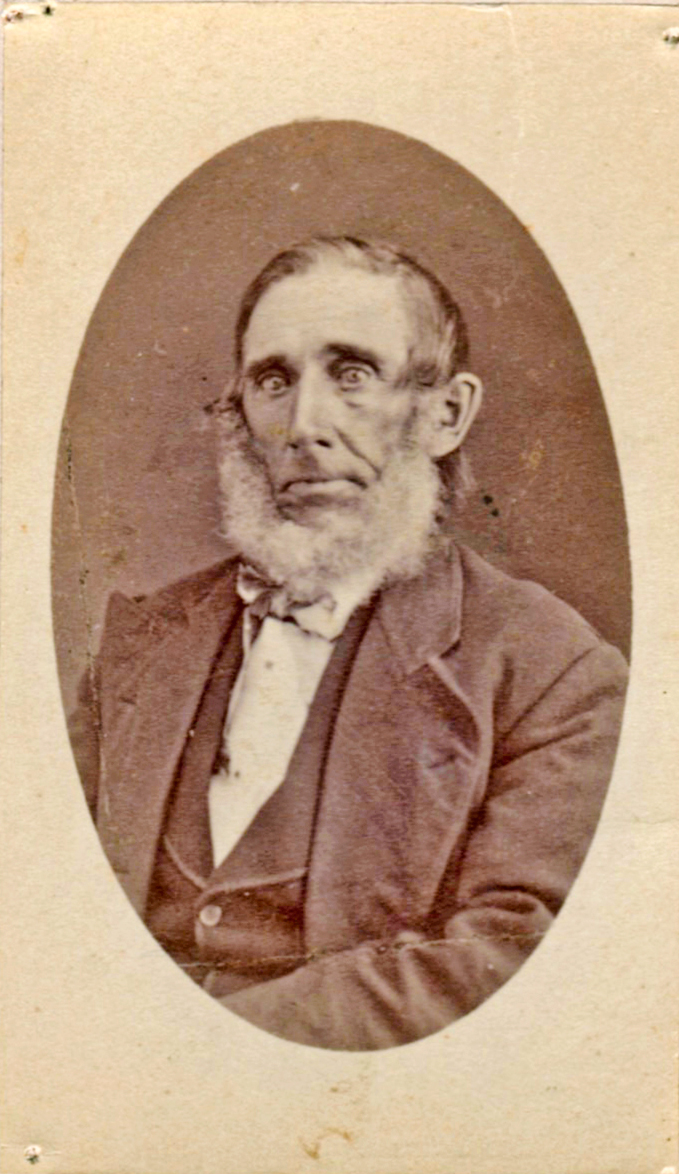
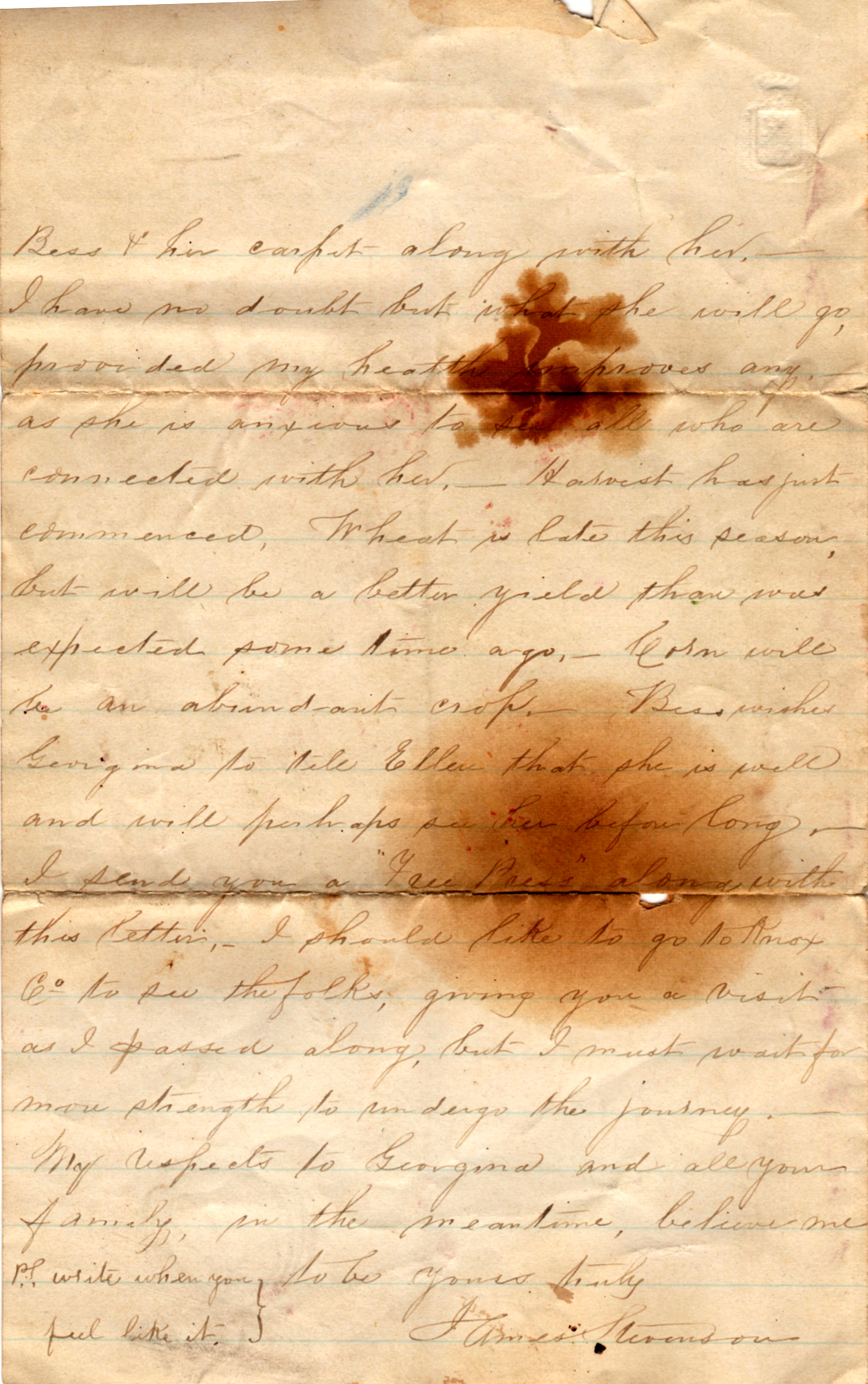
This is a letter from my great great grandfather, James Stevenson ( b.1810 ) in July 1880. He died in September 1880. I think it is to his brother-in-law James Crinklaw who lived in Marietta Nebraska.
Sand Creek, 24th July 1880
Friend James, Your letter was received …time and thanks for the information which was contained in it. Janet paid us a visit 2 weeks ago and I showed her your letter, as those you sent to her were all short ones. I got through taking the cures for a good time but I have been sick ever since; in fact I was not well when I began it. But you know that “need makes the wife trot” _ I wished to calm a little to keep the wolf from showing his nose at the door. If we sit all day with our hands folded it is not to be expected that the Almighty will put a piece of bread into our mouths. He helps those who help themselves. This waiting, for “something to turn up” has been the rumination of thousands. Looking to the top of a ladder will never get one to the top of a building. So if we wish to surmount difficulties which may be in our way, we must not listlessly look at them as obstacles which it is out of our power to overcome; but with a firm resolve and a disposition which will stand no opposition, trample them down one by one as they approach as mountains in appearance will make them dwindle down to the size of molehills; and with health of body and God’s blessing added, success must ultimately follow. _ My liver is badly affected, and I have been taking medicine for 2 weeks. It has helped me somewhat, but the pain in my side is not gone yet. My strength and what ambition I had, seem to have left me. I have a sluggish feeling and am inclined to sleep. Bess has stood out all summer hoeing + weeding. I could get no one to hire. Not a potato or any other vegetable would we have had is she had not seen to the garden. We will have more potatoes than will serve us, if they are a good crop. Besides working in the garden she has all along seen tot he watering, feeding and pulling weeds for the hogs, which have done well under her management. She is in good health being able to eat her breakfast between 5+6 every morning. There is some talk of Ellen Fleming going west in September to take up hadn’t in Holt Co where her brother Andrew and John Gaiene are going. She told Bess that she was going your way to get a carpet wove and offered to take Bess + her carpet along with her. I have no doubt but what she will go , provided my health Improves any, as she is anxious to see all who are connected with her.Harvest has just commenced, Wheat is late this season but will be a better yield than was expected some time ago, _ Corn will be an abundant crop. Bess wished Georgina to tell Ellen that she is well and will perhaps see her before too long. I send you a “Face Press” along with this letter, I should like to go to Knox Co to see the folks, giving you a visit as I passed along, but I must wait for more strength to undergo the journey. My respects to Georgina and all your family, in the meantime believe me to be yours truly,
James Stevenson
P.S. write when you feel like it.
*** Linda D. Crinklaw, who has done extensive research about the Crinklaw family adds this information about James and the “James” to whom the letter is addressed:
“I believe the letter was sent to Neligh, Antelope Co., Nebraska to James Bainard [1817 Coventry, England- 1894 Neligh, Antelope Co., Nebraska] , husband of Georgina Spiers (Crinklaw) Bainard, half-sister of your Elizabeth (Crinklaw) Stevenson, wife of James Stevenson. Georgina (Crinklaw) Bainard is Family #9 in George Fraser’s book. Note that the letter ends, “My respects to Georgina and all your family.” I think the Janet to whom the last letter from the James (person being sent this letter by James Stevenson) is Janet Elizabeth Bainard, daughter of Georgina (Crinklaw) and James Bainard. In other words, James Stevenson showed her the letter written to him by her father, James Bainard, who wrote her only short letters. Janet Bainard was a school teacher, and after teaching in Illinois in the 1870s, she taught by 1879 in Saunders Co., Nebraska four miles from the home of her uncle, Walter Crinklaw, Sr., in Marietta, Saunders Co., Nebraska. Her aunt, Janet (Crinklaw) Gilchrist and her husband, James Gilchrist, also lived in Marietta, Saunders Co., Nebraska in 1880. Your Stevensons were living in Sand Creek, Saunders Co., Nebraska in 1880. The Bainards (James and Georgina) moved from their farm in Illinois to Neligh, Antelope Co., Nebraska in 1880. James Crinklaw, Jr. had apparently from your letter left the Stevensons after setting up the garden for them in 1879 according to my letter. He must have been gone in 1880 and not there to help your Elizabeth. James Crinklaw, Jr. had his own homestead in Antelope Co., Nebraska by 1885, but left it c. 1886 and disappeared for awhile. “
I have shared the diary of Peter Porterfield as he crossed the Atlantic in 1855 and told you about James Crinklaw who came from Scotland in 1833 to London Ontario. How did these two families unite?
Betsy Crinklaw Stevenson.
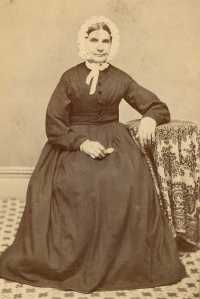
Betsy Crinklaw, my great great grandmother, born in Minto, Scotland in 1807, was the third child of James Crinklaw and Elizabeth Watson. In 1836, in St. Thomas, Ontario, she married James Stevenson, also a Scotsman who had immigrated to Canada. They had four daughters, all born in London Ontario within six years. Then the family up and moved to Nebraska where a census in 1880 lists James as a teacher and Betsy as a housekeeper. In a letter from James to a relative just before his death, he describes “Bess” as a hard worker and gardener in 1880. She died in Neligh, Nebraska at the age of 86.
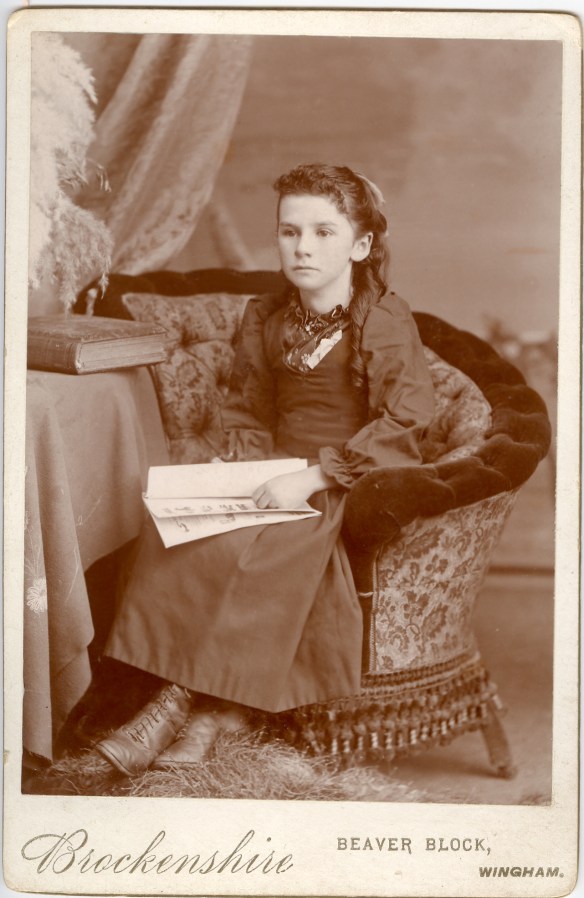
The only one of the James and Betsy Stevenson girls to stay behind in Ontario when the rest moved to Nebraska was their second daughter, Mary, who married Peter Porterfield and became my great grandmother. Now, all of the photos that I have of the Stevenson’s make them look pretty severe. Betsy, as an old lady, was a bit scary. Even as a young woman she looked like a guy in drag. James Stevenson had eyes that bugged out of his head. But Mary, my great grandmother, their daughter looked quite refined. And my grandmother, Mary and Peter’s daughter (photo below) was a beautiful young girl.
My grandmother, Mary Porterfield Geddes in 1895, age 12.
This leather Mason’s Apron belonging to James Stevenson.
My father passed on to me a leather Mason’s apron that belonged to James Stevenson. It is not very big and pretty fragile but it is intriguing to possess something that belonged to my great great grandfather in the mid 1800’s, maybe 175 years old.
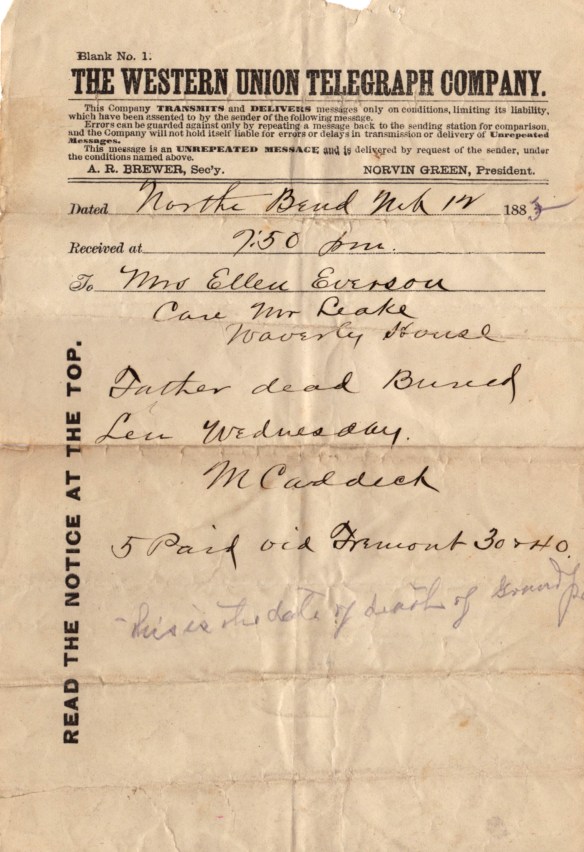
I also have the Western Union telegram sent from North Bend Nebraska from his daughter Margaret (Caddick) to her sister Ellen (Thorson) announcing the death of their father, James. It spares no words. “Father dead. Buried on Wednesday.”
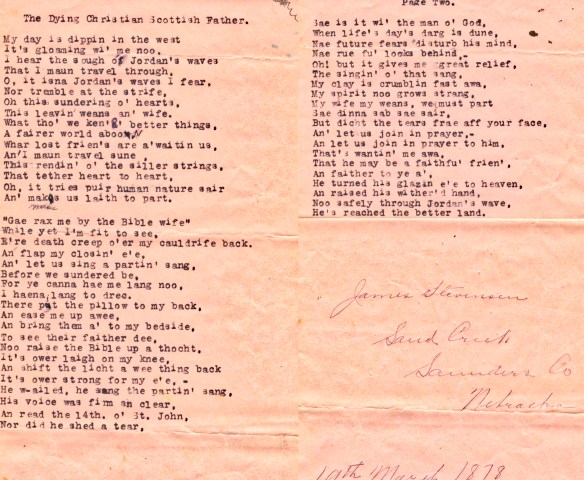
Ellen’s nephew, James, also ended up with a poem written by James Stevenson the year before he died. It was found tucked in his daughter, Ellen’s family Bible. It is a long ode with lots of Scottish brogue, entitled, The Dying Christian Scottish Father. Copies were made and distributed to various family at the time of his death but I have the original, typed on pinkish paper and signed by James Stevenson, himself.
You can also read a letter that James Stevenson wrote just a couple of months before his death in 1880 in the next post.






 I revisited the place where Jenny Geddes (not my niece, the other one) threw a stool (a wooden one, not the other kind) at the Pastor who was attempting to read from the Common Book of Prayer that was being introduced (forcefully) on the Scottish Church by Charles I at St Giles in July, 1637.

 Patrick Geddes was also an interesting and well-respected biologist, philanthropist and town planner from the late 19th century who is commemorated in several plaques and small streets throughout Edinburgh. (also no relation except for the shared original Geddes lineage). The Geddes coat of arms has three fish on it and the name may be derived from the word “gedd” which means pike. Or, my friend Judith Adam might be pleased to know that it could actually be a derivative of MacAdam (the letter G sometimes representing Mac in Gaelic and “eddie” being a substitute for Adam)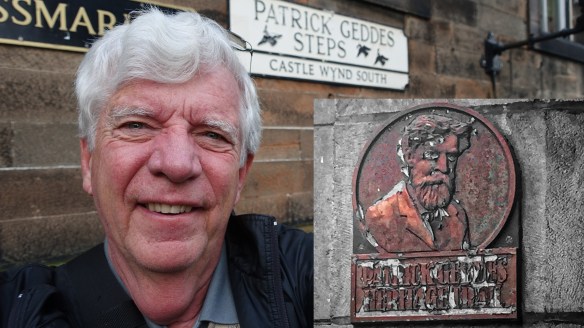
 Potatoes (sliced in 1 inch cubes or thereabouts)



 I also have wonderful memories of Gilbert and Sullivan productions at the Avon Theatre, particularly recalling the late Richard McMillan and Eric Donkin in the Mikado (1982) or a hefty Maureen Forester as the Fairy Queen gliding in on a rope in the 1988 Iolanthe.
 I was happy to take two of my granddaughters to this and we had a fun day that started at 11 with a “Treasure Hunt” lunch where we dressed up as pirates, met one of the pirates who later was seen in the show, got tattoos and then walked through town stopping at various places on our map to say “Arrh” to a pirate and get more candy or a cupcake or ice cream. By the time we reached the theatre for the production the kids were high on glucose and food colouring.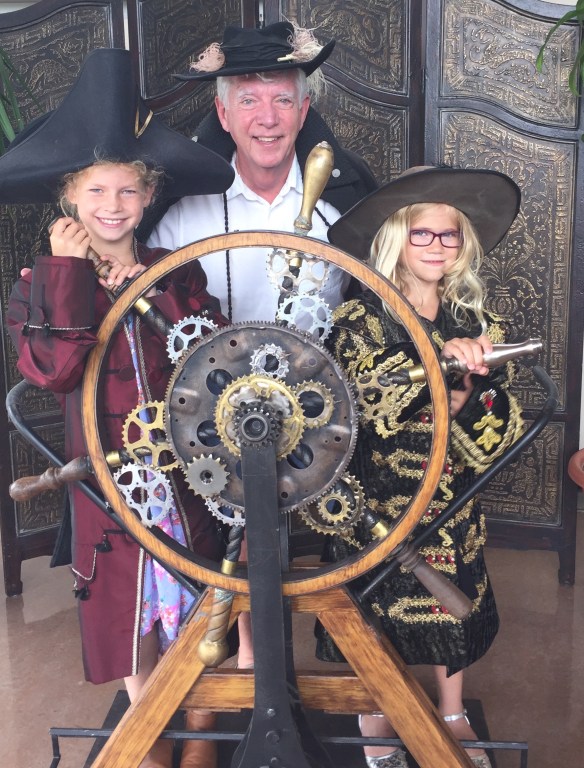





 johnageddes