What famous figure, alive or dead …

I am sure that you have all played this game. “What famous figure, alive or dead, would you like to meet?”

I keep this at “famous” figure as there are many deceased relatives that I would like to visit with again. I would really love to meet my grandparents, now, as an adult. How different it would be to relate to these people and see them for who they really are rather than through a child’s eyes.

And when I look online at the choices people make they range from Jesus Christ to Lady GaGa.

Today my choice is Angelina Jolie.

Apart from being incredibly beautiful, this woman intrigues me. I know very little about the Brangelina stuff that I see on the tabloids as I check out of the grocery store. I have not seen the Lara Croft movies (or any of her movies, in fact) nor do I have any desire to do so. I have, however, seen television interviews in which she has surprised me with her insight, intelligence, eloquence and general “down to earth” demeanour.

I have been impressed that Angelina Jolie has used her celebrity to promote awareness of problems in the developing world and has even adopted children from these areas. She is a United Nations Special Envoy for Refugees and has worked for the UNHCR for some time. In some ways her adoptions have followed the principles espoused by Peter Singer in “The Life You Can Save”. Enjoy the fruits of your work and privilege but also share some of that with others less fortunate. She has three kids of her own and has balanced that with three more that were adopted from the developing world. She has struck a chord with me as I think she has made a genuine effort to use her celebrity to help others.

I am anxious to see In The Land of Milk and Honey, a film that will be released in North America next month – one that Jolie wrote and directed. The plot revolves around a love story of a Serb and a Muslim in Bosnia during the war in that country. I worked in Bosnia for several years and heard horrible stories of violence, rape and ethnic hatred that tore families apart. The film is fictional but the setting real. So real, in fact, that Jolie ran into problems getting permission to shoot the film in Bosnia as originally planned and had to move filming location to Hungary. The film was shot in both Bosnian (with subtitles) and English. I want to see the Bosnian version. I admire Jolie’s gutsy decision to tackle this subject and put her reputation on the line at the same time as writer/director rather than actor with a film that will not be a blockbuster but will explore a delicate topic.

But today’s news was the topper. Angelina Jolie has revealed in the New York Times that she has had a bilateral mastectomy in order to reduce the risk of her acquiring breast cancer after finding that she carries the BRCA1 gene for the disease. Her mother died of breast cancer in 2007 and she is at significantly increased risk herself, being found to carry the genetic mutation that will elevate her lifetime risk of breast cancer significantly. She has made this decision so she can reduce her risk and be available for her children. This must have been a huge decision for a movie celebrity to make. By being open with this Angelina Jolie has also done a great service to other women who face the same risks. Once again today’s revelation by this celebrity also strikes home to me as my wife died of breast cancer at age 48 and one of my daughters, already touched by breast cancer at a young age, has elected bilateral mastectomy with reconstruction to minimize her risk of recurrence. I was proud my daughter for making this difficult life choice and I can relate to the angst that Angelina Jolie must have suffered as she made the same decision (at almost the same age).

We often look at celebrity through a very tainted lens. We see them through Hollywood gossip columnists and papparazzi. But under the movie star veneer live real people who live with personal challenges just like the rest of us.

Today my celebrity hero is Angelina Jolie. I am free for lunch tomorrow if she is.

Renovations at the S.P. Geddes Early Childhood Development Centre

Here is a letter that I have sent out today to friends and family of my 93 year old Dad.

Dear friends and family of S.P. Geddes,

As you may know, I have been very actively promoting infrastructure support in needy communities in East Africa through the CanAssist African Relief Trust. Dad’s example of being supportive of charitable work through the Alzheimer’s Society, CNIB and CanAssist has certainly provided an example to me of how sharing our good-fortune with others is not only a responsibility but a privilege.

Dad has generously been specifically sponsoring a small school in a rural lakeside village in Kenya called Osiri. Prior to Dad’s sponsorship through CanAssist, the small children in this community had no way of acquiring any early education as the nearest school was several kilometers away. This left young children without the basics and when they were eventually able to enter school they were behind and often dropped out.

Children outside the gate of the S.P. Geddes Early Childhood Development Centre in Kenya

Children outside the gate of the S.P. Geddes Early Childhood Development Centre in Kenya

Dad’s donations to CanAssist have allowed this small school to develop a fenced school-yard (the children are young who attend and supervision is important), latrines for the school and a two-classroom structure. Last year, the community named this school the S.P. Geddes Early Childhood Development Centre. Remarkably, one of

the children of the community, the grandson of one of the teachers, was also named Stewart Geddes and I was able to meet little “Geddes” last February. What a delight. You can read more about this encounter and see a brief video of the school in a blog article that I wrote when I visited the school in February  http:// wp.me/p2wvIq-oz.

The original three school classrooms, tin structures with dirt floors, are in poor repair. The school has asked CanAssist for financial support to cement the flooring (providing cleaner, more comfortable foundation to the classrooms and also helpful in reducing the Jigger problem that is made worse by dirt floors in a school)

See this success story of combating jiggers through CanAssist work in this short Youtube video

They have also requested money to provide some rudimentary classroom furnishings for the school. The cost of the renovations to improve safety and stability of the classrooms will be approximately $3400 Can and the school furnishings will cost about $1300.

One way or another, CanAssist has agreed to fund these improvements. Our ability to do this work, however, depends on donations to the CanAssist African Relief Trust. I know that Dad would be supportive again of this school but I am hoping that some of his friends and family will take his example of outgoing generosity to a small needy African community and share in supporting this CanAssist Project.

Donations over $25 are eligible for a Canadian Income Tax receipt and can be made by check to; The CanAssist African Relief Trust, 562 Sycamore Street, Kingston, Ontario, Canada. K7M7L8

OR you can donate right now securely online using a credit card at this direct Canada Helps link: http://www.canadahelps.org/CharityProfilePage.aspx?CharityID=d95557

Be sure to specify with your donation that it is to be allocated to the SP Geddes school.

Thanks for considering this specific request and I know that both Dad and the S.P. Geddes Early Childhood Development Centre in Osiri Village, Kenya will greatly appreciate any support you can muster for this work. Please pass this on to anyone you think may find this an appealing request.

Cheers,

John

Little Stewart Geddes with a plaque acknowledging the contribution of his namesake to the school in Osiri Village Kenya.

Little Stewart Geddes with a plaque acknowledging the contribution of his namesake to the school in Osiri Village Kenya.

Better late than never?

I have acted in amateur theatre on and off for several years but this week was the first time that I totally missed my entrance cue. I will backtrack a bit so you know the story.

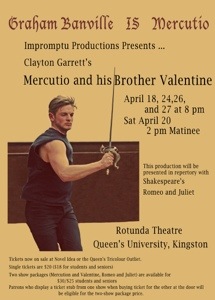
20130420-103647.jpgImpromptu productions, a Kingston-based theatre company has taken on the difficult task of presenting two plays in repertory, alternating performances one with the other. Shakespeare’s Romeo and Juliet is a tragic love story that most people know well. Kingston’s Clayton Garrett has written Mercutio and his Brother Valentine, involving characters mentioned in Shakespeare’s classic and presenting a surprising back-story to the interactions between Capulets and Montagues in “fair Verona”.

My part is Prince Escalus. He is uncle to Mercutio and Valentine and has raised them after their parents died. He hopes one of them will be groomed to take over as Prince of Verona to succeed him but there are snags.

20130420-103627.jpgIn Romeo and Juliet, Escalus appears like bookends on the first half and at the end of the play. He has three entrances. In the first scene he comes in to yell at rowdy citizens to tell them to stop their bickering. Then he vanishes for about 90 minutes, only to appear again to exile Romeo for his part in killing Tybalt. At the end he shows up and says, basically “I told you something like this would happen”.

Of course, Escalus does make this all sound rather more complicated than it is. But that’s Shakespeare.

I decided that I would take my ipad to the theatre and while waiting for my three little entrances, would put together a video of photos that I had taken for both plays. I enjoy photography and also love to share the photos in different ways with friends.

So there I was in the hallway outside the dressing room trying to upload a video to YouTube when one of the stage managers hustled in and indicated that I was called to the stage. Usually we get five minutes warning to be in place. I assumed that I had time to pack up my iPad and get into position. I was wrong. It had been only when I failed to show up on the stage that they realized that I was not in place. My entrance was through a solid door at the back of the audience, the door hidden behind a black cloth. Unfortunately, in the dressing room which is in a totally different wing of the building, or even behind this solid door, it is impossible to tell what is happening on stage. I pulled the door open a crack to hear what was going on. Dead silence. What scene was this? Then someone pushed me from behind and whispered “Go Now”. The whole play had, at least momentarily ground to a halt. The next lines (and advancement of the plot) were mine. No wonder it was quiet on the stage. I regally appeared from behind the black cloth onto the stage to be greeted by one of my fellow actors who was looking at me with eyes that were like a deer in the headlights. Tybalt lay “dead” on the floor (likely wondering how he was going to get out of this one).

I am sure that there had been a very awkward silence and I owe poor Benvolio a beer. He would have wondered how on earth to get out of this situation if I never appeared. When something like this happens in front of an audience, seconds feel like hours.

I was able to jump right in and give my Blah Blah Blah, banish Romeo, tell them to drag the corpse away and confound the audience with the final line of the half – “Mercy but murders, pardoning those that kill.” Lights out. Applause. Intermission. An embarrassing story to tell. Live theatre.

Here is the video that I was uploading to YouTube while all this was happening. I hope it was worth it.

Mercutio and his Brother Valentine will continue next week at the Rotunda Theatre, Queen’s University, Kingston at 8 pm on April 24, 26 and 27. Romeo and Juliet will be at 8 pm on April 25 and 2 pm on April 27. I will try to make my entrances on time.

Fifty Years ago – 1963

It’s strange how the mind can wander. Or at least mine can.

I had a brief Facebook interaction yesterday with friends in which I referenced Mohammed Ali with his well known “floats like a butterfly, stings like a bee” comment. It immediately called up a memory of being on holiday with my family in Western Canada in July 1963. I was a month away from turning 16 and Sonny Liston had just beaten Floyd Patterson to become heavyweight champion of the world. But Cassius Clay (he changed his name to Muhammed Ali a couple of years later) was able to immediately upstage Liston with a challenge and prophesy, “Liston’s not great, he’ll fall in eight.” I was not at all interested in heavyweight boxing at the time but I still remember being in the car and hearing this on the radio as we travelled through Manitoba. I also remember watching a solar eclipse through exposed film two days earlier and having vivid recollections of listening to 13 year old “Little Stevie Wonder” singing Fingertips Part 2. I bought the record – a “45” – when we got home.

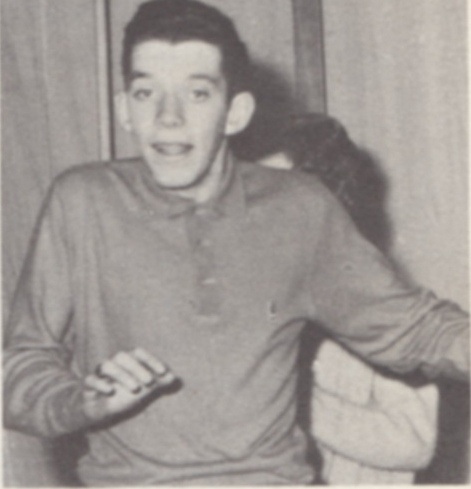
Rehearsing for my role as Mr. Spettigue in Girl Crazy-1963

Rehearsing for my role as Mr. Spettigue in Girl Crazy-1963

I started wondering what else was going on in 1963. I was going into Grade 12 at London Central Collegiate Institute. I was a nerd. I wore corduroy flood pants and sweaters with designs on them. I was into many extracurricular activities, including playing the role of Mr Spettigue in Girl Crazy and dressing up as Quack version of Bess the Landlord’s Daughter in an election skit for my friend Daphne Ward (now Bice). Her campaign theme was centred around Daffy Duck. She didn’t win. The Daffy Duck approach has not been used by politicians since.

I remember sock hops in the gym. I wonder what became of teachers like Hunk Wyatt, Miss Wyanko and Mr Webb who all seemed absolutely ancient (they taught my mom, in fact) but who were all likely younger than I am now.

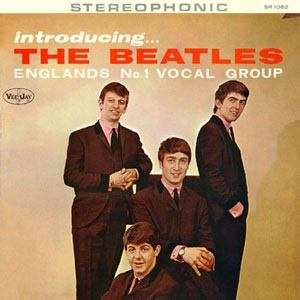
imageThe Beatles released their first hit, Please Please Me in early 1963 and this was followed by other singles and an album…in stereo. They had not yet appeared on the Ed Sullivan Show but Beatlemania was sweeping the UK in 1963. Their long hair verged on scandalous.

Gasoline cost 29 cents a gallon (not litre) and a loaf of bread was 22 cents.

Alfred Hitchock’s “The Birds” was a popular movie along with Elizabeth Taylor and Richard Burton in Cleopatra. Ron Howard was Opie on the Andy Griffith’s Show.

You will be familiar with Bob Dylan’s song, “Blowin’ in the Wind” made popular by Peter Paul and Mary in 1963 but you may not have heard Eydie Gorme’s “Blame it on the Bossa Nova.” Does any body do the bossa nova any more? Blame that on Eydie Gorme.

By far the most memorable event of 1963 was the assassination of John F. Kennedy. I remember the moment that news broke. I recall where I was sitting, the teacher and in the classroom I was in when the principal of the school broke into the lesson over the PA system. I spent the rest of the dreary November weekend glued to the black and white TV that was in the corner of my grandparents’ living room as the rest of the drama, including the shooting of Lee Harvey Oswald, unfolded.

imageEarlier in the year, Martin Luther King gave his “I have a dream” speech and racism and civil rights were paramount in the news. Civil rights movements were being met with violent opposition and it took policemen to allow two black students admission to the University at Birmingham Alabama. Fifty years later the President of the United States is African American. A significant change for the good within my adult lifetime.

It is weirdly wonderful to me that I can remember these events from 50 years ago so vividly. Lots of images and experiences filed in there somewhere.

Oh, and just in case you think I am showing my age, Johnny Depp and Brad Pitt were both born in 1963 which makes them 50 this year. Time marches on.

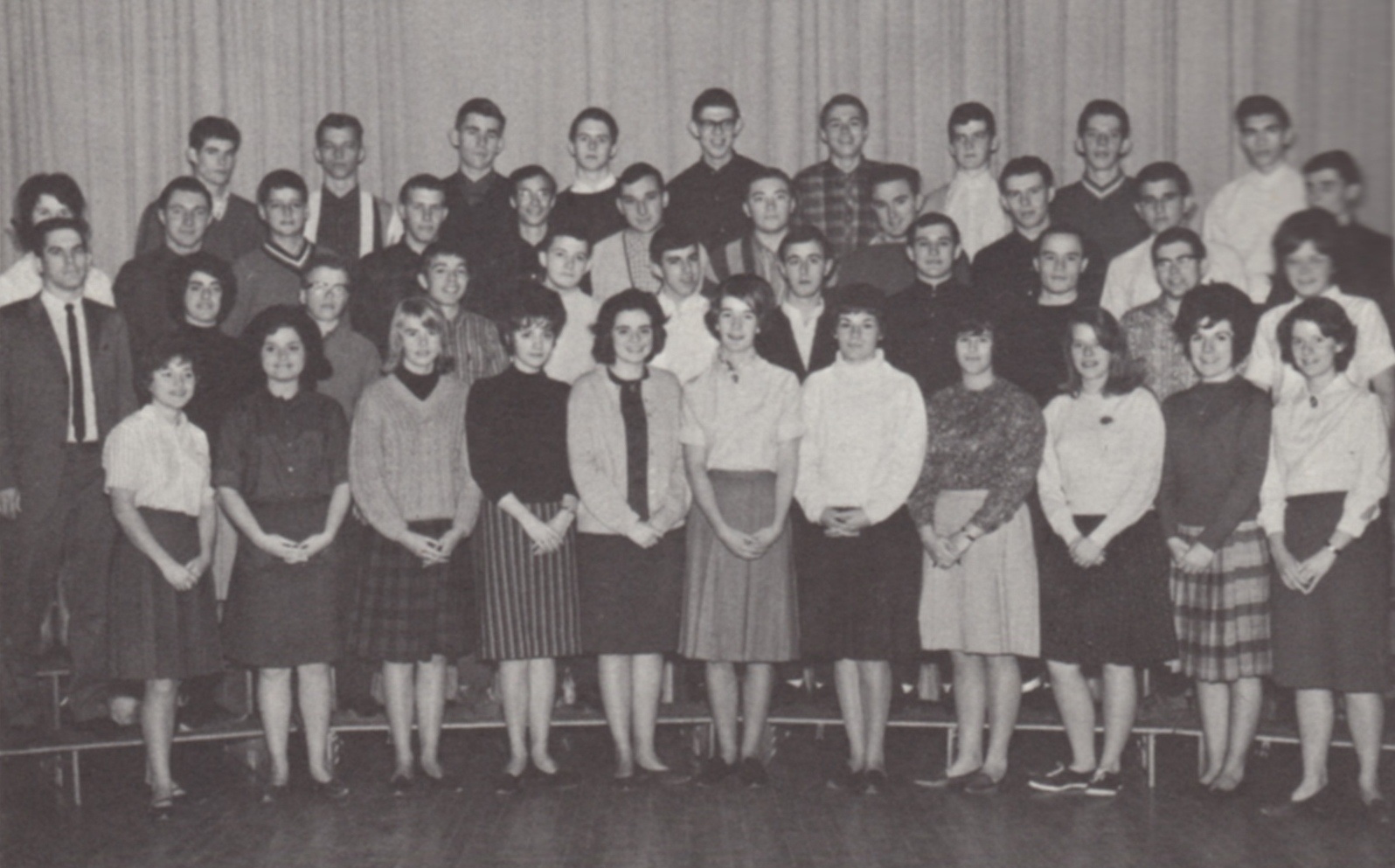
My grade 12 class in 1963. I am in the top right with the V-neck sweater.  Over the years, my head has grown into my ears.   At the far right in the first row is Lorna Harris . Lorna and I are still great friends after these 50 years, corresponding regularly by Facebook and email.  An enduring friendship. Could we ever imagine what the next 50 years would bring?

My grade 12 class in 1963. I am in the top right with the V-neck sweater. Over the years, my head has grown into my ears.
At the far right in the first row is Lorna Harris . Lorna and I are still great friends after these 50 years, corresponding regularly by Facebook and email. An enduring friendship. Could we ever imagine what the next 50 years would bring?

A story rivalling Romeo and Juliet in Sarajevo …

“For never was a story of more woe, than this…”Prince Escalus,  Romeo and Juliet.

Last month I posted a blog that contained references to my first spring in Sarajevo and the “Grandmother’s Breath” that swept the city that spring.

This spring I am in a production of Romeo and Juliet in Kingston that will happen in a couple of weeks.

This is the bridge in Sarajevo where a tragic real-life love story happened in 1993.  I took this photo in 2005.  At that time only a small bow and dried flower bouquet marked the incident.

This is the bridge in Sarajevo where a tragic real-life love story happened in 1993. I took this photo in 2005. At that time only a small bow and dried flower bouquet marked the incident.

Today I came across a wordpress blog article by a Bosnian blogger. His article combines the two themes in a story that is as poignant as Shakespeare’s play only a real-life event – a Muslim woman and a Serb man gunned down as they met to escape Sarajevo over the Vrbanja bridge at the start of the ethnically-driven war.

I share it with my readers. It triggers memories of similar sad stories I heard when I worked in Bosnia. I crossed the bridge where this tragedy occurred many times and sometimes stopped to note the small plaque that had been erected there.

You can read the whole story here:         Romeo and Juliet in Sarajevo.

Every day a school day…

Earlier in the month I posted a blog about the dilemma faces by African girls who attempt to cope with the monthly need for sanitary pads with no money to purchase them.

Here is a video of Mama Benta Odhiambo of Kanyala Little Stars on Rusinga Island, Kenya outlining that need.

I have also written a complementary article for the Kingston Whig Standard published on April 4, 2013. If you are interested, here is a link to that article.

An African solution to an African problem…

When I visited my friends, the Moiko’s, in Kenya in January they were having a problem. They are a typical (modern) Maasai family who, in addition to pursuing higher education and communicating with their iPhones and on Facebook, continue to raise cattle. Traditionally, the Maasai have had a strong link with their herds of cows and most of their typical day revolved around tending to their cattle as their main investment. Finding water and grass for their herds, often when water and pasture is scarce, milking the cows in the morning and evening and protecting them from predator animals took most of the Massai herdsman’s time.

img maasai bomaIn many parts of Kenya and Tanzania, there are Maasai villages that continue in this tradition. People live in bomas, small collections of mud huts around a central paddock where the animals are kept overnight. During the day, the women look after the children, collect firewood and water, cook and repair the homes while the men and boys take the cattle and goats out to graze.

At Stephen’s place, the children are up early to catch the school bus and Stephen goes off in his car to work at a Food Security program as he finishes his work on a PhD from McGill in Montreal. But at home, there are still the cattle to manage. Hired herdsmen look after the cows and goats but the family still goes to the paddock in the evening to inspect the livestock and milk the cows. It is a nice mixture of modern life with the traditional. I imagine that this blend is not easy to maintain.

In rural areas, Maasai men, dress traditionally and periodically meet together to "eat meat" and discuss community problems, like predators attacking their cattle.

In rural areas, Maasai men, dress traditionally and periodically meet together to “eat meat” and discuss community problems, like predators attacking their cattle.

One of the problems in more rural settings is with predators attacking the cattle. I remember dropping in to a clinic at Talek, near the Maasai Mara, only to be drawn into the small treatment room by the local health care provider who was covered in blood as he sewed up the wounds of a young Maasai fellow who had been mauled by a lion he was chasing away from his cattle.

Nearer to Nairobi, the risk of these larger predators is not as great although I do recall Stephen’s daughter telling me of having to walk past a cheetah on her way up the driveway one day as she came home from school.

The recent problem for Stephen is buffalo that come down from the Ngong Hills to a salt lick in his pasture. They break down the fence and they eat the grass. Buffalo are also a significant security risk as they can be ornery beasts, dangerous to humans. When I visited in January, Stephen was getting tired of mending the fence and wondering what to do.

Well it seems that not far away other Maasai were having similar problems with lions. And this boy came up with a solution. Check it out. I wonder if it will work for Stephen’s buffalo problem.

Finally … my very own Red Rider

Boys like toys. I could empathize with Ralphie in A Christmas Story for wanting that Red Ryder BB-gun. And boys don’t seem to grow up.

Jim on his Silver Bullet.

Jim on his Silver Bullet.

A couple of weeks ago a friend of mine called me over to his place to check out his new toy. An E-Bike. Much like an E-book, this thing is a modification of the standard object. It has all the usual things that a bicycle would have but also has a battery that powers a motor that can either let you sail along, throttling it like a motorcycle or set it to call in electric power when your legs are not quite doing the trick.

It was a delight to ride. He gave me a brand new helmet that he had that was not a good fit for him but fit me perfectly.

Now I had the helmet, all I needed was the bike.

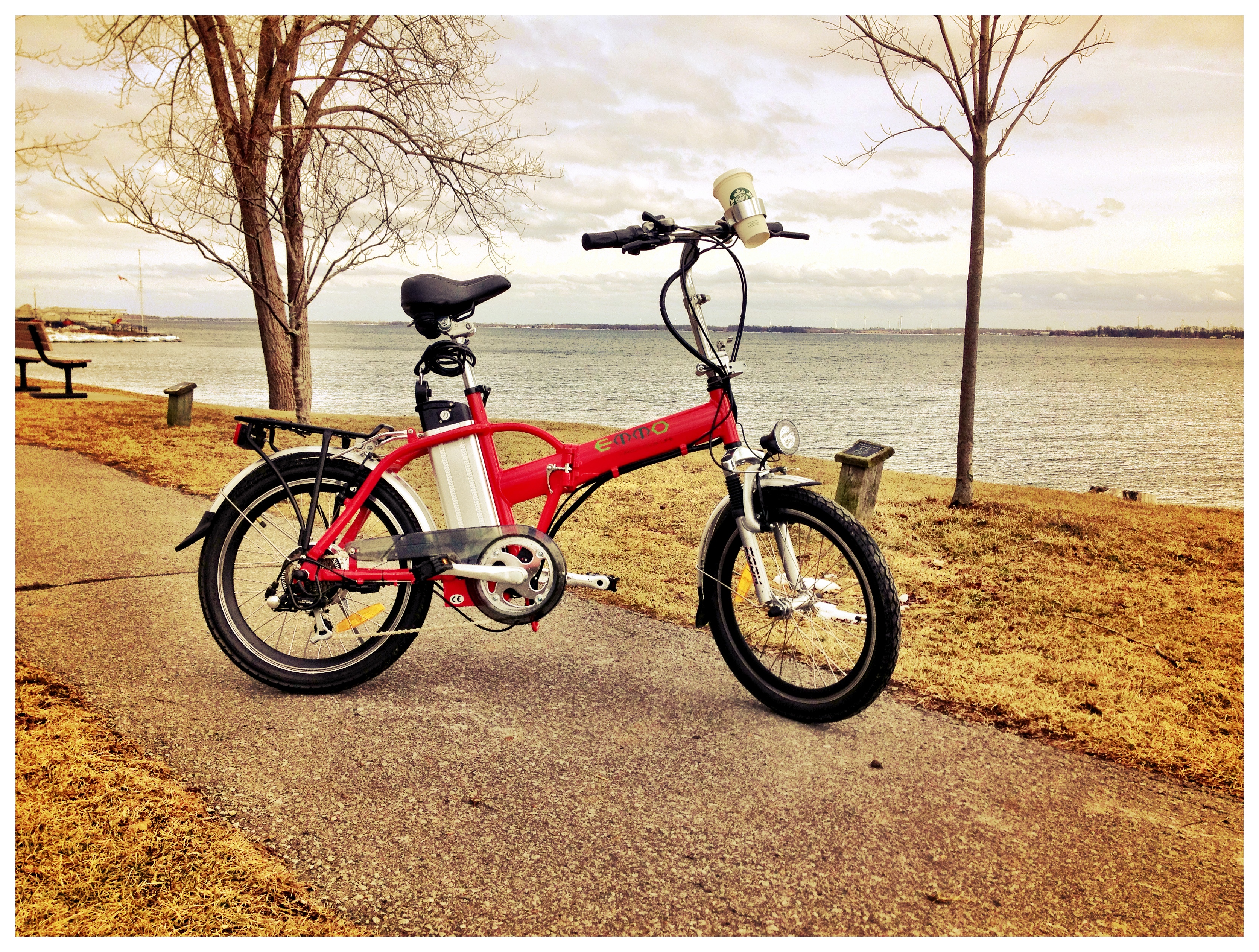
Last weekend I picked up my very own “official, red, folding, EMMO double action six-speed, dual-braked hybrid electric bicycle with a kickstand, bell, rechargeable lithium-ion battery and a Starbucks cup holder right on the handlebar.” I am going to call it my Red Rider.

My Red Rider

My Red Rider

I had been thinking of getting a bike this spring but the whole exercise thing was just a little more than I was looking forward to. It would have been OK on the flat but when there is a hill – well, my old joints and muscles are just not up to it. But this E-bike seemed perfect. If I get tired, I can just throttle up and ride. Easy stuff, right?

Well, initially I had to get used to the controls. The throttle, I found, is sensitive. As I was walking the bike through my underground garage I had, unwittingly (the word unwittingly may come up more than once here) left the key in the on position. I accidentally gripped the throttle and the bike took off, wheelie-style, toward a neighbouring car. Luckily I was able to stumble along side and eventually realized that if I just let up on the throttle things would be OK. A close call and I was not even out of the garage.

A ride on the street was in order. What fun to put the bike in boost mode, sit beside a car at a stop light and when the light turns green, give minimal pedal power and have the bike shoot off the mark like I am Lance Armstrong on steroids. I’m sure they were thinking “Who is this old guy on the bike that can beat me away from the corner on his bike?”

All went well – my crotch will get used to the seat, I hope – until the next day when my sacroiliac joints were complaining and my calves ached. I had not counted on using those muscles which had been sitting (literally) dormant for some time. I realize that this is a good thing in many ways – the bike is not completely a wimp thing – but I also thought that maybe I should do some stretching before I set out the next time.

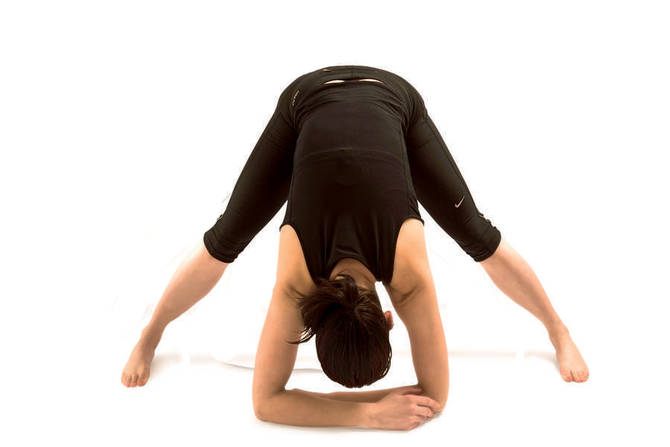
I looked online for stretches for bikers. The nubile, 20-something woman that was demonstrating the stretches looked very good. But I soon recognized that I couldn’t get my maturing body contorted into the stretch position she was showing. I tried. It made me dizzy.

On to another YouTube page of stretches – this time done holding the bike. I watched the first minute which involved straddling the front wheel and holding onto the handlebars to stretch. Given my parking lot experience with the throttle, I decided immediately against that one.

Eventually I found a stretch where you just lie on the floor and bend your knees up to one side. I will adopt this pre-cycle “stretch” although I am not sure it is stretching anything but the time.

The Red Rider folds up and weighs less than 50 pounds. It has a battery that will, apparently, take you up to 40 km.  It folds up and fits in the back of my car.  I can take it anywhere!

I am waiting anxiously now for warmer weather to arrive (it is still cold here in Ontario). I have fantasies of eventually getting my muscles accustomed to the new activity and heading up to the hill on Fort Henry on a June evening to watch the sunset. I can hardly wait to smile innocently as I peddle effortlessly and cruise past others who have given up and are struggling to push their bikes up the hill.

To everyone’s relief, I have decided not to purchase lycra bicycle pants.

Grandmother’s Breath

It is 15 years, almost to the day, that I first went to Sarajevo to start work with the Queens Family Medicine Development Programme in Bosnia and Herzegovina.   I find it hard to imagine where those 15 years have gone.

I remember arriving in Sarajevo, flying into the airport over houses whose roofs had been destroyed by the recent war.  The city had been devastated and in the dreary spring weather looked particularly tired.

On March 24 we had a light snow and a cooler dip in temperatures to about 2 degrees.  The locals called it “Grandmother’s Breath”.  I always wondered why that might be the nickname for this last burst of winter.  I always had associated grandmothers with warmth and comfort. Maybe it was grandmother winter saying “I’m not done yet.  There is still breath in me.”  Just when it looks like spring is on the way, there is a brief and surprising turn to the life of old winter.

photoThis past two days we have experienced Grandmother’s Breath in Kingston. We wake up in the morning to a fresh whallop of snow.  As the day goes on the sun quickly warms our spirit however and melts much of the snow on the sidewalks and streets.  Winter saying, “Don’t give up on me yet, I am not through.”

This reflection made me look through an old journal entry I had written on March 25, 1998.  It was the start of  an adventure in Bosnia that lasted for 11 years and my foray into International Development that has taken me in a direction I would never have imagined.

It is also obvious that digital photography has come a long way in the past 15 years!

 Sarajevo. March 25, 1998.

The apartment where we are staying is very interesting. It is an old, high-ceilinged place on the top of a hill. It has a great view from the balcony overlooking the main part of the city and the mountains beyond.  There are several places in the wooden floors that are splintered from bullets that would have come through the windows during the war and the outside of the building is pock-marked with the shelling from grenades.  Buildings nearby remain totally gutted.

The view from our Sarajevo apartment in March 1998 after "Grandmother's Breath" had dumped a bit of snow on the city.

The view from our Sarajevo apartment in March 1998 after “Grandmother’s Breath” had dumped a bit of snow on the city.

There has been a light dusting of snow. The locals call it Grandmother’s breath, the last winter’s snow. It is about 2 degrees. Today the sun is shining. There are a lot of funny things about living here. The water is often shut off during the middle of the day or at night which makes flushing the toilet a bit of a problem. You have to plan your washroom activities around the water or let it sit there until the water comes back on.

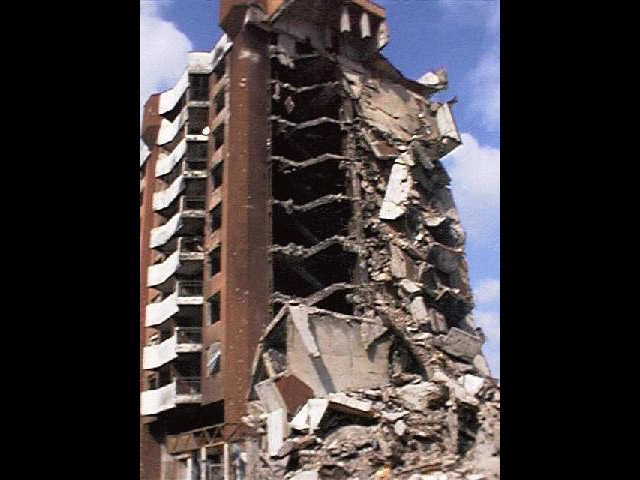
Many of the buildings in Sarajevo had been destroyed by the recent war.

Many of the buildings in Sarajevo had been destroyed by the recent war.

The food is great. The Bosnians tend to be meat and potato people. Lots of Lamb and Veal but they have some other great vegetable dishes as well. Today for lunch we went to a little restaurant to have Cevapcici, a sort of pita  thing made a local bread called Somun filled with grilled sausages, vegetables and onions. This is a popular meal like a hamburger in North America. Last night we went to another little restaurant that was like a deli with lots of good selection of local foods. The local beer (pivo) is called Lachka (or something similar) and I have had a few cans.

Everyone is a winner…

I am always happy to be part of a win-win situation. Last year I enjoyed one that was win-win-win. If I think about it I could add more win’s but you get the point, I am sure.

The St Gorety School is a secondary school in a small village called Mikei, Kenya. It is pretty rurual, about 20 km inland from Lake Victoria and in Nyanza Province, one of the least advantaged districts of Kenya.

Through CanAssist, and with my Canadian friends, Virginia and Suzanne I met Edward Kabaka a couple of years ago. Edward is a founder of a local support group called Rieko Kenya. Well, to make a rather long story shorter, Edward brought the needs of St Gorety School to our attention. Basically the school, serving secondary students from the surrounding region, was overcrowded and needed more classroom space.

St G classroom 2013So in 2012, CanAssist agreed to construct one classroom and complete another which had been partially built with Kenyan government funds which dried up before the roof could be put on the building.

Virginia and Suzanne, secondary school teachers themselves in Kingston, promoted this project to some of their students who responded with fundraising to help with this building.

At the same time, the Queen’s Health Outreach group, university students whose mandate is to promote Health education to students and youth in various parts of the developing world, were looking for a new district in Kenya to work. I have been an ad hoc mentor to this group for the past several years and it seemed natural to put them in touch with Edward and the St. Gorety School.

QHO students visited several schools and community groups in the Nyatike region in 2012.

QHO students visited several schools and community groups in the Nyatike region in 2012.

Last year the QHO group spent several weeks in the Mikei/Nyatike community, living in a house overlooking the rolling Kenyan hills and interacting with schools and women’s groups in the region to educate and promote healthy living practices. Another group of six QHO students are excited to be returning to the community in May/June this year.

When I visited the St Gorety School and other groups in the region in February, they all lit up with smiles at the mention of the QHO students and were ecstatic to hear that there would be a group returning this year.

So where do all the “win’s” come in?

  • CanAssist has been delighted to be able to provide infrastructure support to the school (and three other community groups as well…more about those in later posts).
  • The QHO group has found a welcoming community where they are able to do their outreach work to promote education about health to young Africans.
  • The community which was actually quite neglected and off the beaten track for development has been excited to welcome visitors from Canada who are eager to help them improve their living circumstances. Kenyans love visitors.
  • Edward Kabaka has found support for his dream of improving well-being in the community.
  • Some of the students at KCVI and LCVI in Kingston have established pen-pal relationships with students in Kenya and have the satisfaction of having been able to help their peers in Africa.

And I sit back and smile. It’s all so good.

Treat yourself to the joyous music from the St. Gorety school choir in the Youtube video below.