My goat – Veronica

In an earlier post, I mentioned my goat, Veronica. Let me tell you about how she came to be mine.

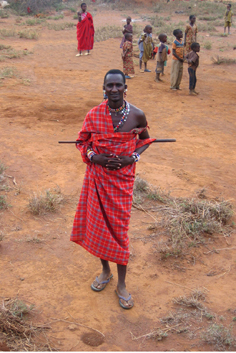
Over the time I spent with the Canadian Field Studies in East Africa, I became good friends with Stephen Moiko, a Maasai fellow who, I met in 2004. In addition to having a traditional Maasai background (he is the second youngest of 27 in his extended Maasai family) Stephen has excelled in academics and is soon completing his Phd in Anthropology at McGill.

His family lives just outside Nairobi on a home site that was once part of his father’s traditional village. They are gradually acquiring various more modern amenities but still struggle with access to water and have outdoor latrines. Electricity is a convenience introduced to their home only 3 years ago.

I have stayed with this family several times since meeting them in 2004 and the many conversations I have had with Stephen, his wife, his mom and his kids have really helped me understand Maasai culture.

On one visit, young Dennis, a nephew of Stephen’s who lives across the road, was sitting with me in the living area as the solar lights were gradually dimming. He was about 12 at the time and intrigued by this muzungu from Canada.

Our conversation was limited and some of our time was spent sitting side by side in silence.

At some point we started talking about friends. “Who is your best friend?” I asked.

“Right now, you are.” was his answer. He took a Maasai bracelet that had been made by his grandmother off his wrist and gave it to me. “I want you to have this,” he said.

Then he said “And I want to give you one of my goats, too.”

I was flattered but didn’t want the boy to give me something so valuable to their family. “Thanks, Dennis but I can’t take it. You know I live far away.”I said

“Oh, you won’t take it away, I will look after it for you but it will be yours. I want to give it to you as my friend.”

The next morning he took me to the paddock and showed me the goat that was to become mine. It was a healthy young female goat with dark marks over the eyes. “She looks like Veronica Lake,” I said. “Let’s call her Veronica.”

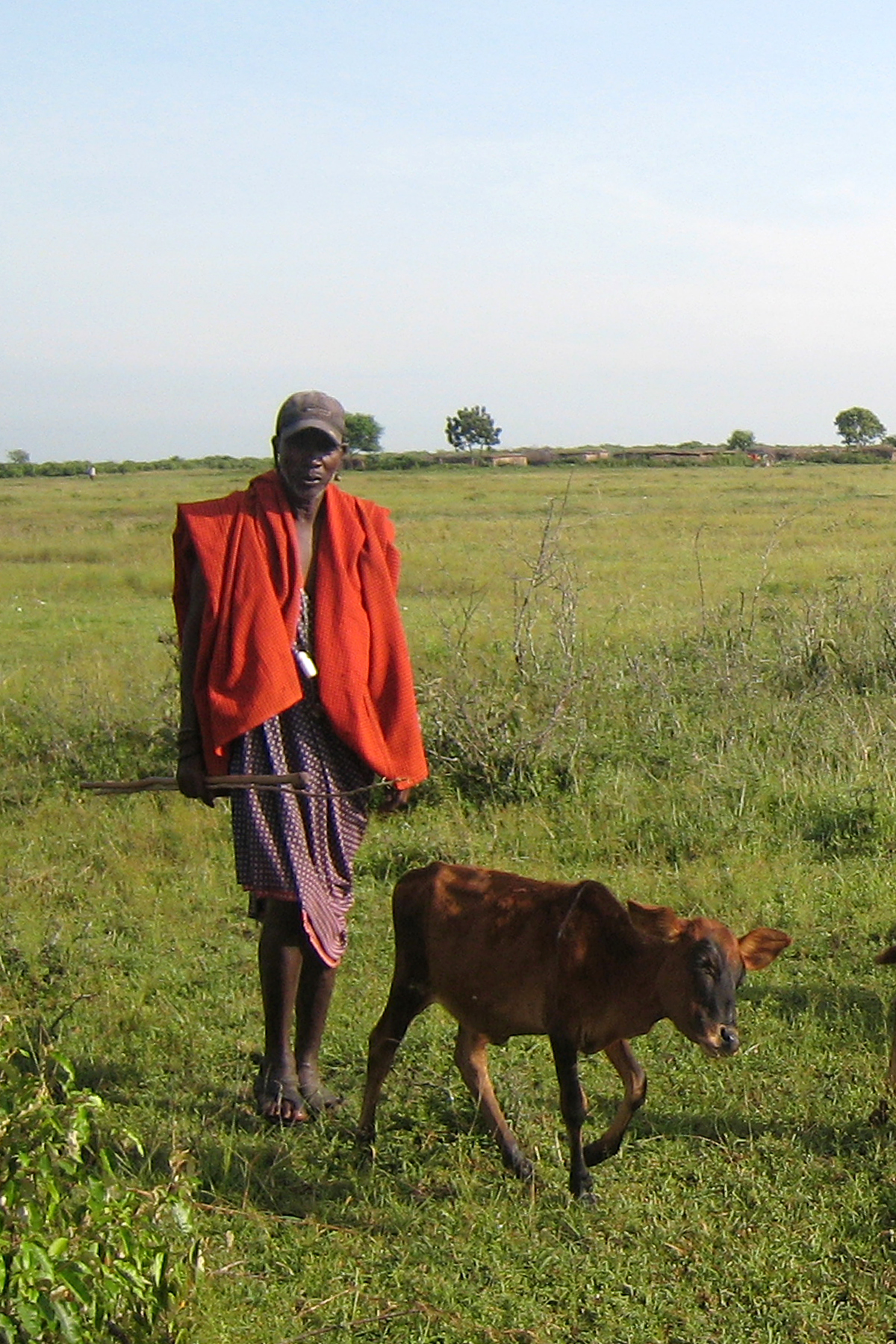
Time has gone on. Dennis is now a young man, having just completed secondary school. Veronica looks a little old and tired but she has had a few kids over the years and Stephen’s mom can still point them out to me. Maasai herdsmen identify their animals by making a unique combination of cuts in their ears to show who owns them. Veronica and her progeny are marked with my unique brand – as part of the Moiko clan. When I visit the family, I always go out to the field to find Veronica and what remains of her extended family. Some of her offspring have, no doubt, become someone’s dinner.

I will always remember the generosity of this young Maasai boy. I still have the beaded bracelet and although I have been given many other beaded items over the years, this is the one that I wear when I visit Maasai communities in Kenya. And Dennis and his grandmother still notice with pride that it is his bracelet that is on my arm. The bracelet reminds us all of the endearing connection we have established despite our quite divergent backgrounds.

I suspect that when I visit them over the years, Maria will point out a goat that is supposed to be one of Veronica’s offspring. I won’t know if they are just humouring me or if it really is one of “mine”. But really, it doesn’t matter. We know that it is a little remembrance that will bond us and that is what is important.

Dennis LP.S. How cool is this? As a result of publishing this blog article three days ago, my young friend Dennis has found me online and we have had a chat. He is now a young man, attending University in Nairobi. What a Christmas treat for me!!! The internet has shrunk the world beyond belief.

My very extended global family

Although I am Canadian to the core, since 1998 I have spent many scattered weeks and months working elsewhere in the world and, to my surprise, have come to think of myself as a global citizen.

One of the great pleasures I have had is developing enduring friendships with people in many communities where I have visited or worked.

In Bosnia I enjoyed the hospitality of several families, and developed ongoing friendships with co-workers during the 11 years that I worked there. My closest associates were Bosniak Muslims, Orthodox Serbs and Croat Catholics. We were all able to get along and work together despite the preceding years of war based on “ethnic” differences.

With my Italian “family”. We chat regularly by Skype and get together every year or two either in Europe or North America.

In Italy, I have friends who have a bedroom in their house that they call “John’s room”. I have enjoyed making pasta with Aunt Bruna, babysat young Enrico when he was a baby and enjoyed special pizza made for me by their friend, Antonio.

In East Africa I have been blessed with cultural nicknames. In Maasai, I am John Ole Moiko Geddes and am a part of the Maasai Oseuri age set. In Uganda I also have been given traditional names of endearment. In western Uganda I have been given the empaako name Amooti. In another part of Uganda I am known as Otim. Emails that I get from there are addressed to Dr. Otim.

My non-conformist calf.

I have my own goat in Kenya (her name is Veronica) and have actually developed a little herd of her offspring. When I visit there, my Moiko family can find my goat(s) in their herd and point them out to me. The goats, however, don’t remember me.

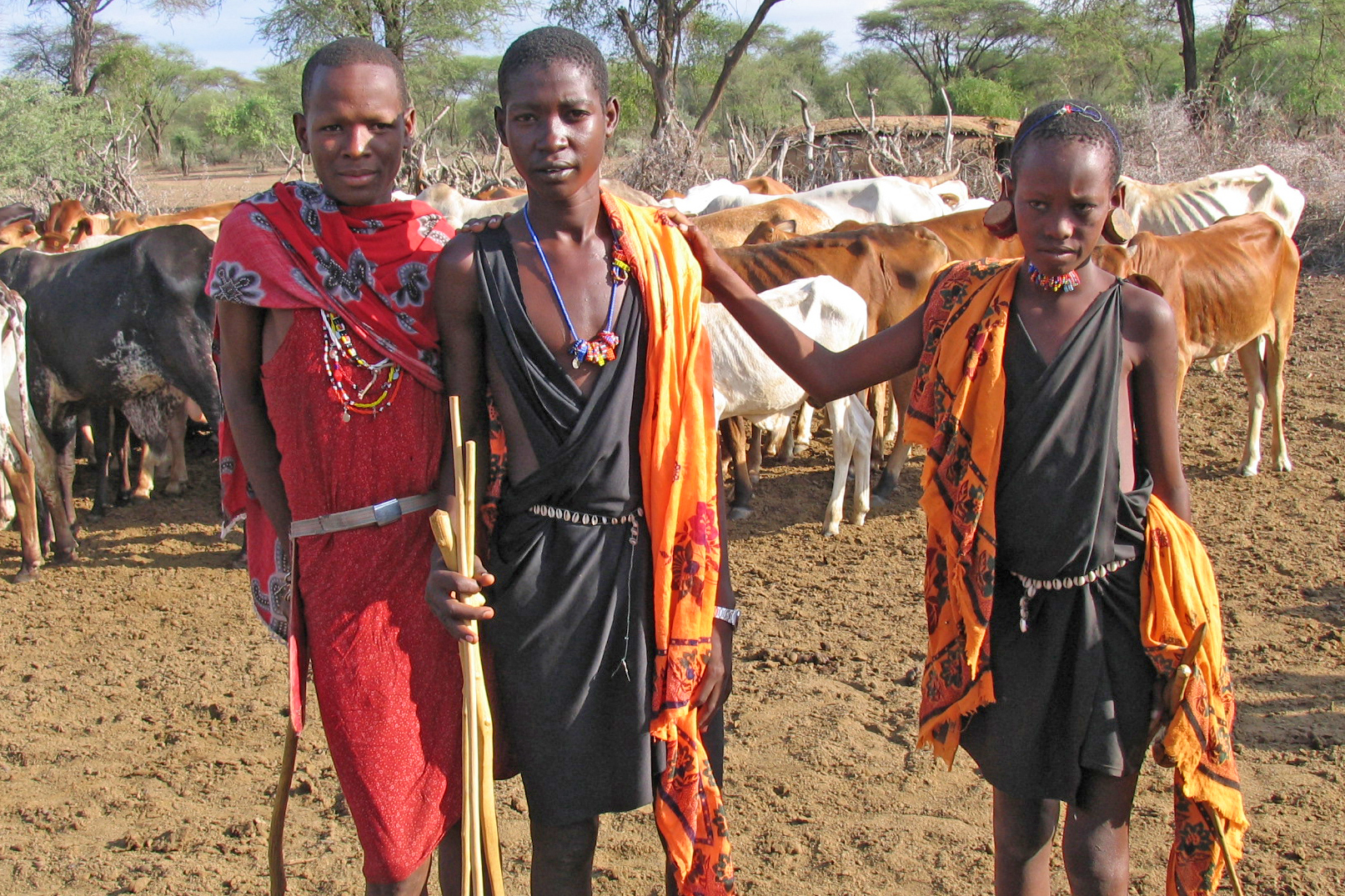
I also had a calf given to me a few years ago. The Maasai fellow who did this said he picked this particular animal because it was “weird”. It was a real non-conformist liking to ramble with the other animals, goats and sheep. I took this as a compliment. Culture, colour, race or religion make no difference to me as to who my friends and family are.

Dan learned early on that if he wanted to be part of my family, he had to sport the right T-Shirt.

In Kenya there is a fellow who calls me “Dad”. I hear from him every week (more often sometimes than my kids here in Canada!) and he is Facebook friends with my family, has chatted on Skype with my 93 year old father and has pictures of my grandchildren stuck on the door of his refrigerator.

Having the chance to actually live with families in different communities has definitely given me opportunities to develop close friendships not usually available to “tourists”. These relationships have enriched my life immeasurably.

The “D” word…Drought.

This is a slight variation on an article that I wrote that was published in the Kingston Whig Standard, on Monday October 22, 2012.

In Eastern Ontario it has been a dry hot summer. Ideal for vacations, swimming at the cottage and just living outdoors. But not ideal for farmers.

We tend to take water and even adequate rainfall for granted here in Canada. But this year farmers in Ontario were suffering. Apparently corn crops are miserable. Many farmers who raise livestock are having trouble finding feed for them. Grazing fields have been dry and wheat crops have failed. The Ontario Federation of Agriculture, combined with the Mennonite Disaster Service have initiated a program whereby Western Canadian Wheat farmers can donate bales of hay for feed to ship by train or truck to their Ontario peers.

The first shipment of 200 bales arrived this week. They estimate that the need is more like fifty thousand bales.

I wonder if we are getting the idea that the climate is changing and that it will affect us. We have been relatively insulated from the shift in weather patterns. Air conditioning when it is hot. Ample supply of fresh water in lakes and rivers. Government subsidies. Social assistance.

In Africa the situation is more challenging.

Just for a moment, put yourself in the shoes of a Maasai herdsman in Kenya.

First of all, the shoes would likely be made from old auto tires. Or maybe you would have no shoes at all.

Your herd of cattle, even at their best being scrawny compared to what you see in Canada, are grazing in the open on land that is barren and dry. It has not rained in several months. You have to walk miles with your cattle to the local watering hole, a source shared by the livestock and humans alike for drinking, cleaning and bathing.

On the way to the water source one of your animals becomes weak and collapses. You have no choice but to leave her there. Hyenas and vultures will take care of the rest.

Traditionally you have always relied on your animals as your source of wealth and many years ago you moved with your extended family from region to region, building a new village as you relocated and following the rain and grass for your animals.

Early in the 1900’s the British colonialists arrived saw your land as being not “owned” by anyone. Ignoring your traditions, they quickly set to work according to their laws and customs to purchase land for themselves and erect fences. You and your animals became gradually squeezed to less favourable locales. The city of Nairobi now sits on land that your grandfather used for grazing his cattle.

Rain is essential to your survival. In the past few years there have been increasingly longer periods of drought, often lasting for months and months. Your animals stop producing milk. Many of them die. Your “wealth” is drastically reduced along with your supply of food.

You have nowhere to turn for social support. Food prices in general escalate, in part because of lack of local foodstuffs but also because of the increasing cost of fuel to transport food from further away.

What can you do? Where can you turn? You might give up your traditional means of livelihood and move to the city. But you are not educated, have never used a computer and when you get there would be forced to cram into slum living conditions with others who are flocking to the city looking for work.

So you pray for rain. Your children go hungry. You scrounge for any bit of food for you and your animals. You rely on handouts from International Food Aid programs or your neighbours. You hope.

Eventually rain comes. Within days there is a tinge of green on the landscape. You rejoice that you have survived this crisis, emerging more poor even than you were before, but ready to start over.

Every few years, this kind of drought event has occurred in East Africa for a long time. Now, the problem is that this pattern is happening with increasing frequency.

People in tropical climates have recognized these changing patterns for a while now. They are powerless to change them. The CO2 emissions that are leading to these climate variations are coming, almost entirely, from the more opulent nations in temperate climates – regions that have been somewhat protected from the resulting changes. We may be happy to shovel less in the winter, spend more time on the beach in the summer but eventually the penny will drop.

This year in Ontario we have had a significant drought. It has been a crisis for farmers and food producers here. Will it become more common as time goes on and the climate changes? How can we prepare for this?

And I wonder what will happen to the Maasai pastoralists.

Here are some weather observations that reinforce the notion that patterns are changing.

Digging in to help Africa

Food security is a major issue in Africa. The cost of living in East African countries has risen substantially over the past couple of years and, coupled with erratic climate changes, this has resulted in a situation where people who are already living on the edge are having trouble affording basic foods, let alone nutritious diets.

The CanAssist African Relief Trust has sponsored  school garden projects that have been very successful. Our first project related to this was with the Kanyala Little Stars school on Rusinga Island, Kenya. The first step in starting a garden here was to put up fencing to keep hippos and other grazing domestic animals like donkeys and goats out of the garden. If you think think squirrels and rabbits are a garden nuisance, imagine the havoc that can be created by a family of hippos lumbering up from Lake Victoria to graze overnight. For the Little Stars garden,  CanAssist also arranged appropriate irrigation through a pump and sprinkler system and set up a work shed, toilets and provided seeds and fertilizer. The garden has proven to be a great boon to the school and community, now producing fruits and vegetables that supply the school children with better nourishment, and provide a bit of extra income to help with other school expenses, provide nutritious supplements to needy families in the community at reasonable cost. It has worked well.

In other schools in Kenya and Uganda we have supported similar projects which are also proving to be equally successful.

Earlier this year, we also helped a local youth group in Migori district of Kenya and this week we received an encouraging report from Edward Kabaka, director of Rieko Kenya, a local development organizaton.

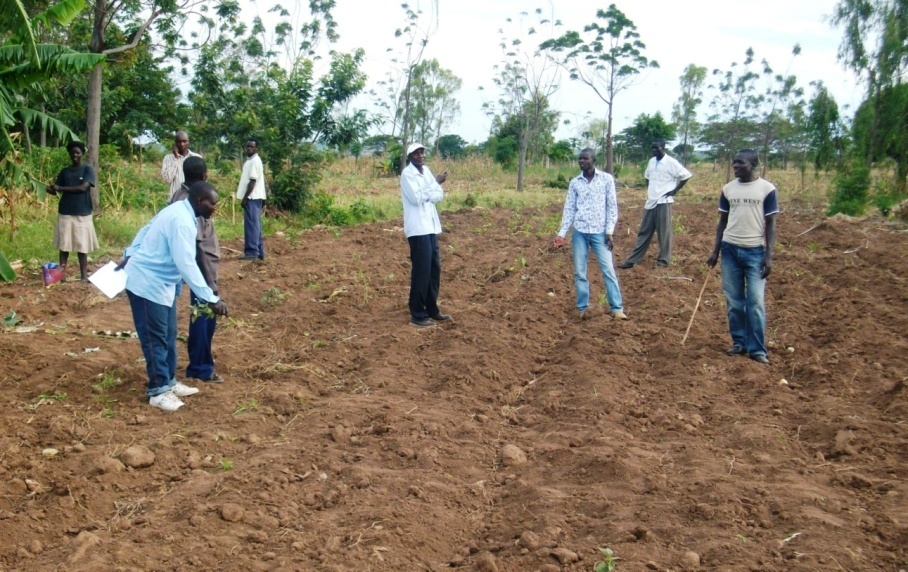
The Nyaruanda Youth group provides the manpower to till and maintain their local garden.

“The Nyaruanda Youth Development Group is a community based initiative started in March 2010 in south Kadem Location, Nyatike District in Kenya. It was started by a group of orphaned youths who were left behind as head of households in their families. When they were 10-12 years old, many of them lost their parents to HIV/AIDS. They have graduated to replace their deceased parents in roles of fending for their siblings. As they grew up together, they realized that they were facing the same challenges and started organizing themselves in small groups. They need to provide food, clothing, shelter, medical care and above all schooling for their families.

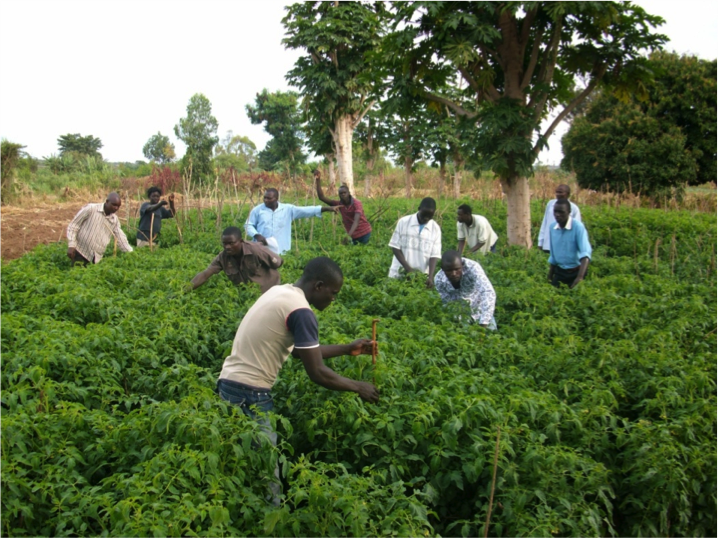
A first harvest of Tomatoes, Watermelons and Sukuma wiki (a staple African green rich in iron and vitamins) from the CanAssist-supported Nyarunda Youth Group garden.

In the beginning of 2012, Rieko Kenya had the opportunity to be visited by John Geddes, the Executive Director of CanAssist African Relief Trust (CAART). Rieko Kenya considered Nyaruanda Youth as one of the groups to be visited by John. John agreed to present an application to CAART to help support the group, through Rieko Kenya, with small scale irrigation equipment and materials. The support from CAART was realized with Rieko Kenya providing training and facilitating the purchase of the irrigation equipment and materials (Water pump and pipes) and presented to the group. After a period of a half a year and following this life saving and transforming support, the Nyaruanda group is very excited and happy to report a huge financial gain. They are now able to be self reliant and meet their financial obligations.”

CanAssist is delighted that these local agriculture projects are not only providing better nutrition to communities; they are helping to stimulate economic development.

A letter from Africa

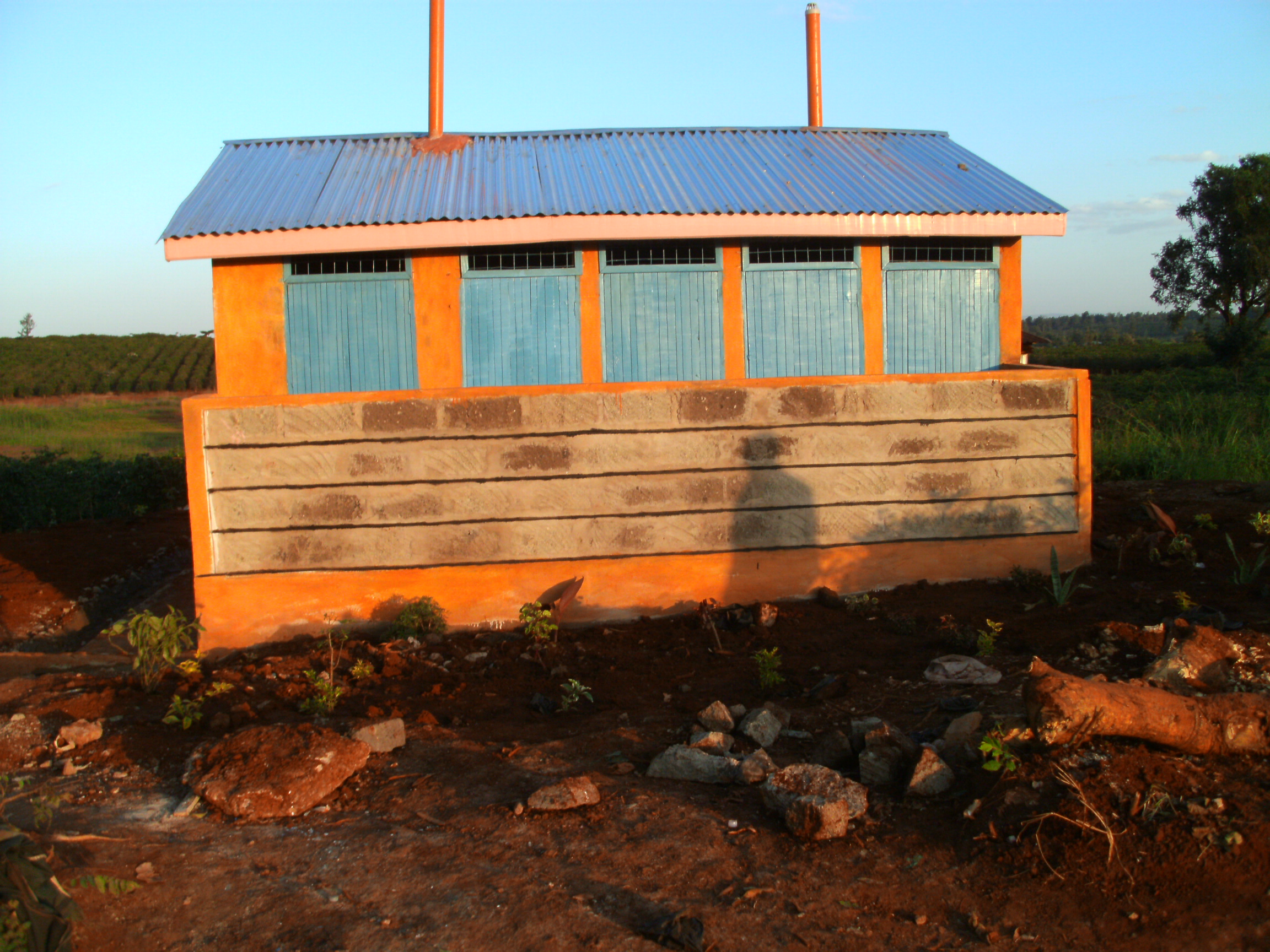
One of the three completed latrines that will dramatically improve sanitation for students at the Mutundu School in Kenya – funded by CanAssist African Relief Trust

I am happy to share this letter of appreciation from Michael Gichia who has been the African contact with the Murera Community Empowerment group and the Mutundu School where the CanAssist African Relief Trust has funded construction of new latrines and provision of clean water.

See these earlier posts for background on this project.

Sanitation…or lack of it
Sanitation..making progress
Not just new latrines

Dear John,
I hope you are doing fine as we are here in Kenya. I would like to let you know that we have completed the proposed project successfully and I’m taking this opportunity on behalf of MCESO to thank all the trustees, board members, staff and the friends of Can Assist African Relief Trust for their generosity in support of our project titled, provision of clean portable drinking water and construction of enhanced sanitation facilities in Mutundu primary school in Ruiru District 0f Kenya. Your financial commitment has incredibly helped and has allowed us to reach our goal. We would like to let you know that your financial inputs towards our proposed project have greatly helped the project turn into a successful and replicable model and the situation at Mutundu pry school has improved from worst to best.

We pray that may God keep continue giving you good health as well as good will to keep on helping marginalized communities.Please find attached our end project for your files.Too, we have kept all the project invoices safe.We look forward to submitting another project proposal to Can Assist African Relief Trust soon.

Thank you once more and God bless.
Sincerely,
Michael.

Read Michael’s full report on this project here.

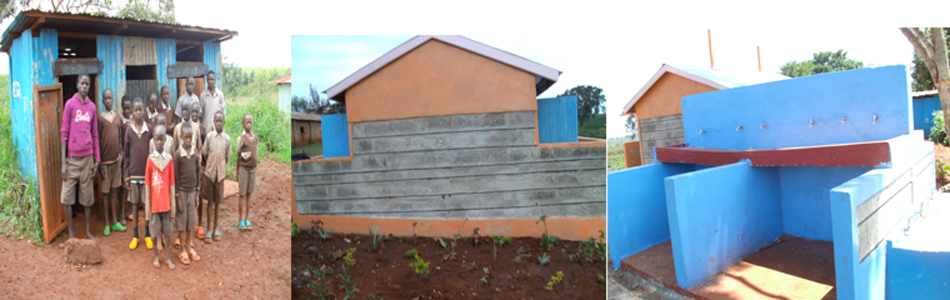
Mutundu school latrines

Before and after photos of the boys latrines at Mutundu School. In addition to the latrines, sanitation has been improved by the construction of handwashing stations. CanAssist has been delighted to have funded these sanitation improvements.

Now look what you have done!

On July 1, I issued an appeal/challenge on behalf of the CanAssist African Relief Trust to raise money to build two classrooms at the Hope School in Mbita, Kenya on the shores of Lake Victoria.

The Vancouver-based Sasamat Foundation had offered $10,000 and up to another $5000 to match 2:1 donations that were received from CanAssist supporters to build the school.

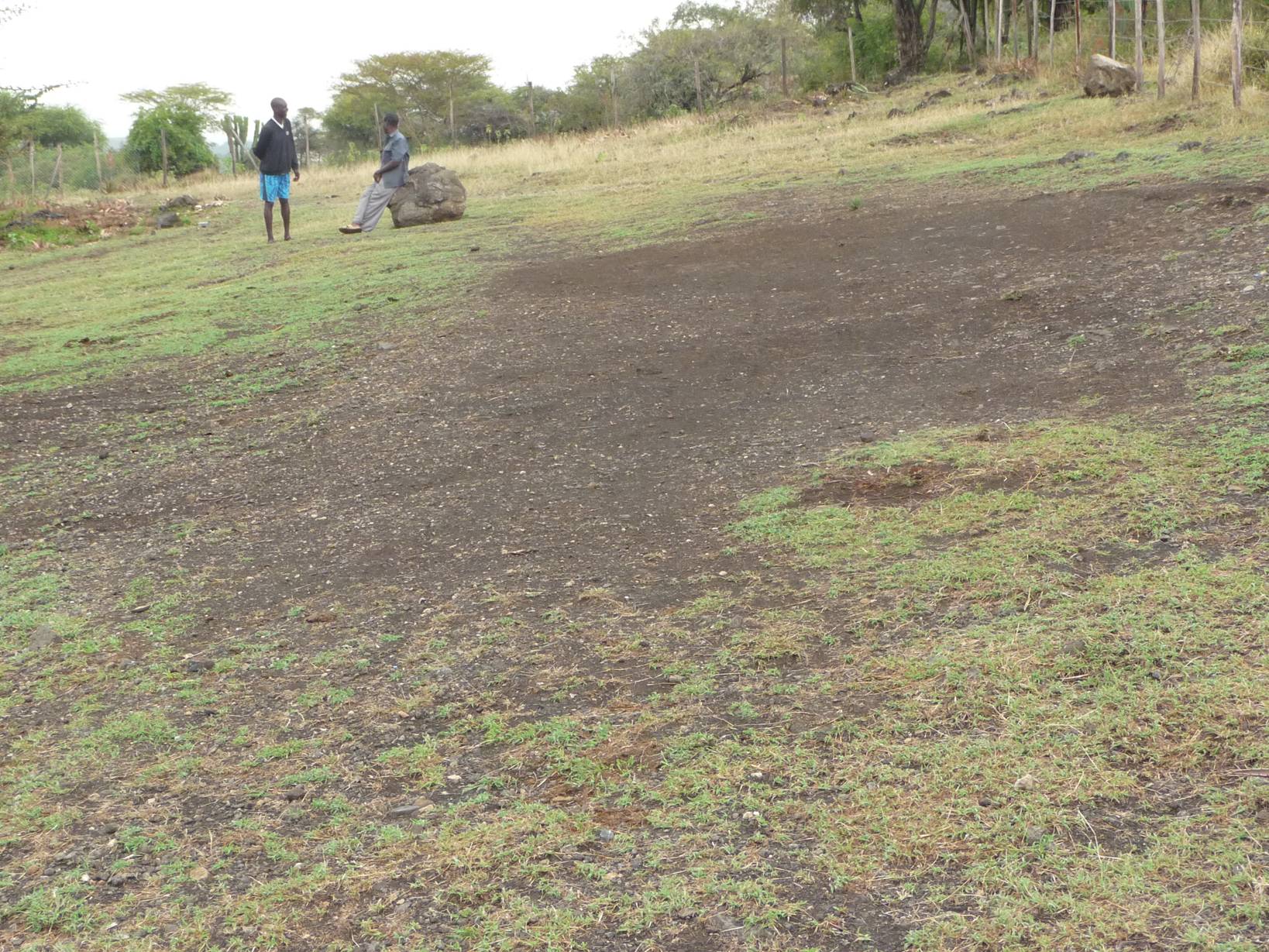
This is the schoolyard of Hope School in mid August 2012. The site of proposed CanAssist classrooms.

By the end of July we had reached our goal and in late August the money to start construction was sent to the Hope School.

The CanAssist Hope School Classrooms are coming along in leaps and bounds. I could not believe my eyes when I received photos today of the construction under way. The barren piece of ground in the schoolyard is quickly being converted into a learning setting for the children of this community who have previously been taught in a rudimentary building or under a tree. Most of the children in this neighbourhood are disadvantaged and some have simply not been able to attend school even up to age 9 or 10.

The CanAssist Hope School Classrooms are coming along in leaps and bounds.

This project will transform the community for these kids. And as I have mentioned previously, this not only provides the classrooms for the children, it gives some employment to local workmen who struggle to find employment.

Thanks to everyone who rose to the challenge. I hope you are gratified with the way that your gift to these children is working so quickly. I look forward to visiting this school in early February and participating in a Grand Opening celebration.

Read earlier blog posts about this project here:
A Canada Day Challenge
Canada Day Challenge Met.

My thanks, as well, to Kennedy Onyango for the photos and for the ongoing responsible supervision of this project.

Not just new latrines

I’m delighted to have received further updates about the sanitation improvements that CanAssist is funding at the Mutundu Primary School in Kenya.

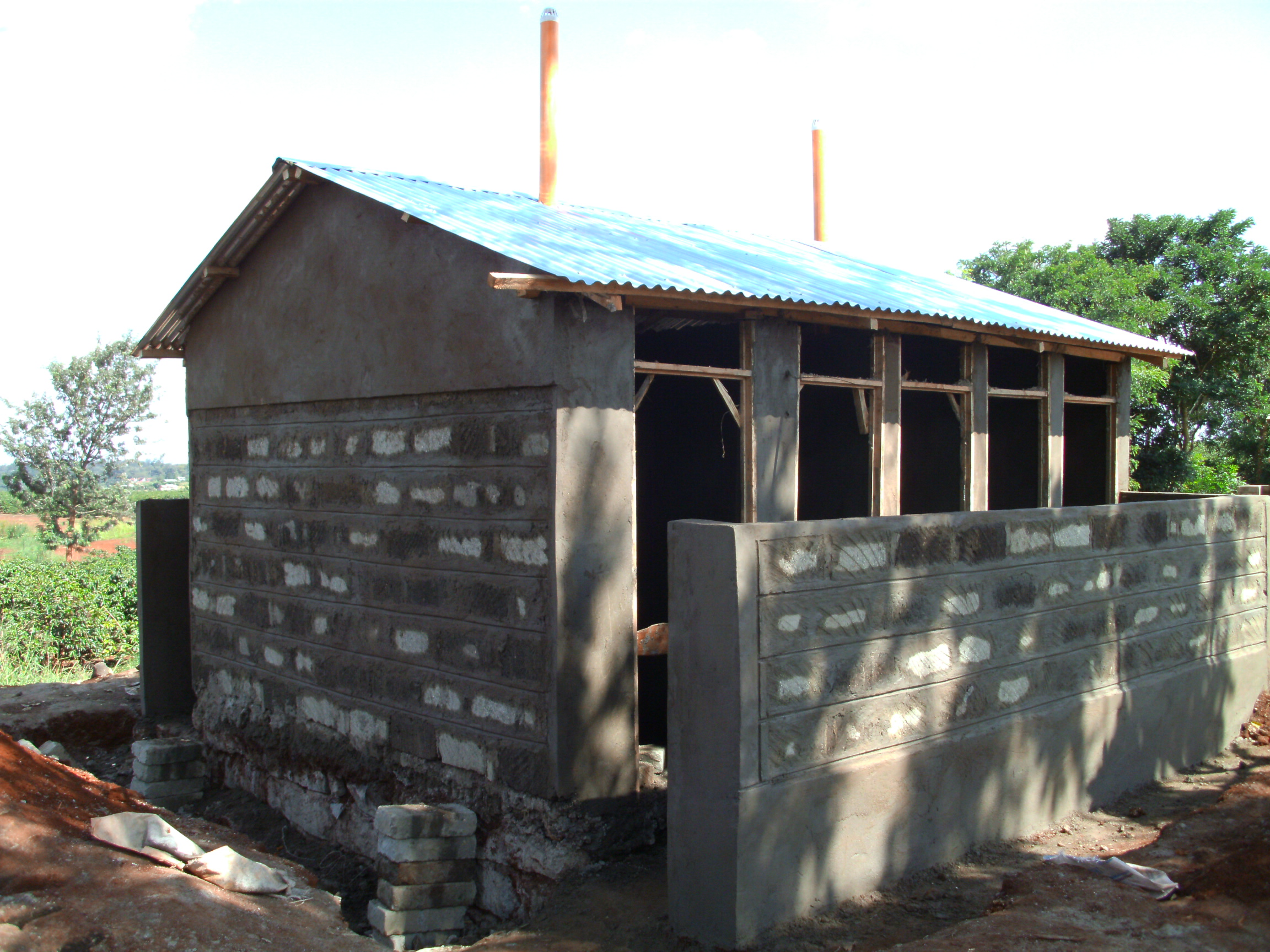
Toilet for girls at the Mutundu School – Spring 2012

I first wrote about this in a blog article in June (Sanitation – or lack of it) and subsequently updated it last month (Sanitation – Making progress) As you can see from the photos, the state of the toilets for staff and students at the school when our Kenyan assistant, Dan Otieno, assessed them was nothing short of disgusting.

Last week I received more pictures of the new latrines at the Mutundu School I would like to share along with some hidden advantages to the community from the kind of development work we are doing through the CanAssist African Relief Trust.

New CanAssist-funded girls toilet at Mutundu School. August 2012

I have come to realize that often the stimulus to a community provided by the funding of an infrastructure project such as this one has other less obvious benefits. The materials for construction are all locally purchased and the skilled (and unskilled) labourers to construct the projects are local tradesmen, often without much work. So we are not only providing the structure or item that will be part of the community and improve well-being there, we are also giving some employment to the locals, albeit temporary.

CanAssist recently sent money to another school in Uganda – Hope for Youth School near Mukono – to purchase 70 desks and chairs for the school. The cost comes to just over $5000 to do this. The bonus is that the desks and chairs will all be made locally by carpenters who will therefore benefit as well. This is a Win-Win situation. The school gets the needed furnishings and the local carpenters (and suppliers) benefit from the business.

It makes me happy to see this work at the Mutundu school progressing, knowing that the sanitation (and thereby health) conditions at the school will be greatly improved. I am also glad that the community are having some opportunity to participate in the construction and even earn a bit of money as they contribute to achieving these goals.

When money for infrastructure projects like the latrines at Mutundu School becomes available, it creates lots of interest in the community, a sense of ownership of the project and employment for tradesmen in the region.

Vacation on the Equator in July?

While Canadians sweat it out on the 45th parallel with July temperatures around 30 degrees Celcius, can you imagine what it is like on the Maasai Mara in Kenya, just below the equator?

Well, it is fantastic! Daytime temperatures in Kenya are around 24 degrees during the day in July and dip to a comfortable level in the teens at night. It is perfect weather and generally not rainy, either. My African friends complain that it is cool and call it their “winter”.

Giraffes on the Maasai MaraCombine that with the fact that it is summer vacation time here in North America and it makes the ideal time to travel to East Africa on a holiday.

The weather in East Africa has traditionally followed the pattern of having two rainy seasons, one in October to December and one in April and May. And when it rains in Africa, it rains.

During the dry season the ground gets packed down and hard and the first rains flow over the land in rivulets, causing great furrows in the roads and problems with erosion. So avoiding the rainy seasons are a good idea if you are planning a safari. Unfortunately, the weather conditions have become less reliable with climate change and rains tend to occur a bit more unpredictably.

But, in general, July and August and January and February remain pleasant and relatively dry.

Added to this weather appeal is the fact that the famous Wildebeest migration happens in July and August. Two million of these oddly constructed creatures migrate from the Serengeti in Tanzania to the Maasai Mara in Kenya, bringing with them hordes of zebras and enticing carnivores like lions to activley gorge themselves with the plenty. Even the crocodiles in the Mara River wake up for this passage, feeding while they can and then lying dormant for months between feeds.

The Indian Ocean coast, by comparison, is hot all year through. If you like to swim in the ocean or scuba dive or snorkel, the clear reef waters are the perfect place for a beach vacation.

Another unusual thing is that, despite it seeming quite summery, the days remain on an almost 12 hour cycle throughtout the whole year. The sun comes up between 6:30 and 7 in the morning and sets between 6:30 and 7 all year round. Early to bed and early to rise is the habit.

The only down side of traveling in July and August is that it is a more expensive time to fly to Nairobi since all the flights from North America tend to bounce through Europe and connect from there south. Being the peak season for travel in the Northern Hemisphere adds to the cost.

Wanting a trip of a lifetime? Kenya in July might fit the bill.

I took my “once in a lifetime” visit to Kenya in July 2003. I have been back to East Africa ten times since that trip. Indeed, it was a safari that changed my life forever.

Canada Day challenge met!

A huge THANK YOU is in order for everyone who responded to the Canada Day Challenge I wrote about in this blog on July 1. Through your generous donations and a bonus from the Sasamat Foundation in British Columbia, CanAssist has secured the money to build the two needed classrooms at Hope School in Mbita Kenya. Everyone is delighted. I will be sure to provide updates as the school classrooms rise from the dust.

Kennedy Onyango is our contact and the founder of the Hope School. I first encountered him in July 2010. He exemplifies the typical story of relatively ordinary Africans (but motivated ones) who see a need in their community and they dedicate their personal resources and time to finding ways to improve the plight of the people who live around them.

In Kennedy’s case this was to help vulnerable young children in his region – kids who lived in poverty or were orphaned – get a start at being educated. He founded a “school” which is divided into two locations. One is in two crammed classrooms behind a bank in the town of Mbita and another on a larger property in the hills beyond the town. There are 160 kids who come to these makeshift classrooms.

In addition to giving them education, the school also provides a mid-day meal for the children. Sometimes this is the only food that they get for the day.

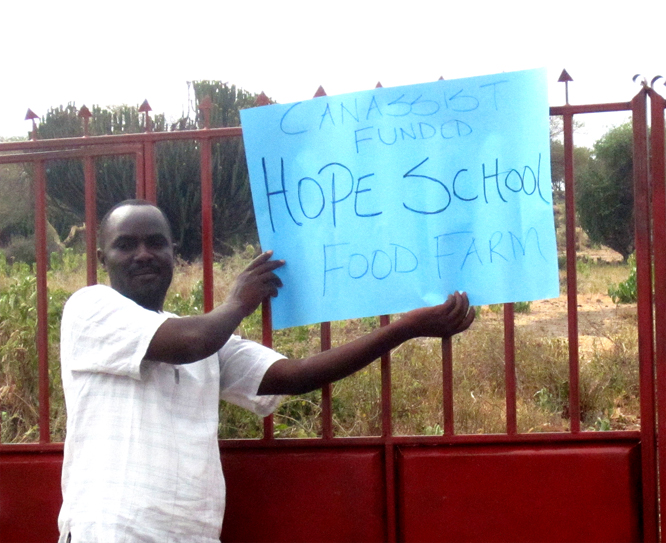
Kennedy Onango holds up a sign that marks the beginning of the CanAssist Oasis of Hope Garden for the Hope School at Mbita Kenya

Kennedy first asked CanAssist to help develop a small farm where they could raise vegetables and fruits to supplement the otherwise bland gruel diet provided to the kids. In early 2012, CanAssist gave the money to start this up and very soon Kennedy had created what he calls the “Oasis of Hope” on the rurual school property.

In mid July, I got this report from Kennedy. It surpassed my expectations for success in the early months of developing this garden. Kennedy writes:

This month in CanAssist funded ‘Oasis of Hope Garden’, we take a deeper look at this farm, which is celebrating its first harvest. In a single 3 month production cycle, 480 kilograms of sourghum, 120 kgs of beans have been harvested so far from a 2 acre ploughed open farm. The same 3-month production cycle is also projected to yield a 120 kilogram of maize (corn). This has clearly reinforced our earlier thought of making the garden both food granary and source of funds to support key school operations. It’s true, a good income can be realized from the selling of sourghum.
Why is this important? 140+ children at Hope School have never had an opportunity to drink nutritious porridge from the initially barren school farm yard. Rural peasant families of Mbita don’t have the money to take a chance on unproven technologies. Demonstration farms like the CanAssist funded ‘Oasis of Hope Garden’ give families a firsthand look at the income increases they can achieve with an investment in appropriate technologies for improved on-farm yields
You can see how CanAssist’s approach of working with poor, marginalized rural communities of East Africa transforms lives on our first ever bumper harvest in this school farm.
We remain appreciative for CanAssist supporters and with special thanks to Sasamat Foundation for having donated funds towards classrooms construction at Hope School, besides nutritious meals, the children will now get conducive learning environment!”

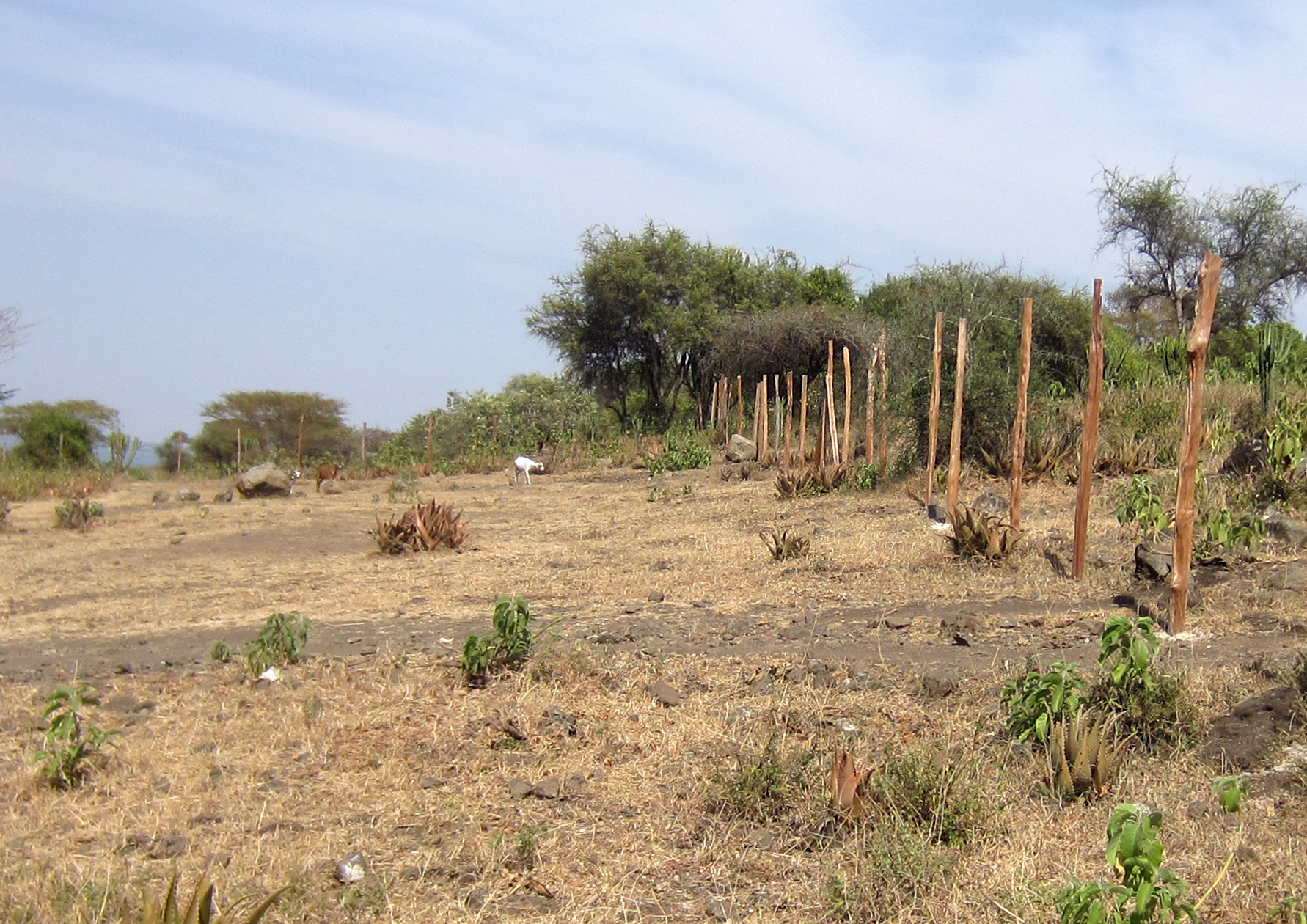
The first step in creating a garden was to fence the property to keep protect the garden from wandering neighbourhood goats. This dry corner is the same place where the banner picture of maize plants was taken three months later.

I hope that this enthusiastic endorsement of the work that we are doing through CanAssist makes our donors smile with satisfaction. With the support of Canadian donors, Kennedy and others in his community have been able to take a barren piece of land and turn it into a veritable Oasis of Hope for the children at Hope School and those who live around it. We are making a difference to individuals and communities in East Africa. Asante sana for your help in achieving this.

Another “Big Day” for Kanyala Little Stars

One year ago, twenty Canadian supporters of the CanAssist African Relief Trust joined the children and staff at Kanyala Little Stars School on Rusinga Island, Kenya to celebrate the “opening” of the school farm. With a lot of hard work by the Kanyala team, financial and moral support from CanAssist, and a sprinkling of engineering advice from Canadian Andrew Forsyth, the school turned a dry open field into a lush garden that now produces vegetables and fruits to support the school, both nutritionally and economically. Some of the initial challenges included getting water to this dry property, fencing it to keep the hippos from ravaging the garden at night and enriching the soil to make it fertile.

This week, I received this email message from Mama Benta Odhiambo, the director of the Kanyala Little Stars School :

“I am writing to share with your honourable self and the CANASSIST-Canada Team that we are planning for a Big Event on Wednesday 25th July 2012 to celebrate the 1st Anniversary since our Farm’s launching by CANASSIST. This day-long event will bring together key local goverment officials and local groups and community members to see for themselves how the farm has changed from a drought-strickened, barren Land to a green, beautiful heaven with variety of fruits,trees and crops.

We will also hold a big celebration for the orphans and the Little Stars children, where they will be given fruit salads made from our farm produce on that day.

The Canadian flag will be raised high on that day both at the farm-gate and in the school to show our gratitude and appreciation to CANASSIST and the people of Canada.

We owe you alot and would feel happy if you allow us share this success wih the government of Kenya,locals groups community and the children.”

Val Horsfall and Erin Firlotte ride with students of Kanyala Little Stars School to the School Farm where the school and their visitors from Canada celebrated the official opening of the farm project on July 25, 2011.

There has been another remarkable surprise. The CanAssist farm and the hard work of the Kanyala team has been internationally recognized. Last month, Mama Benta attended a conference in Geneva, Switzerland to present the CanAssist Kanyala farm as a model for mitigating the effects of drought on food security in Sub-Saharan Africa. Quite a change for Benta to go from rural Rusinga Island to an international meeting in Geneva.

Africans know what to do to improve their lot. They do, however, lack the financial resources to put their plans and dreams into action. CanAssist is happy to be able to provide the needed spark to ignite this development. Following the Kanyala success, CanAssist has also started a second school garden in the Mbita region. The school has named it “The CanAssist Oasis of Hope”.

Congratulations, Kanyala Little Stars, on your success.

This week, several of the Canadians in the group that visited the farm a year ago gathered for a reunion of their own. They were happy to record greetings and messages of congratulations to their friends at Little Stars in Kenya and send them through is short YouTube video.

CanAssist supporter, Susan Potvin, interacts with children at the Kanyala Little Stars “Big Day” on July 25, 2011 when the school celebrated the official opening of the Kanyala CanAssist Farm.