I have been curiously surprised that every time I watch the rescue video of that crane operator stuck out on the boom above a raging fire in Kingston I choke up.
Maybe I am just getting soft in my old age. But there is something very gripping and touching about one human being rescuing another from probable death. It is all the more remarkable that the rescuers were helping a total stranger. (Although the fellow dangling below the helicopter seems to have gotten most of the attention! there was a virtual squadron of Emergency and rescue people involved in making this happen.) I know it is their “job” but they seem to have done their “job” without questioning the risk to themselves. We owe these people a huge thank you for keeping us safe.
What touches me most is the reassurance that we humans can respond without question when we see one of our own in mortal danger or in need. We are constantly bombarded with news reports about mankind fighting and cheating, manipulating and hurting each other . With this incident, we are reminded that at the core we can be good. I am grateful for that reminder this week. It is an unexpected gift to be reassured that we can and will look after each other.
Anyone using the internet has seen the touching photos and videos of animals braving danger to rescue one of their own. The African Buffalo that save one of their young from lions and a crocodile are dramatic and heart-warming. For me, the heroic aerial rescue that happened right here in my home town is as spectacular.
Photos from Kingston Whig Standard, CKWS TV and YouTube.
For several years I worked in Bosnia and spent a lot of early Decembers in Sarajevo, a multicultural city that was still predominantly Muslim, before returning home for Christmas. The country was also in a post-war period and struggling to rebuild. I was always struck by the contrast between their society as it prepared for the winter solstice and year-end and mark varied religious celebrations and the onslaught I got when I came home the week before Christmas where I was bombarded with the pre-Christmas hype and commercialism that we endure in North America.
In the past few years, retailers have developed special shopping days to encourage people to buy, buy, buy – Black Friday and Cyber Monday. The aim seems to be to offer bargains for people buying Christmas gifts and help the retailer get everyone in the spending mode.
This year, for the first time, Canada will mark Giving Tuesday. Instead of focusing on getting, on December 3 there will be a country-wide effort to think about giving back – either through donations or volunteering.
The CanAssist African Relief Trust depends on donations from people across Canada to do the infrastructure support work in East Africa that we know helps communities to improve their well-being. We fund school classrooms and desks, hospital equipment and beds, rainwater catchment equipment in schools, clinics and communities, latrines for vulnerable children and adults at schools and in villages where no facilities have existed.
Each year CanAssist attempts to fund about $100,000 work. We rely on the generosity of donors to do this.
This Giving Tuesday we hope you will consider the CanAssist African Relief Trust in your charitable activities. And a bonus is that a donor has agreed to match the first $3000 in donations to CanAssist on December 3. So the value your donations (which already can buy about 4 times as much in East Africa as it would in Canada) will be doubled. Your donation will also be tax-deductible.
A study in the U.S. last year showed that the majority of people would prefer to have money donated to a charity than receive a gift that they could not use or did not really want. In this Holiday Season, please put CanAssist on your Giving list. Donations can be made with a credit card on the Canada Helps link below or by searching for CanAssist on the Giving Tuesday website. Or you can mail a check to 582 Sycamore Street, Kingston, Canada K7M7L8.
In the next few days, I will post some videos that highlight some of the work that CanAssist has already done in Kenya, Uganda and Tanzania. We plan to continue to do similar work next year with your support.
Listen to members of various CanAssist partner communities as they express their appreciation for the generosity of Canadians that is making a difference for them and their families.
I have been drawn to the vibrant colours of the early summer flowers and, like most photographers, can not resist capturing some of these images.
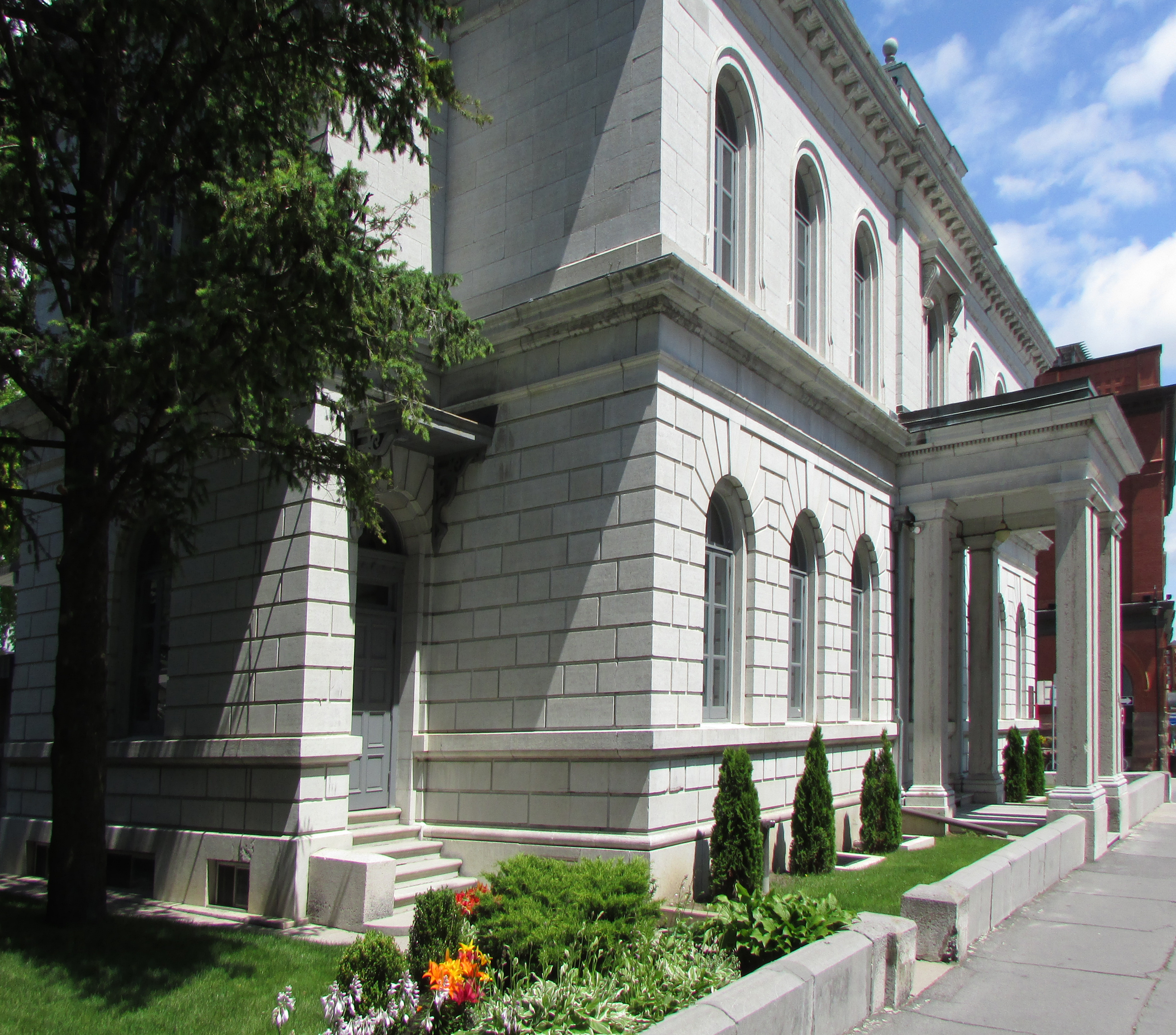
The lilies are in a garden just outside the historic Kingston Customs House buliding built in 1856 at the corner of Brock and King Streets.
The pansies are in a pot on my balcony – loving the weather.
This geranium is on a plant that I have in my living room window. It overlooks the lake and watches the Wolfe Island Ferry come and go. I have had this plant (or an offspring of it) for over five years and it currently has 61 buds and blooms on it. Like me, it is very happy to be living by the lake in Kingston.
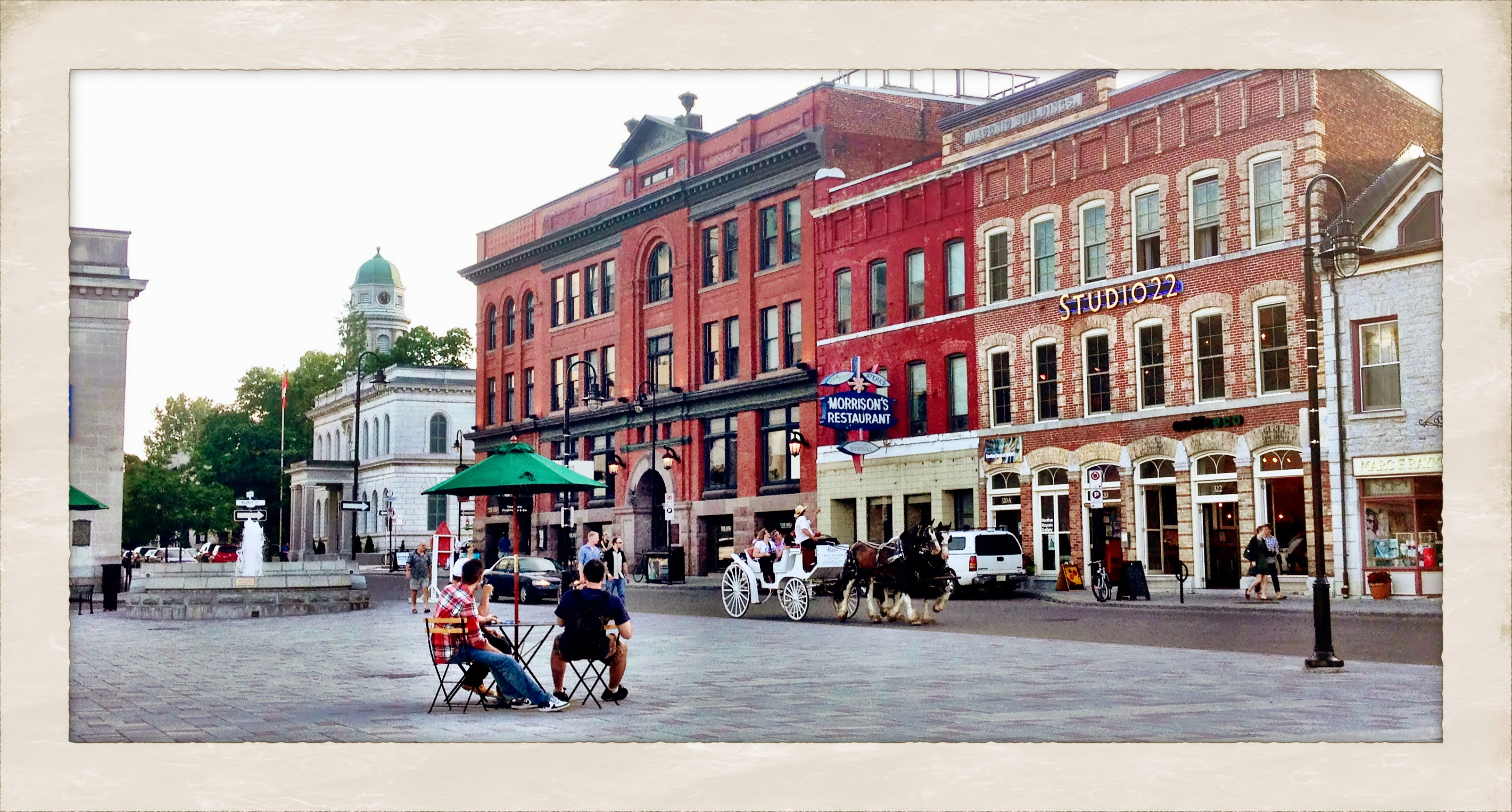
And Kingston Market Square behind City Hall, of course.
Today was the first day of summer according to the calendar.
This evening the Lake Ontario was calm and there were lots of people out enjoying the longest day of the year for us. Sunrise was this morning at 5:22am and sunset at 8:53.
I went out to enjoy the evening and, once again, had to pull out my phone for some photos, all taken within a 10 minute walk from where I live. How I do enjoy living in downtown Kingston.
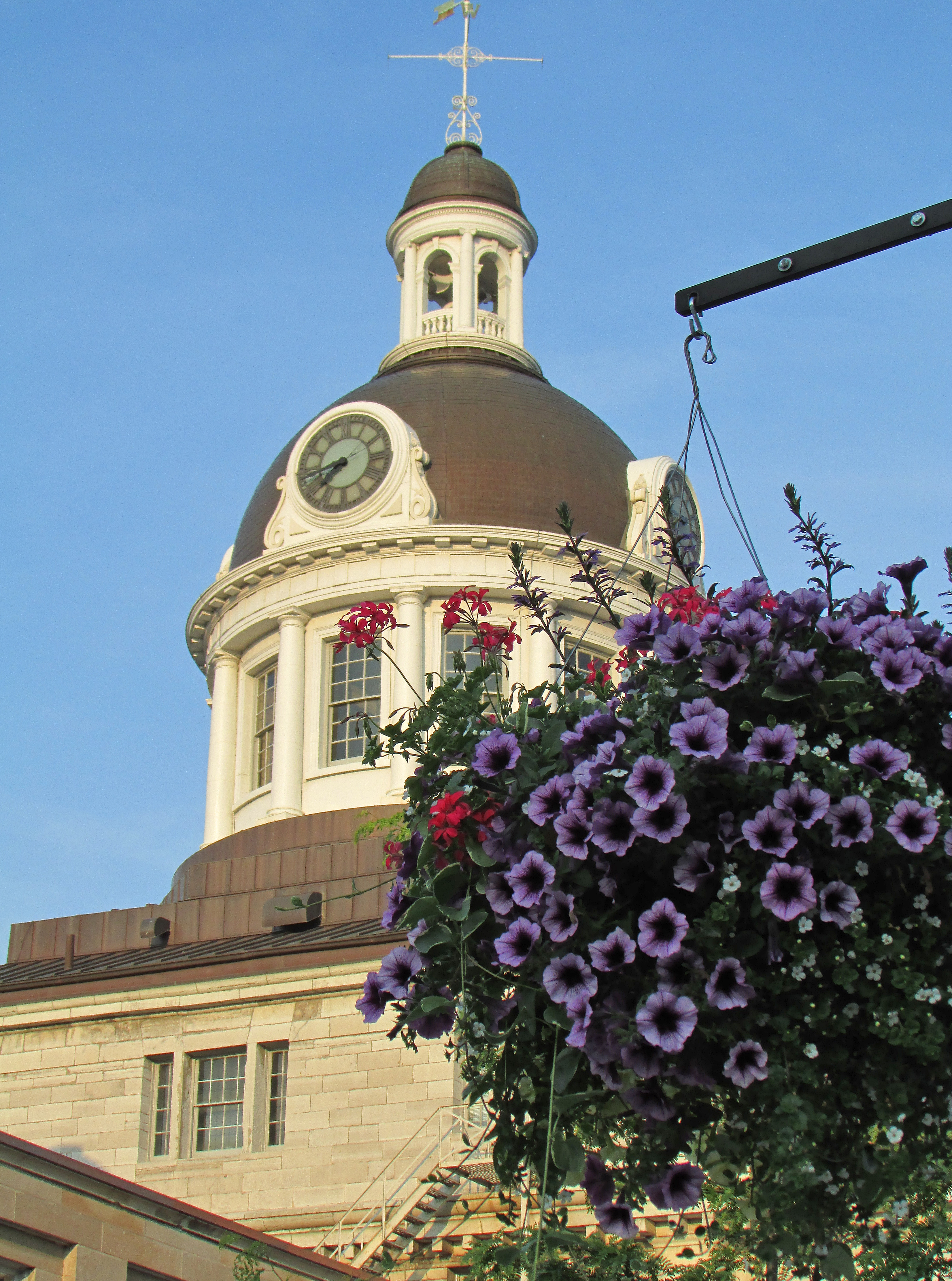
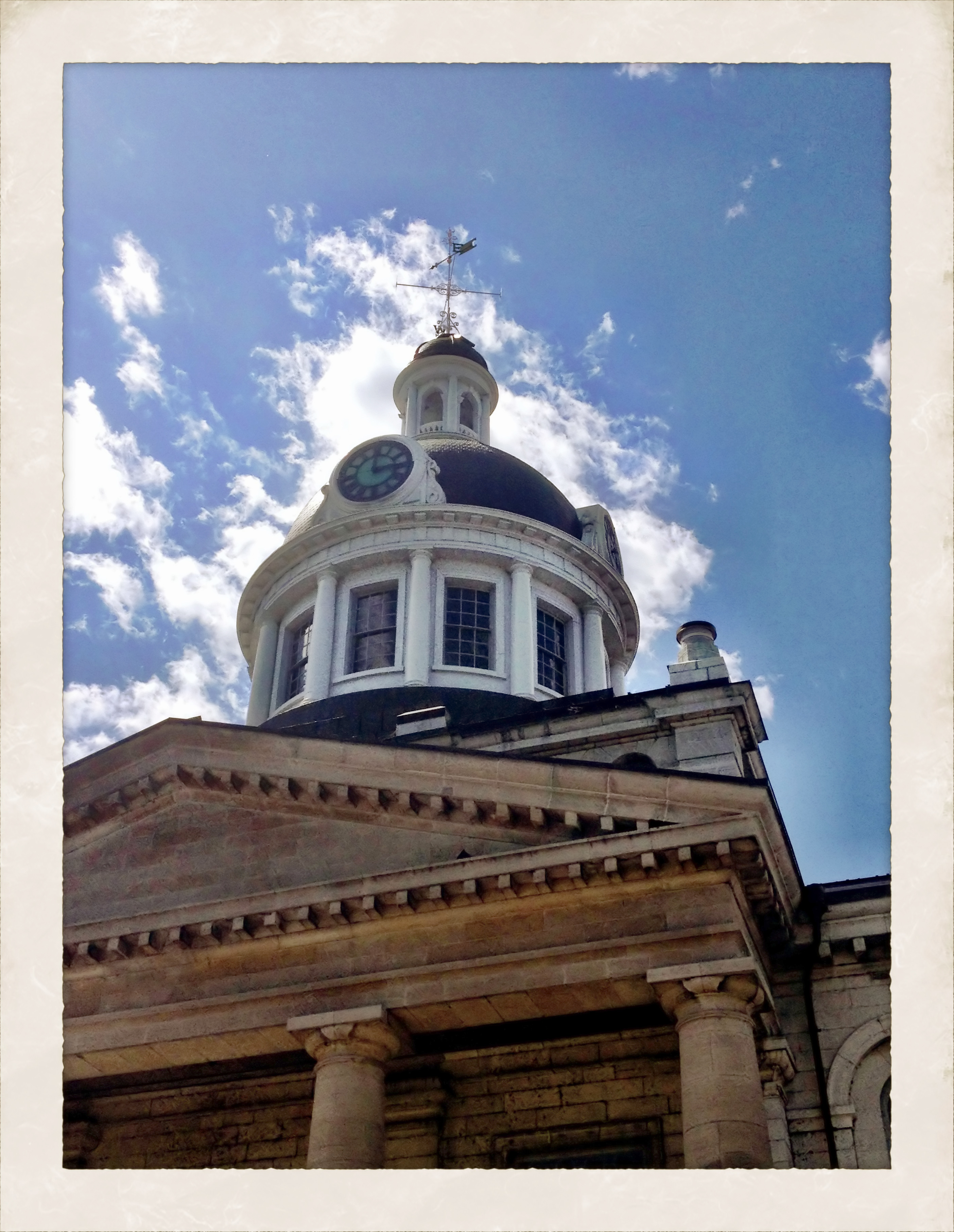
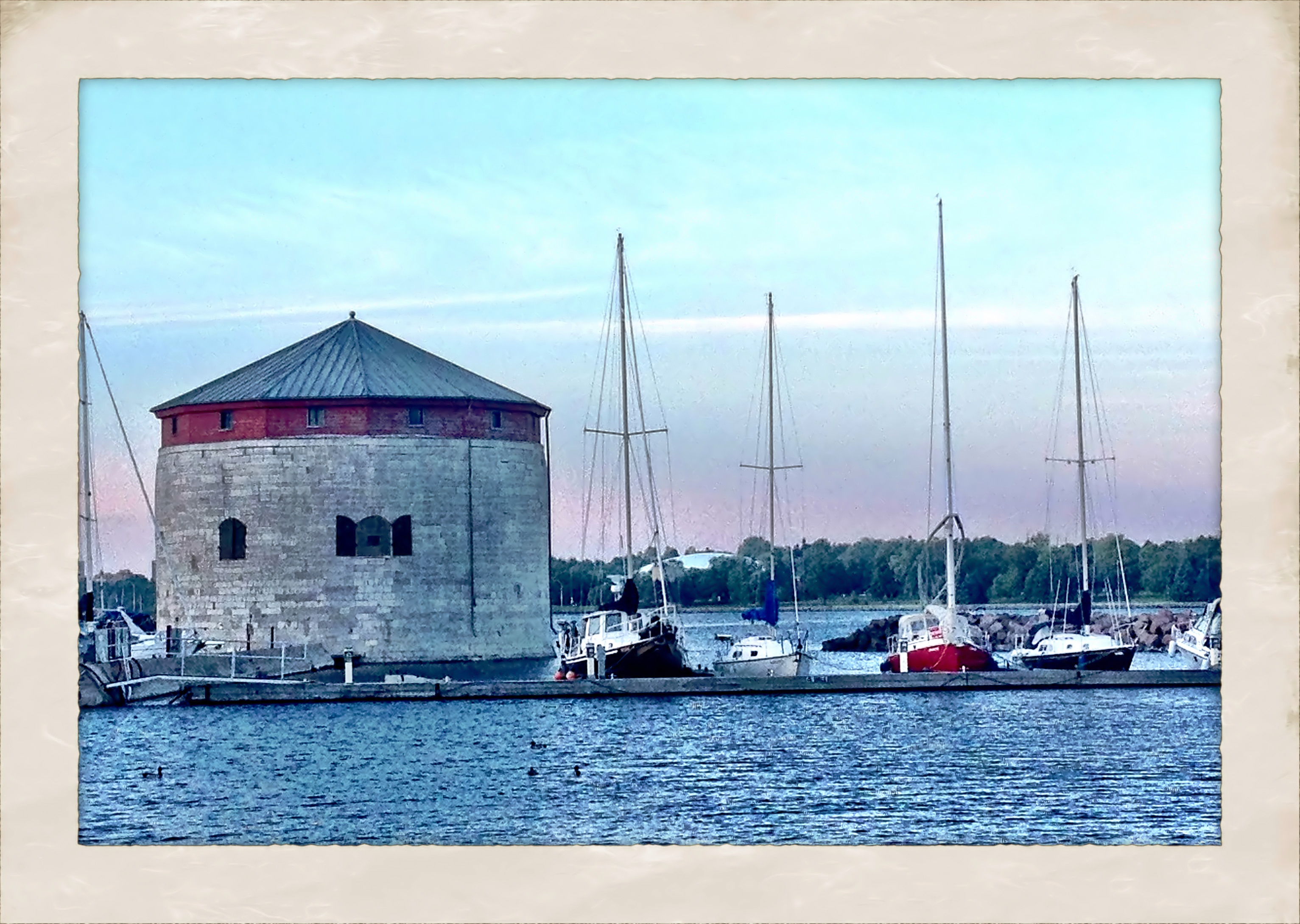
Kingston City Hall from the Confederation Basin
Behind City Hall. I grabbed a coffee from Starbucks and sat at this table for a while just soaking up Kingston.
This afternoon I rode the Red Rider from one end of Kingston (Lake Ontario Park) to the other (Fort Henry). Kingston today was just so vibrant. Stunning, bright blue sky and lake – both punctuated by patches of white – fluffy clouds in the sky and the odd whitecap blown up by the lake wind. Fresh breeze to make it comfortable. Peonies and strawberries on the market. Downtown and all the parks full of people outdoors enjoying the day.
My fantasy of passing a jocky cyclist in lycra pants sweating her way up Fort Henry hill came true. Trouble containing my grin as I pulled out to pass her on the hill.
Pulled out my phone along the way to take some photos that I will let speak for themselves.
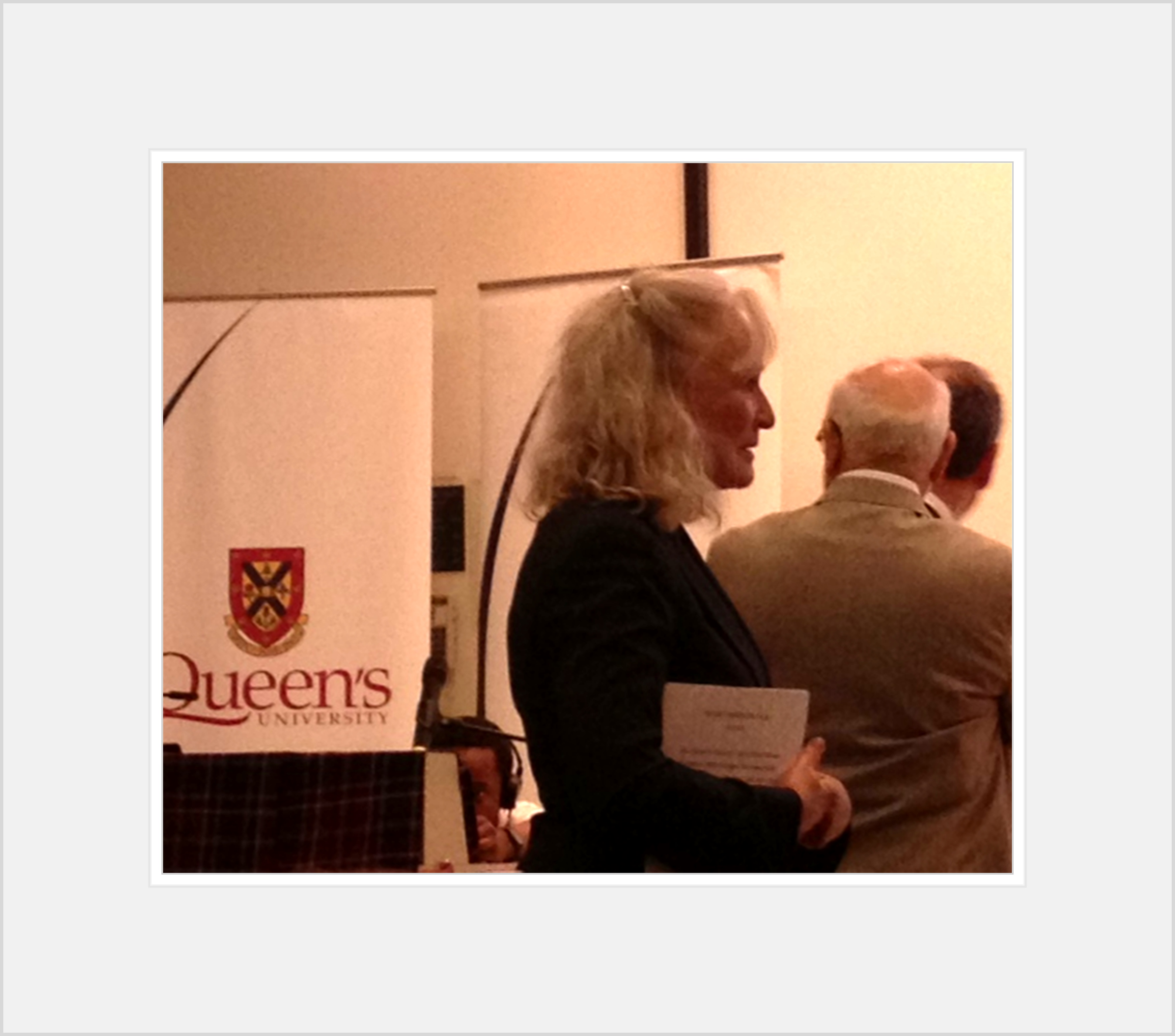
Today, actress and humanitarian, Glenn Close will receive an honorary Doctor of Laws degree from Queen’s University in Kingston, Canada. Yesterday afternoon I was lucky to be able to attend a lecture that she gave at the university which was based on the work that she has been doing with Bring Change 2 Mind– an organization she founded to help reduce stigma associated with mental health problems.
My first notice of Glenn Close was when she was in the movie The Big Chill – a film made in 1983 and also starring other favourites of mine, William Hurt and Kevin Kline. I saw the movie in the Dream Theatre in Monterey, California. The theatre was small and the seats were actually from cars – big and bulky. They gave you the feeling that you were at a drive-in – the perfect venue to see this movie. I have vivid memories of that evening etched indellibly somewhere in my brain. The Big Chill will remain a favourite movie of mine,more for the venue than the film and certainly for a very attractive Glenn Close.
But I digress.
Although she alluded to some of her movie and acting experiences in her talk, it was really about the work she has been doing to try to reduce stigma associated with mental illness. Some of her work is with a Queen’s professor, Dr Heather Stewart who holds the Bell Canada Mental Health and Anti-Stigma Research Chair at Queen’s.
The talk was very personal and often touching. Close has a sister who suffers from Bipolar Illness and a nephew who has Schizophrenia. For years, they went untreated. Everyone just thought they were “difficult” or acting out. Her sister had two suicide attempts as a teen. The family was fed up with their aberrant behaviour. In time, they realized the root of the problem was much deeper.
Close related the statistic that 2 of 3 people in North America with mental illness avoid getting treatment, often because of the stigma attached to their problem. She also said that one in four of us is touched by significant mental illness in their friends, family or themselves. None of us are immune, or so separated from people suffering from Depression, Schizophrenia, Bipolar Illness, PTSD or any other significant mental illness.
The gist of her talk – we have to accept mental illness like we do Diabetes or Cardiovascular Disease, not make it shameful or hidden and encourage access to appropriate care for people who suffer from it.
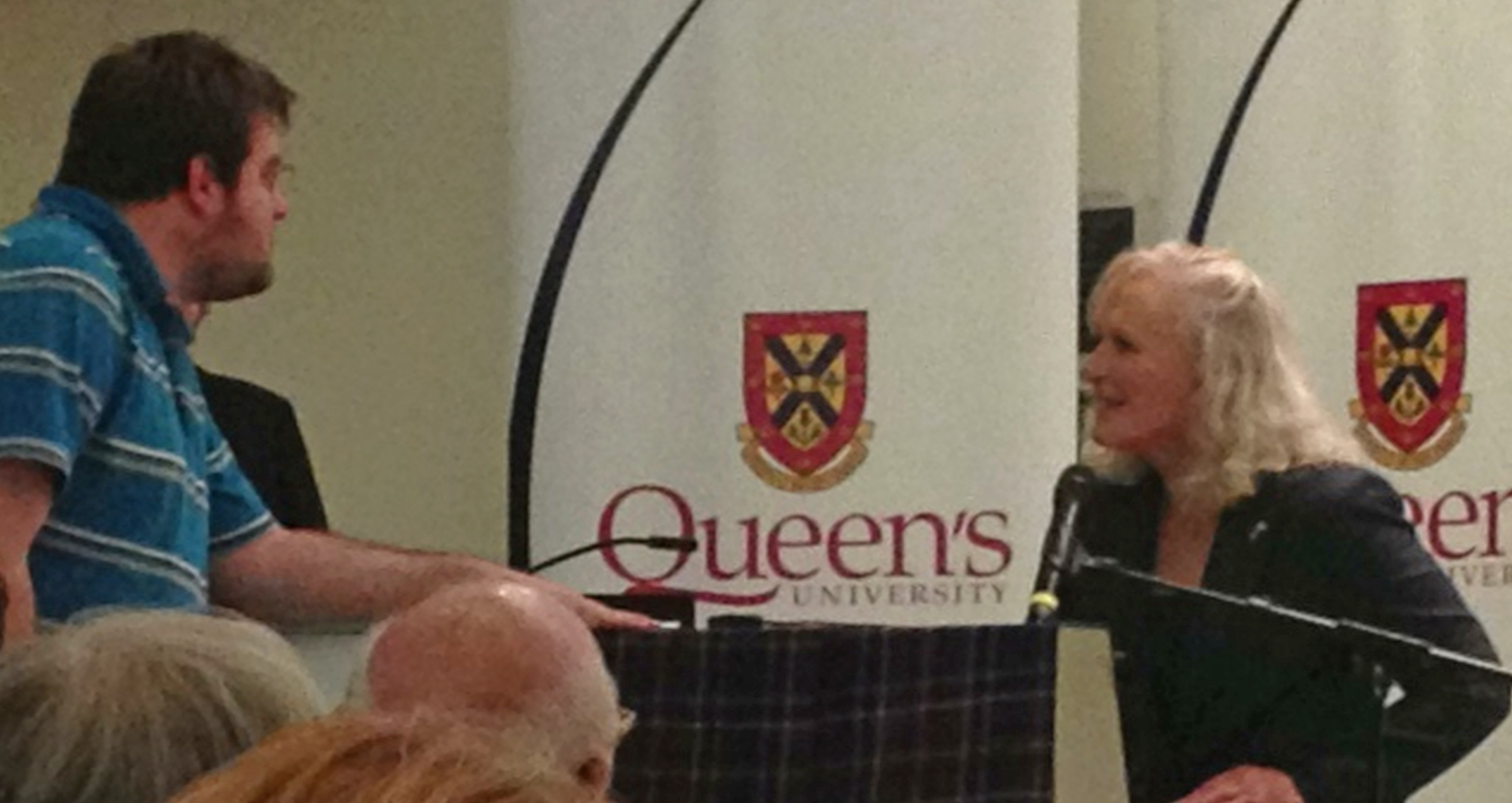
Glenn Close answers questions from an audience member with hearing impairment. He had to get close so they could converse and she engaged him one-on-one.
As a Health Care professional, I have to wonder if our system is actually up to this task. We often talk about “difficult” patients – people that the system has trouble dealing with because of their manipulative behaviour, poor compliance, anger issues or being demanding. I wonder how many of these “difficult” patients suffer from mental illness. How many of our patients who are non-compliant, aggressive and drug seeking actually have depressive illness or PTSD? How many of our patients with Eating Disorders have been victims of abuse in the past – sexual or emotional? If they or their problems seem “difficult” to us, how “difficult” must it be to be them?
And how are these patients often portrayed? Check out this short Public Service Announcement made by Glenn Close and her professional colleagues from the crew of the TV series “Damages”. ( Close revealed that the crew donated their time to make this short promo film after one of their own committed suicide… and none of them recognized his depression.)
Last month I was admiring the courage and openness of Angelina Jolie. This week it is Glenn Close. And it is not their celebrity that awes me, it is their determination to use that celebrity to bring notice and change to social issues that are often overlooked or hidden. They are putting their talents and good fortune to work to improve well-being. I am impressed with their integrity and openness and their determination to “do something” about important social issues.
Read more about the work Glenn Close is doing to reduce stigma in mental illness here:
Movie stars seem to loom “large” in our imagination. Glenn Close is actually surprisingly petite – probably not more than five feet four in height. I discovered that she shares her birthday with my brother (March 19) and my year (1947). As with Angelina Jolie, I am available for lunch any time.
I have acted in amateur theatre on and off for several years but this week was the first time that I totally missed my entrance cue. I will backtrack a bit so you know the story.
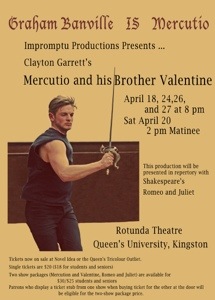
Impromptu productions, a Kingston-based theatre company has taken on the difficult task of presenting two plays in repertory, alternating performances one with the other. Shakespeare’s Romeo and Juliet is a tragic love story that most people know well. Kingston’s Clayton Garrett has written Mercutio and his Brother Valentine, involving characters mentioned in Shakespeare’s classic and presenting a surprising back-story to the interactions between Capulets and Montagues in “fair Verona”.
My part is Prince Escalus. He is uncle to Mercutio and Valentine and has raised them after their parents died. He hopes one of them will be groomed to take over as Prince of Verona to succeed him but there are snags.
In Romeo and Juliet, Escalus appears like bookends on the first half and at the end of the play. He has three entrances. In the first scene he comes in to yell at rowdy citizens to tell them to stop their bickering. Then he vanishes for about 90 minutes, only to appear again to exile Romeo for his part in killing Tybalt. At the end he shows up and says, basically “I told you something like this would happen”.
Of course, Escalus does make this all sound rather more complicated than it is. But that’s Shakespeare.
I decided that I would take my ipad to the theatre and while waiting for my three little entrances, would put together a video of photos that I had taken for both plays. I enjoy photography and also love to share the photos in different ways with friends.
So there I was in the hallway outside the dressing room trying to upload a video to YouTube when one of the stage managers hustled in and indicated that I was called to the stage. Usually we get five minutes warning to be in place. I assumed that I had time to pack up my iPad and get into position. I was wrong. It had been only when I failed to show up on the stage that they realized that I was not in place. My entrance was through a solid door at the back of the audience, the door hidden behind a black cloth. Unfortunately, in the dressing room which is in a totally different wing of the building, or even behind this solid door, it is impossible to tell what is happening on stage. I pulled the door open a crack to hear what was going on. Dead silence. What scene was this? Then someone pushed me from behind and whispered “Go Now”. The whole play had, at least momentarily ground to a halt. The next lines (and advancement of the plot) were mine. No wonder it was quiet on the stage. I regally appeared from behind the black cloth onto the stage to be greeted by one of my fellow actors who was looking at me with eyes that were like a deer in the headlights. Tybalt lay “dead” on the floor (likely wondering how he was going to get out of this one).
I am sure that there had been a very awkward silence and I owe poor Benvolio a beer. He would have wondered how on earth to get out of this situation if I never appeared. When something like this happens in front of an audience, seconds feel like hours.
I was able to jump right in and give my Blah Blah Blah, banish Romeo, tell them to drag the corpse away and confound the audience with the final line of the half – “Mercy but murders, pardoning those that kill.” Lights out. Applause. Intermission. An embarrassing story to tell. Live theatre.
Here is the video that I was uploading to YouTube while all this was happening. I hope it was worth it.
Mercutio and his Brother Valentine will continue next week at the Rotunda Theatre, Queen’s University, Kingston at 8 pm on April 24, 26 and 27. Romeo and Juliet will be at 8 pm on April 25 and 2 pm on April 27. I will try to make my entrances on time.
I am always happy to be part of a win-win situation. Last year I enjoyed one that was win-win-win. If I think about it I could add more win’s but you get the point, I am sure.
The St Gorety School is a secondary school in a small village called Mikei, Kenya. It is pretty rurual, about 20 km inland from Lake Victoria and in Nyanza Province, one of the least advantaged districts of Kenya.
Through CanAssist, and with my Canadian friends, Virginia and Suzanne I met Edward Kabaka a couple of years ago. Edward is a founder of a local support group called Rieko Kenya. Well, to make a rather long story shorter, Edward brought the needs of St Gorety School to our attention. Basically the school, serving secondary students from the surrounding region, was overcrowded and needed more classroom space.
So in 2012, CanAssist agreed to construct one classroom and complete another which had been partially built with Kenyan government funds which dried up before the roof could be put on the building.
Virginia and Suzanne, secondary school teachers themselves in Kingston, promoted this project to some of their students who responded with fundraising to help with this building.
At the same time, the Queen’s Health Outreach group, university students whose mandate is to promote Health education to students and youth in various parts of the developing world, were looking for a new district in Kenya to work. I have been an ad hoc mentor to this group for the past several years and it seemed natural to put them in touch with Edward and the St. Gorety School.
QHO students visited several schools and community groups in the Nyatike region in 2012.
Last year the QHO group spent several weeks in the Mikei/Nyatike community, living in a house overlooking the rolling Kenyan hills and interacting with schools and women’s groups in the region to educate and promote healthy living practices. Another group of six QHO students are excited to be returning to the community in May/June this year.
When I visited the St Gorety School and other groups in the region in February, they all lit up with smiles at the mention of the QHO students and were ecstatic to hear that there would be a group returning this year.
So where do all the “win’s” come in?
CanAssist has been delighted to be able to provide infrastructure support to the school (and three other community groups as well…more about those in later posts).
The QHO group has found a welcoming community where they are able to do their outreach work to promote education about health to young Africans.
The community which was actually quite neglected and off the beaten track for development has been excited to welcome visitors from Canada who are eager to help them improve their living circumstances. Kenyans love visitors.
Edward Kabaka has found support for his dream of improving well-being in the community.
Some of the students at KCVI and LCVI in Kingston have established pen-pal relationships with students in Kenya and have the satisfaction of having been able to help their peers in Africa.
And I sit back and smile. It’s all so good.
Treat yourself to the joyous music from the St. Gorety school choir in the Youtube video below.
My daughter recently pointed out to me that I was fortunate to be the recipient of most of the feedback from the communities in East Africa that we help through the CanAssist African Relief Trust. She’s right. How can I share that with other supporters of CanAssist?
I do consider myself lucky to have been able to visit the schools, clinics and communities that have been supported, in one way or another, by the CanAssist African Relief Trust…or rather by the donors who give to CanAssist to keep our activities afloat. One of the appeals to our donors is that we pay no Canadian salaries, travel at our own expense and therefore every donated dollar is spent by Africans in East Africa. The cost to us as volunteer travellers, however, is repaid ten times over in the wonderful experience of interacting with our friends in Africa.
Recently a group of Canadians who are supporters of CanAssist visited the B.L.K. Muwonge Secondary School in a remote, small Ugandan town called Kyabazaala. One of the students at the school sent back a letter of thanks to CanAssist supporters. I thought it only appropriate that I share this. I hope you find it as motivating as I do to keep doing what we are working toward to help communities in Kenya, Uganda and Tanzania with their infrastructure needs.
Students at the B.L.K. Muwonge Secondary School in Kyabazaala, Uganda write exams in a building that was constructed with funding from the CanAssist African Relief Trust.
A huge THANK YOU is in order for everyone who responded to the Canada Day Challenge I wrote about in this blog on July 1. Through your generous donations and a bonus from the Sasamat Foundation in British Columbia, CanAssist has secured the money to build the two needed classrooms at Hope School in Mbita Kenya. Everyone is delighted. I will be sure to provide updates as the school classrooms rise from the dust.
Kennedy Onyango is our contact and the founder of the Hope School. I first encountered him in July 2010. He exemplifies the typical story of relatively ordinary Africans (but motivated ones) who see a need in their community and they dedicate their personal resources and time to finding ways to improve the plight of the people who live around them.
In Kennedy’s case this was to help vulnerable young children in his region – kids who lived in poverty or were orphaned – get a start at being educated. He founded a “school” which is divided into two locations. One is in two crammed classrooms behind a bank in the town of Mbita and another on a larger property in the hills beyond the town. There are 160 kids who come to these makeshift classrooms.
In addition to giving them education, the school also provides a mid-day meal for the children. Sometimes this is the only food that they get for the day.
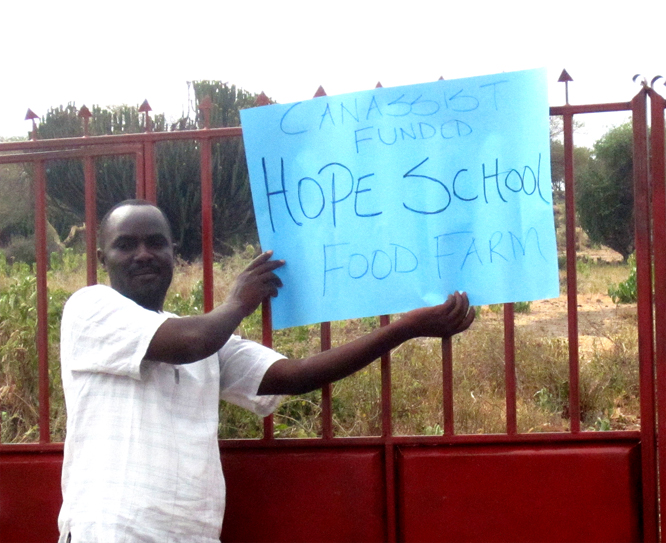
Kennedy Onango holds up a sign that marks the beginning of the CanAssist Oasis of Hope Garden for the Hope School at Mbita Kenya
Kennedy first asked CanAssist to help develop a small farm where they could raise vegetables and fruits to supplement the otherwise bland gruel diet provided to the kids. In early 2012, CanAssist gave the money to start this up and very soon Kennedy had created what he calls the “Oasis of Hope” on the rurual school property.
In mid July, I got this report from Kennedy. It surpassed my expectations for success in the early months of developing this garden. Kennedy writes:
This month in CanAssist funded ‘Oasis of Hope Garden’, we take a deeper look at this farm, which is celebrating its first harvest. In a single 3 month production cycle, 480 kilograms of sourghum, 120 kgs of beans have been harvested so far from a 2 acre ploughed open farm. The same 3-month production cycle is also projected to yield a 120 kilogram of maize (corn). This has clearly reinforced our earlier thought of making the garden both food granary and source of funds to support key school operations. It’s true, a good income can be realized from the selling of sourghum.
Why is this important? 140+ children at Hope School have never had an opportunity to drink nutritious porridge from the initially barren school farm yard. Rural peasant families of Mbita don’t have the money to take a chance on unproven technologies. Demonstration farms like the CanAssist funded ‘Oasis of Hope Garden’ give families a firsthand look at the income increases they can achieve with an investment in appropriate technologies for improved on-farm yields
You can see how CanAssist’s approach of working with poor, marginalized rural communities of East Africa transforms lives on our first ever bumper harvest in this school farm.
We remain appreciative for CanAssist supporters and with special thanks to Sasamat Foundation for having donated funds towards classrooms construction at Hope School, besides nutritious meals, the children will now get conducive learning environment!”
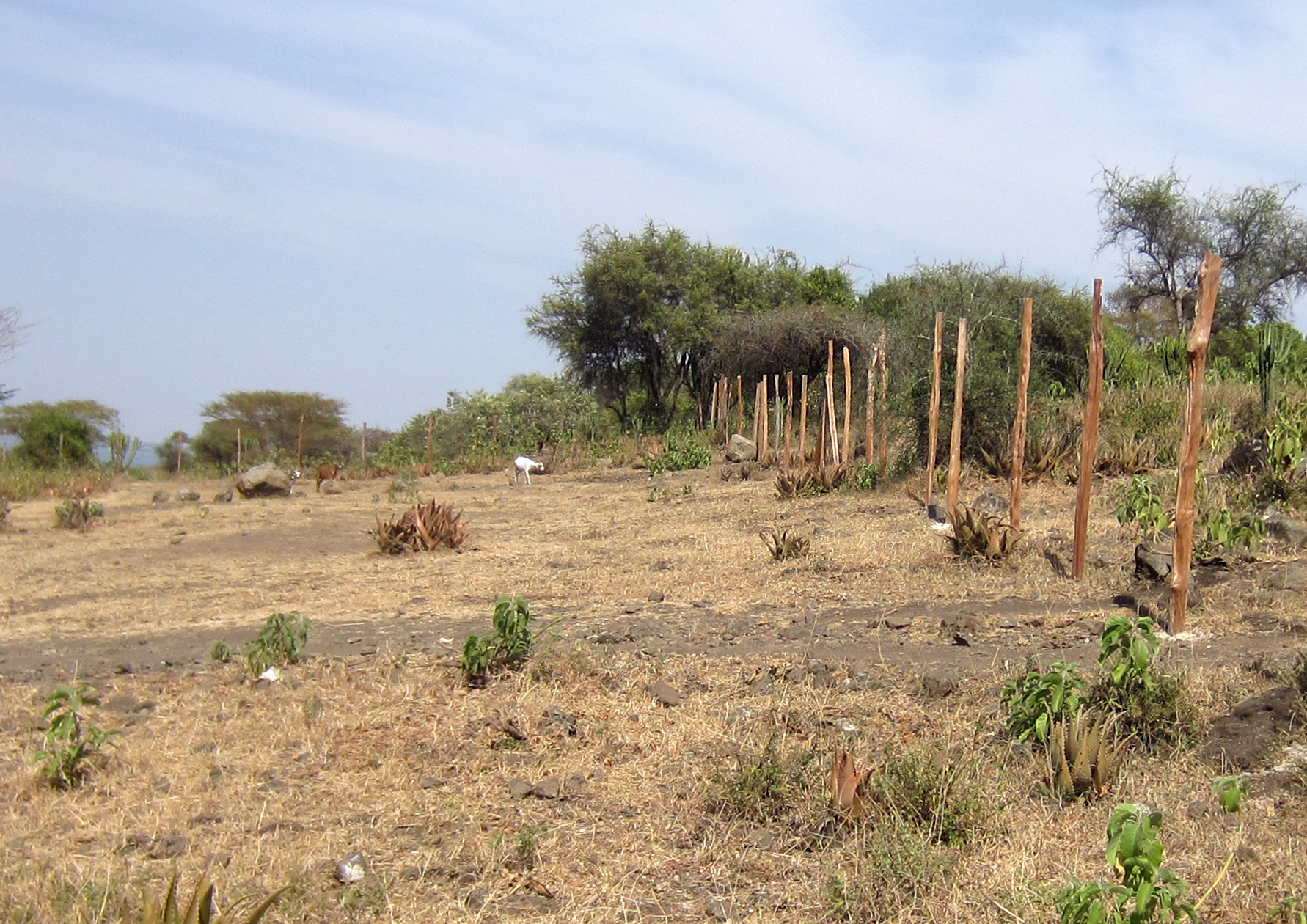
The first step in creating a garden was to fence the property to keep protect the garden from wandering neighbourhood goats. This dry corner is the same place where the banner picture of maize plants was taken three months later.
I hope that this enthusiastic endorsement of the work that we are doing through CanAssist makes our donors smile with satisfaction. With the support of Canadian donors, Kennedy and others in his community have been able to take a barren piece of land and turn it into a veritable Oasis of Hope for the children at Hope School and those who live around it. We are making a difference to individuals and communities in East Africa. Asante sana for your help in achieving this.

 Photos from Kingston Whig Standard, CKWS TV and YouTube.

















 johnageddes